
competition

Content tagged with "competition"

Related Topics
Displaying 51 - 60 of 709

Massachusetts’ Gap Networks Program Awards Verizon $37 million; One Muni Network Gets $750K

State broadband officials in Massachusetts have announced over $45 million in grant awards from the state’s Broadband Infrastructure Gap Networks Program with the lion’s share going to Verizon to “expand high-speed broadband [I]nternet infrastructure to underserved homes, business, and community anchor institutions across the state.”

State broadband officials say the $45.4 million in grant awards will be coupled with $40 million in matching funds from the awardees to expand broadband access to approximately 2,000 locations in 41 Massachusetts communities.

In 2022, as we previously reported here, Massachusetts was allocated a total of $145 million in federal Rescue Plan dollars to fund the Bay State program. With the state’s first round of funding from the Gap Networks Program awarding $45 million to four applicants, about $100 million is left in the pot for future funding rounds. Massachusetts has yet to receive its $147 million share of federal BEAD funds from the bipartisan infrastructure law, the spending rules for which are much more stringent than the more flexible CPF funding rules.

CBRS Spectrum: A Potential Boon To Community Broadband

Recent federal government efforts to expand use of public Citizens Broadband Radio Service (CBRS) spectrum could be of significant help to municipalities and local communities looking to bridge the digital divide with the increasingly popular wireless technology.

CBRS spectrum refers to 150 MHz of spectrum in the 3.5 GHz band. In 2015, the FCC adopted rules for shared commercial use of the band, creating a three-tiered structure to avoid interference with military radar during collaborative use of the spectrum.

For municipalities, the spectrum has already proven to be a valuable way to deploy wireless access to the public. In Syracuse, New York, the city last fall launched a new public wireless network on the back of CRBS. In Longmont, Colorado, the St. Vrain Valley School District used CBRS to build a private LTE network connecting 4,000 students in partnership with NextLight, which operates Longmont's city-owned municipal fiber network.

Not all community deployments of CRBS have delivered satisfactory results for municipalities, however. The STEM Alliance in Westchester County, New York retired their efforts to deploy a CBRS network in Yonkers after they struggled with urban capacity constraints and low usage.

Surf Internet Expands Fiber In Partnership With Newton County, Indiana

Surf Internet and Newton County, Indiana say they’re expanding a public private partnership (PPP) that will extend gigabit fiber access to 97 percent of the county – or roughly 3,839 Newton County households by the end of this year.

According to a joint announcement, Surf will contribute $6.6 million to the new endeavor, with the Newton County Economic Development Commission (EDC) contributing $4 million. The expansion should extend the gigabit network to Lake Township, Lake Village, Roselawn, Thayer and several additional rural areas.

Image
Newton County Indiana map

Surf Internet also provides access in Michigan and Illinois. The ISP’s service speeds and pricing can vary greatly by market, but range from symmetrical 50 Mbps (megabit per second) service for $35 a month, to symmetrical 1 Gbps (gigabit per second) service for anywhere from $70 to $80 per month, with no caps, hidden fees, or long-term contracts.

Surf Internet first came to Newton County in 2020, when it launched a $1.7 million project– funded by the FCC E-Rate program – that brought fiber connections to the North Newton School District. In 2023, Surf Internet expanded that fiber network to 382 Newton County homes as part of Indiana’s $81 million Next Level Connections (NLC) Broadband Grant Program.

Colorado Passes New Broadband Laws, Takes Aim At Landlord Monopolies

The Colorado legislature has passed several new broadband bills that should aid affordable broadband deployment in the state. According to a state announcement, the new bills do everything from expanding the leeway the state has in spending broadband funding, to providing some tax breaks to providers heavily invested in rural deployment.

Colorado has been a key player in the municipal broadband space, and is home to several major municipal broadband deployments (from Longmont’s Nextlight to Fort Collins’ Connexion) that have been proven inspirational to municipalities across the country.

Several of the new laws should prove helpful to municipal broadband operations and private sector ISPs alike.

Image
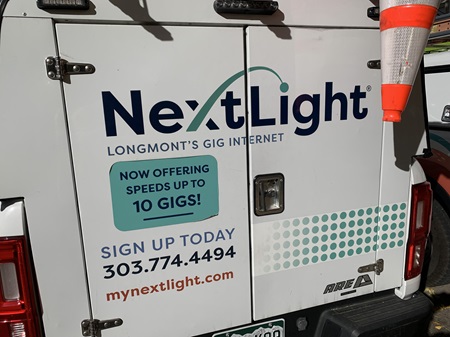
Longmont Nextlight Truck

HB 24-1334, for example, dictates that a multi-dwelling unit (MDU) building owner can’t deny a broadband provider access to the property to install broadband infrastructure. Muni operations in places like Dryden, New York have told ILSR repeatedly that they often face difficulty accessing MDU properties.

New York State Is Trying To Make It Easier For Municipal Broadband To Succeed

In March, Charter Communications tried (and failed) to include a poison bill in New York State’s budget bill that would have hamstrung community broadband. In stark contrast, a New York legislator this month introduced new legislation he says would make it easier than ever for New York state municipal broadband projects to thrive.

State Senator Jeremy Cooney of Rochester has introduced the Broadband Deployment Assistance Act of 2024 (S9134), which would streamline the permitting process for municipal broadband projects by "amending the general municipal law, in relation to requiring substantially similar permits for broadband deployment to be processed together at the same time and on an expedited basis."

“With a quicker timeline and more efficient process for local governments, we can create affordable options for New Yorkers that empower them to take control of their digital destiny,” Cooney wrote in an editorial published at Syracuse.com.

Image
New York State Seal

Cooney says he was motivated by a lack of broadband competition in New York State. New York is dominated by Charter Communications, which was almost kicked out of the state in 2019 for poor service and  misleading regulators about broadband deployment conditions affixed to its 2016 purchase of Time Warner Cable.

Vermont CUD Maple Broadband Moving Quickly To Expand Access

Vermont’s Communications Union Districts (CUDs), which were the subject of a recently released ILSR report, continue to make steady inroads in delivering high-quality broadband access to long-neglected rural Vermont residents.

That includes locally owned not-for-profit municipal operation Maple Broadband, which has completed the first phase of its broadband network and is busy on an expansion.

Maple Broadband is technically an extension of the Addison County Communications Union District (ACCUD), a coalition of 20 different member towns working collaboratively to bring gigabit-capable fiber to residents long left unserved or underserved by regional telecom giants.

In September of 2021 Maple Broadband announced a public private partnership with Vermont-based Waitsfield and Champlain Valley Telecom (WCVT), to build and operate a district-wide fiber network. The $30 million network is, in part, propped up by ARPA funds and a $9.1 million grant from the Vermont Community Broadband Board (VCBB).

Image
Maple Broadband logo

Three years later and the CUD says it has completed the first phase of its network; laying 143.5 miles of fiber and passing 1,647 homes and businesses in portions of the Vermont towns of Cornwall, Orwell, Shoreham, Whiting, Salisbury, and Middlebury.

Houston, Missouri’s Municipal Fiber Network Revs Up City’s Economic Development Engine With Big City Connectivity

In the Show Me State – cradled in the center of the Ozarks – Houston, Missouri is the biggest small city in Texas County.

And what local officials have shown its 2,100 or so residents over the last four years is that it can build its own modern telecommunication infrastructure to help spark economic development and offer big city Internet connectivity at affordable rates.

It began with a citizen survey in 2019, asking residents if they would be interested in a municipal broadband service, given the inadequate offerings of the big incumbent providers. Since then – not only has the city built an 18-mile fiber ring for an institutional network (I-net) to connect the city’s facilities – it has built a fiber-to-the-home (FTTH) network that now covers 95 percent of the 3.6 square-mile county seat.

Image
Houston MO fiber cabinet

“The project started in 2020 and we went live in the spring of 2021,” Randon Brown, Technology Director for the City of Houston Fiber Department, tells ILSR. “Construction of the project has taken approximately four years. (Today) 95 percent of the town (network) is operational and can be serviced.”

The city has spent $3 million of its own money to fund construction of the aerial fiber network, Brown said.

The network passes 1,200 premises with 272 subscribers now getting service from Houston Fiber, “which encompasses a mixture of residential and business customers” – though that number will soon rise to 364 (30 percent take rate) in the near future as more residents and businesses are in the pipeline waiting to be connected, he added.

Destination Crenshaw Breathes Life Into 'Open Air Museum' and Emerging ‘Digital Equity Zone’

On a map, the Crenshaw District is a 2.9 square-mile neighborhood in South Central Los Angeles, home to nearly 30,000 mostly black residents.

In the popular imagination, Crenshaw is the backdrop for the Oscar-nominated movie "Boyz In the Hood" – the real life neighborhood that cultivated the likes of former Los Angeles Mayor Thomas Bradley; rappers-turned-actors Ice Cube and Ice T; and the late rapper/entrepreneur Nipsey Hussle.

But on the streets of Crenshaw, a transformative vision is unfolding – an initiative local leaders describe as “a reparative development project.”

The idea is to inspire and empower neighborhood residents with strategic investments rather than displace them through gentrification. The effort is being led by Destination Crenshaw, a nonprofit community organization established in 2017 to celebrate the history and culture of Black Los Angeles.

The most visible part of the vision is to create the largest Black public art project in the nation along Crenshaw Boulevard, the 1.3 mile spine of the neighborhood – or what Destination Crenshaw describes as an “open air museum” centered around “pocket parks” and a “comprehensive streetscape design” that will feature commissioned murals and sculptures from local Black artists.

Yellow Springs, Ohio Eyes Next Steps After Successful Fiber Trial

Yellow Springs, Ohio has been thinking about a city-owned fiber network since 2016, when the municipality issued its first white paper discussing its potential benefits.

Since then, the city has made steady inroads on making those plans a reality, recently culminating in a fiber pilot project currently being used by 100 local homes and businesses.

Launched in 2022, the pilot project currently offers locals two tiers of fiber access: A “standard tier” at a symmetrical 300 megabits per second (Mbps) for $45 a month, and a “premium” tier offering symmetrical gig speed service for $65 a month. There currently are no usage caps, long-term contracts, or installation fees.

Image
Downtown Yellow Springs

“Final pricing will be determined after the pilot project, and could be higher or lower depending on the ‘take rate,’ customer service offerings, and other knowledge gained from the pilot,” the project FAQ states.

Currently the fiber network covers roughly 600 potential homes around Yellow Springs, and was funded entirely via a $300,000 grant from Broadband Ohio. The city also provides free Wi-Fi via 12 Wi-Fi access points spread throughout the city’s downtown business district.

Like so many U.S. communities, Yellow Springs sees a dearth of meaningful broadband competition, resulting in spotty access, high prices, and substandard service.

Charter Communications (Spectrum) enjoys a monopoly over next-gen broadband access across the majority of the city. Some areas are peppered with sluggish and expensive AT&T DSL.

Minnesota Strikes Down Preemption Laws Blocking Municipal Broadband

Community broadband advocates have scored a major victory in Minnesota as state lawmakers there have repealed the state’s preemption laws that prevented cities and towns in the Land of 10,000 Lakes from providing municipal broadband services.

The new legislation, signed into law yesterday by Gov. Tim Walz, took aim at two statutes that sought to protect large monopoly telecommunications providers from competition.

New Law Unwinds Antiquated Statutes

One antiquated law that had been on the books for over a century (Minn. Stat. Ann. § 237.19) allowed municipalities in Minnesota to buy or construct “telephone exchanges” only if they secured a supermajority vote in a local referendum election. Though intended to regulate telephone service, the way the law had been interpreted after the invention of the Internet was to lump broadband in with telephone service thereby imposing that super-majority threshold to the building of broadband networks.

Image
Minnesota state seal

Another law (Minn. Stat. Ann. § 429.021(19)) gave municipalities the express authority to “improve, construct, extend, and maintain facilities for Internet access” but only if a private provider was not offering service in that municipality.

But this week, with a single omnibus bill (SF 4097), those old preemption laws were repealed by state legislators and signed into law by the Gov. Walz yesterday, officially paving the way for any municipality in the state to have the option of building networks to offer municipal broadband service or partner for the same.