
BEAD

Content tagged with "BEAD"

Displaying 1 - 10 of 268

Decatur County Electric Cooperative Leads Charge as Indiana's BEAD Rollout Begins

Indiana Cooperatives are once again at the front of the pack as the state prepares to dramatically expand affordable fiber access on the back of $483 million in Broadband, Equity, Access, and Deployment (BEAD) broadband grants.

The first round of bead funding is expected to connect an estimated 123,000 Indiana households and businesses that currently have either substandard Internet access, or no access at all. All told, the state’s BEAD deployment plan is slated to expand affordable fiber access to 91 of Indiana's 92 counties.

Last June, the Decatur County Rural Electric Membership Corporation (DCREMC) was the first of the state’s 24 BEAD grant awardees to sign a contract with the Indiana Broadband Office.

The cooperative’s $7.1 million BEAD award will help extend fiber service to roughly 2,800 additional homes and businesses across the rural and sparsely populated communities across Decatur County, including Greensburg, Napoleon, Millhousen, and St. Paul. Most of the construction is expected to be finished before year’s end.

Image
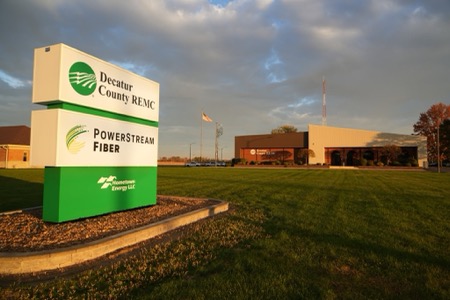
Decatur County Elec Coop building and sign

Decatur County REMC expanded into fiber Internet access in January of 2025 under the Power Stream Fiber brand. Power Stream Fiber currently offers three tiers of service: a symmetrical 500 megabit per second (Mbps) offering for $65 a month; a symmetrical 1 gigabit per second (Gbps) tier for $80 a month; and a symmetrical 2 Gbps service option for $110 a month.

Oregon Picks New BEAD Winners After Four Bidders Retreat

The Oregon Broadband Office (OBO) has announced the preliminary awardees selected to assume Broadband Equity, Access and Deployment (BEAD) projects that were voluntarily declined by their original awardees.  

As ILSR has explored, the unpopular changes and massive delays introduced by the Trump administration to the BEAD program have resulted in not only a large number of states having to retool their plans, but many original project bidders retreating from their original proposals.

In some cases, soaring U.S. costs have resulted in ISPs reconsidering their commitment to original broadband expansion plans. 

In other instances, providers have grown frustrated with additional bureaucratic hurdles affixed to BEAD deployments by the NTIA.

Image
Oregon Broadband Office strategic plan cover sheet

According to an OBO announcement, four of the state’s original BEAD awardees declined a total of 15 projects prior to the state’s June 10 Notice of Intent to Award acceptance deadline. The projects represented 13,381 broadband serviceable locations (BSLs), approximately $122.9 million in requested grant funding, and more than $39.1 million in matching contributions.

Oregon is slated to receive $689 million in total BEAD funding to shore up Internet access to communities trapped on the wrong side of the digital divide.

Too Easy to Reach Orbit? - Episode 16 of Unbuffered

Unbuffered Logo - Two text bubbles

In this episode of Unbuffered, Chris is joined again by Douglas Dawson for a conversation about the challenges and opportunities shaping the future of broadband.

Chris and Doug begin by discussing the latest developments in the National Digital Inclusion Alliance's lawsuit against the Trump administration over the Digital Equity Act, examining what the case could mean for digital equity efforts and the communities working to expand access, affordability, and digital skills.

From there, they turn to the results of a recent survey examining how rural Americans use the Internet, exploring what it reveals about changing consumer habits, growing bandwidth demands, and the ways AI and other emerging technologies are reshaping how people connect online.

The conversation then shifts to the practical realities of building broadband networks, including the rising cost of Fiber construction, permitting delays, make-ready work, and why better pole inventories could significantly reduce deployment costs and speed up network expansion.

Chris and Doug also take a closer look at the Federal Communications Commission's evolving approach to satellite broadband, discussing recent regulatory changes, what they could mean for the industry, and whether the agency's approach strikes the right balance as more companies look to launch satellite broadband services. They also explore how satellite fits alongside Fiber and other technologies as communities work to expand reliable Internet access.

Throughout the episode, Chris and Doug connect today's policy debates with broader questions about technology, infrastructure, and what it will take to ensure communities have reliable, affordable Internet in the years ahead.

This show is 48 minutes long and can be played on this page or via Apple Podcasts or the tool of your choice using this feed

You can also check out the video version via YouTube.

Transcript below.

We want your feedback and suggestions for the show-please e-mail us or leave a comment below.

Listen to other episodes (formerly Community Broadband Bits) or view all episodes in our index. See other podcasts from the Institute for Local Self-Reliance.

Thanks to Whitedrift for the song Operator, licensed Creative Commons Attribution (3.0).
Rural Cooperatives Frustrated With NTIA BEAD Changes

Rural cooperatives have been the backbone of modern efforts to bring affordable next-generation fiber to long-neglected rural U.S. communities. 

So it’s important to listen to them when they warn that Trump administration NTIA changes to U.S. telecom subsidy programs are going to have a profoundly-negative impact on efforts to expand fast, affordable Internet access.

Earlier this month rural electric and broadband cooperatives gathered in Washington, DC, for the 5th annual Broadband Leadership Summit

The topic du jour was broadly unpopular changes made by the NTIA to the Broadband, Equity, Deployment, and Access program (BEAD) created by the 2021 infrastructure bill.

As ILSR has repeatedly explored, NTIA BEAD changes reduced oversight of deployment, lowered quality standards, stripped away requirements that the resulting taxpayer Internet access be affordable and equitably deployed, and redirected billions of dollars away from affordable fiber to the low-Earth orbit space ambitions of billionaires Jeff Bezos and Elon Musk.

That’s not sitting well with the cooperatives doing the heavy and costly lifting to bring affordable access into long-neglected rural communities.

The Plot to Hijack America’s Broadband - Episode 15 of Unbuffered

Unbuffered Logo - Two text bubbles

In this episode of Unbuffered, Chris is joined by Sean Gonsalves and Karl Bode for a wide-ranging conversation about the latest stories shaping the telecommunications landscape.

The group begins by discussing the upcoming 250th anniversary of the United States, prompting a broader discussion about the country's history, civic identity, and how Americans can use the milestone as an opportunity to reflect on the nation's past while looking toward its future.

From there, they dive into Sean and Karl's recent article for The Verge: Elon Musk and the Plot to Hijack America’s Broadband, reflecting on the state of broadband policy, the challenges facing community broadband, and how the national conversation around Internet infrastructure continues to evolve.

Finally, Chris, Sean, and Karl unpacked the recent House Committee on Energy & Commerce Hearings regarding Arielle Roth and the National Telecommunications and Information Administration's revised BEAD guidance, discussing changes to technology neutrality, the growing role of low-Earth orbit satellite providers, and what the new rules could mean for states, communities, and long-term broadband investment. 

Along the way, they debate the tradeoffs between Fiber, fixed wireless, and satellite service, and whether the updated approach will deliver the infrastructure communities need.

Throughout the episode, Chris, Sean, and Karl connect today's policy debates with broader questions about investment, local leadership, and what it will take to ensure communities have access to reliable, affordable Internet for decades to come.

This show is 53 minutes long and can be played on this page or via Apple Podcasts or the tool of your choice using this feed

You can also check out the video version via YouTube.

Transcript below.

We want your feedback and suggestions for the show-please e-mail us or leave a comment below.

Listen to other episodes (formerly Community Broadband Bits) or view all episodes in our index. See other podcasts from the Institute for Local Self-Reliance.

Thanks to Whitedrift for the song Operator, licensed Creative Commons Attribution (3.0).

Lawmakers Press Trump Admin To Stop Waffling On BEAD ‘Non Deployment Funds’

Lawmakers are pushing the Trump administration to stop being murky on whether states will be able to access tens of billions in “non-deployment funds” mandated by Congress that have been temporarily hijacked by the administration’s unpopular changes to a once-in-a-lifetime federal grant program to expand high-speed Internet access.

Representative April McClain Delaney (D-MD) is the latest politician to send a letter to the Trump NTIA asking for competent guidance on what will happen to the estimated $21 billion in “non deployment funds” suddenly stuck in limbo.

“States cannot build a workforce without workforce development funding; they cannot ensure safe adoption without digital safety education; they cannot support vulnerable populations without telehealth and remote-learning infrastructure; and they cannot protect critical networks without robust cybersecurity capacity,” Delaney and three other lawmakers wrote.

Image
Congress woman April Delaney

A year ago the Trump administration made numerous controversial changes to the $42.5 billion Broadband, Equity, Access, and Deployment (BEAD) program included in the 2021 infrastructure bill. That included removing rules ensuring that the resulting taxpayer-funded Internet access would be equitably deployed and affordable.

In The Verge: Elon Musk and the plot to hijack America’s broadband

Today, The Verge published an in-depth piece – “Elon Musk and the plot to hijack America’s broadband” – authored by our own Sean Gonsalves and ILSR contributor Karl Bode that examines the BEAD program from its inception to where it is now.

The piece details how the once-in-a-generation federal initiative to solve America’s digital divide has devolved into “a flaming mess.”

Here's a few excerpts:

"At 9PM ET on the night of May 28th, a Blue Origin New Glenn rocket sat on the launchpad at the Cape Canaveral Space Force Station. The craft was in the middle of a hot-fire test awaiting the arrival of Amazon Leo satellites, the first of 24 batches to be shuttled into low Earth orbit for an ambitious satellite internet venture. The effort was backed by hundreds of millions of taxpayer dollars, leveraging a Biden-era law meant to address America’s digital divide."

"But before the satellites even reached the launch site, Jeff Bezos’ rocket exploded into a massive fireball, its wreckage left smoldering on the ground. It was an unintentionally perfect metaphor for a once-in-a-generation attempt to fix the creaky US broadband system, now a flaming mess melting into a slush fund for billionaires."

"Bezos — along with newly minted trillionaire Elon Musk — has become one of the biggest beneficiaries of Broadband Equity, Access, and Deployment (BEAD), a $42.45 billion broadband expansion program passed as part of President Joe Biden’s 2021 “Build Back Better” initiative. BEAD was intended to give long-underserved communities billions of dollars for high-quality, future-proof fiber networks."

"But under President Donald Trump and a coalition of MAGA-allied tech moguls, Build Back Better has been transformed into 'tear down quickly,' leaving states mired in bureaucracy and delays. Five years later, only a handful of the millions of Americans slated for an internet access upgrade actually got one, and there’s little accountability in sight..."

FCC’s Carr Eyes Dubious ‘Reforms’ To E-Rate, Broadband Mapping

Trump Federal Communication Commission Chairman Brendan Carr has announced vague potential changes to the FCC’s E-Rate program that could harm program funding, effectiveness, and the overarching goal of bringing affordable Internet access to long-neglected schools and rural communities trapped on the wrong side of the digital divide.

The reforms come as Carr also looks to make changes to the FCC’s broadband mapping efforts, something consumer groups say could harm the government’s ability to measure which communities need improved, affordable access, or suffer from a pronounced lack of broadband competition.

In an announcement to the FCC website, Carr stated the 30-year-old bipartisan E-Rate program, which costs $3 billion annually, was in dire need of reforms. The program is primarily funded by a small surcharge affixed to phone lines. With the steady erosion of copper-based phone lines, debates have arisen about how to best sustain the program.

But instead of focusing on issues like subsidy fraud by large telecoms, Carr’s announcement oddly focuses heavily on concerns about student “screen time” and what content students are allowed to view. It’s a problematic foray for an FCC boss recently under fire for unconstitutional censorship efforts targeting comedians and journalists.

Vermont’s Community Broadband Model, Starlink, and the Future of Search - Episode 10 of Unbuffered

Unbuffered Logo - Two text bubbles

In this episode of Unbuffered, Chris and Sean Gonsalves talk about Vermont’s push for universal connectivity, the future of Starlink and SpaceX, and major changes coming to Google Search.

They begin with Vermont and the state’s unique approach to broadband expansion through Communication Union Districts. Sean shares reporting on how Vermont is using local leadership, apprenticeship programs, community networks, and federal funding to bring fiber connectivity to the most rural state in the nation. You can find Sean's story about Vermont Closing In on Universal Broadband Access here.

Chris reflects on the long history behind these efforts, including earlier fights over wireless towers, Burlington Telecom, and the emergence of EC Fiber as a model for community broadband. 

Together, they discuss why Vermont’s approach “wasn’t inevitable,” and why local power and community organizing matter when building long-term infrastructure.

From there, the conversation turns to Starlink, SpaceX, and the future of the Universal Service Fund. Chris and Sean discuss Starlink’s rapid growth, SpaceX’s position on universal service, and concerns about replacing locally rooted providers with a monopoly platform that may not be able to serve everyone equally well. 

They also talk about rural connectivity, customer service, satellite capacity, and what happens when essential communications infrastructure is treated only as a market problem.

The episode closes with a “What the Tech!?!” segment focused on Google’s latest AI-powered search changes. Chris and Sean reflect on what it could mean for the future of the Internet, online content, platform economics, and the growing role of AI in everyday life. 

Along the way, they discuss “enshittification,” the pressure to monetize AI, and concerns about making human-created content harder to find online. 

This show is 30 minutes long and can be played on this page or via Apple Podcasts or the tool of your choice using this feed

You can also check out the video version via YouTube.

Transcript below.

We want your feedback and suggestions for the show-please e-mail us or leave a comment below.

Listen to other episodes (formerly Community Broadband Bits) or view all episodes in our index. See other podcasts from the Institute for Local Self-Reliance.

Thanks to Whitedrift for the song Operator, licensed Creative Commons Attribution (3.0).
The Digital Divide Is a Civil Rights Issue: The Fight for Digital Equity and the Battle Against Dark Money- Episode 9 of Unbuffered

Unbuffered Logo - Two text bubbles

In this episode of Unbuffered, Chris is joined by Sean Gonsalves, Doug Dawson, and Bill Callahan for a conversation about digital discrimination, digital equity, and the growing challenges around Internet access in the United States.

They begin by discussing the “regressive moment” surrounding digital equity, including the cancellation of the Digital Equity Act, the Eighth Circuit ruling, and broader questions about what digital discrimination actually means in practice. The group reflects on how many people still do not have access to “a normal Internet connection,” as well as the barriers created by affordability, devices, skills, and reliability.

Chris, Sean, Doug, and Bill then discuss monopoly power, local organizing, municipal networks, and the role of money in politics. They reflect on local fights over broadband projects, efforts to undermine public options, and why communities often face organized opposition when trying to build their own infrastructure.

The episode also explores BEAD, NTIA guidance, low-income broadband requirements, and the tension between federal policy and state decision making. Along the way, the group discusses New York, Pennsylvania, co-ops, affordability programs, and the limits of relying on large monopoly providers to solve access problems.

This show is 53 minutes long and can be played on this page or via Apple Podcasts or the tool of your choice using this feed

You can also check out the video version via YouTube.

Transcript below.

We want your feedback and suggestions for the show-please e-mail us or leave a comment below.

Listen to other episodes (formerly Community Broadband Bits) or view all episodes in our index. See other podcasts from the Institute for Local Self-Reliance.

Thanks to Whitedrift for the song Operator, licensed Creative Commons Attribution (3.0).