
Google Fiber

Content tagged with "Google Fiber"

Related Topics
Displaying 81 - 90 of 105

Blair Levin Discusses Gig.U and More for Community Broadband Bits Episode #37
Blair Levin is Executive Director of Gig.U. Prior to that, he was in charge of developing the National Broadband Plan and long before that was Chief of Staff for the FCC during the Clinton Presidency. He's had a lot of experience in telecommunications policy but here we focus on what can be done to move America's communities forward. I asked Blair to join us for the show so I could ask him some hard questions about the Gig.U initiative, including the difficulty of achieving universal service and the tradeoffs around allowing entities not rooted in the community to own (and set the rules for) essential infrastructure. I also challenge Blair's preference for "private sector" investment, asking him what exactly that means. I hope our discussion is helpful in understanding the tradeoffs communities must make in choosing exactly how to improve Internet access locally. Though Blair and I disagree in some ways, I think we clearly illuminate why we disagree so the listener can make up his/her own mind. If you have some questions left unanswered or points you wish were made, note them in the comments below and we'll ask him to join us again. Read the transcript from our discussion here. We want your feedback and suggestions for the show - please e-mail us or leave a comment below. Also, feel free to suggest other guests, topics, or questions you want us to address. This show is 35 minutes long and can be played below on this page or subscribe via iTunes or via the tool of your choice using this feed. Search for us in iTunes and leave a positive comment! Listen to previous episodes here. You can can download this Mp3 file directly from here. Find more episodes in our podcast index. Thanks to D. Charles Speer & the Helix for the music, licensed using Creative Commons.
High Tech Companies Oppose Bill to Limit Internet Investment in Georgia

Several high tech companies and trade associations have sent a joint letter to Georgia legislators to oppose HB 282, a bill designed to limit investment in Internet Networks. The letter has already been signed by Alcatel-Lucent, Google, Atlantic Engineering, Gigabit Squared, OnTrac, FTTH Council, American Public Power Association, NATOA, SEATOA, Utilities Telecom Council, and the Telecommunications Industry Association. The full letter is available here [pdf]: Dear Chairman Parsons: We, the private-sector companies and trade associations listed below, urge you to oppose HB 282 because this bill will harm both the public and private sectors, stifle economic growth, prevent the creation or retention of thousands of jobs, hamper work force development, and diminish the quality of life in Georgia. In particular, HB 282 will hurt the private sector in several ways: by curtailing public-private partnerships; by stifling the ability of private companies to sell equipment and services to public broadband providers; and by impairing economic and educational opportunities that contribute to a skilled workforce from which businesses across the state will benefit. The United States must compete in a global economy in which affordable access to advanced communications networks is playing an increasingly significant role. As Federal Communications Commission Chairman Julius Genachowski recently noted in calling for broadband providers and state and municipal community leaders to come together to develop at least one gigabit community in all 50 states by 2015, “The U.S. needs a critical mass of gigabit communities nationwide so that innovators can develop next-generation applications and services that will drive economic growth and global competitiveness.”The private sector alone cannot enable the United States to take full advantage of the opportunities that advanced communications networks can create in virtually every area of life. As a result, federal and state efforts are taking place across the Nation, including Georgia, to deploy both private and public broadband infrastructure to stimulate and support economic development and job creation, especially in economically distressed areas.

How a Muni Network in The Dalles Led to a $600 million Data Center

As I recently mentioned in my endorsement of Tubes by Andrew Blum, the book explains how a municipal fiber network helped to attract Google to town. Google sited its first "built-from-scratch data center" there, a $600 million investment according to Stephen Levy. According to Blum, it all started back in 2000 when the community got fed up with incumbent telephone company Sprint.

The Dalles was without high-speed access for businesses and homes, despite the big nationwide backbones that tore right through along the railroad tracks, and the BPA's big network. Worse, Sprint, the local carrier, said the city wouldn't get access for another five to ten years. "It was like being a town that sits next to the freeway but has no off-ramp," was how Nolan Young, the city manager, explained it to me in his worn office...

The Dalles was suffering economically due to its reliance on industrial jobs that were slowly disappearing.

Fiberhoods New Destination for Start-Up Businesses

As more and more businesses consider broadband a critical utility, property demand reflects the need for high-speed Internet. In Kansas City, property designated as a future Fiberhood is already in high demand. Phillip Dampier reports in Stop the Cap! that tech businesses are relocating to get the jump on the gigabit fiber service, inching property values up in targeted areas.

And it is not commercial property in demand. Companies want access to the future gigabit network and are buying in residential areas, which are the first slated to recieve the fiber service. From the article:

Google is not officially selling fiber service to businesses just yet. Answer? Buy residential property in the area and move workers who could deliver increased productivity with faster Internet speeds.

That was the answer for Local Ruckus LLC, which is opening its new headquarters in a 2,500-square foot home in the first neighborhood scheduled to receive Google Fiber service.

“It just makes life easier,” CEO Adam Arredondo told the Kansas City Star.

Tech start-ups have been the target for the community since the Google Fiber intitiative. More and more are finding their way into the future fiber hoods and to the Kansas City region. The city is also using special initiatives to bring high tech companies and their jobs to Missouri.

Communities that are building their own FTTH networks should take a look at Google's approach. They neighborhood by neighborhood contests helped to make sure everyone knew about the network, increasing excitement. Marketing is tremendously important to securing enough subscribers to pay the debts of building the network.

Also from the article:

KCMO mayor Sly James last month unveiled Launch KC — an effort to attract technology companies to Kansas City, particularly start-ups.

James announced five companies and Union Station were prepared to offer free or “very affordable” office space in the city’s Crossroads district, the West Bottoms, and downtown. Office space is even available at the Kansas City International Airport.

Google Fiber Spurs Digital Divide Discussions

“I’m concerned that the digital divide” — the gap between electronic haves and have-nots — “will be exacerbated by the fact that you’ll have extremely fast Internet in some neighborhoods while people in neighborhoods with fewer resources will be left even further behind,” said Christopher Barnickel, an assistant director at the Kansas City, Kan., Public Library.

Christopher Barnickel, speaking with Scott Canon of the Kansas City Star, echoed the growing concerns of many in Kansas City. The Google fiber initiative, meant to offer the fastest broadband, may leave many behind. Google is connecting neighborhoods that met a minimum threshold for service, creating concern that low-income neighborhoods will not meet that threshold. Of the 202 possible neighborhoods, 22 will not be connected.

We discussed in a previous post how Google is in the unique position of being able to offer their gigabit service for such a low price. But one of the reasons they make it work is by building only in areas where people are ready to sign up today. Their agreement with the City is very clear that they do not have to serve everyone.

Google's Kansas City preregistration just ended. But Canon's words from 2 weeks ago remain important: 

Two weeks remain for dozens of neighborhoods to sign up enough potential customers to qualify for Google’s service before a Sept. 9 deadline. But many neighborhoods — chiefly the least prosperous pockets of the metro area — remain far behind the pace needed to hit the Google-established thresholds of customer penetration.

That means many of the free connections Google agreed to make to public buildings, library branches and community centers won’t happen.

At that time, the map was fairly divided among income lines. 

Google Creates Competition in Kansas City, TWC Hires 81 People

A Business Journal story yesterday reveals that Time Warner Cable is adding 81 jobs in Kansas City, an increase of 9% over its present area workforce:
The company, which currently employs about 900 locally, wants to fill customer service, finance, sales and other positions.
These are the jobs that result from competition - which does not exist when the providers a limited to a complacent duopoly comprised of a single cable company and a single telephone company. This is one of the way that community networks create jobs. Community Networks create traditional jobs to offer their own services (and a multiplier effect by using local accounting, local marketing, and other services). But they also create more revenue for local papers (advertising) and job opportunities with rival companies that suddenly need to fight for subscribers. On a different track, Light Reading says it has a copy of Google's franchise with the city and notes that Google is under no obligation to serve everyone in the city. However, Karl Bode rightly notes that it was the state legislature in Kansas, flush with AT&T campaign contributions, that revoked the authority of local governments to require cable providers to serve everyone. Presently, 14 "fiberhoods" in Kansas and 49 in Missouri have met the registration goals and will be among the first served. Google will build to any fiberhood that meets the minimum threshold of interest. One cannot blame Google then for only building where they will profit. In fact, this is what one would expect any rational profit-maximizing company to do. It is a failure of governance to require that everyone have access to an essential infrastructure. And we know what causes these failures of governance - systematic legalized bribery in our campaign finance system. Light Reading does note that the franchise is far more generous to Google than overbuilders can typically negotiate. This is a result of Google offering such a unique product. Local leaders decided to effectively subsidize Google's network with favorable terms in the right-of-way, including making inspections as quick and painless as possible.

The Economics of the Google Gigabit

In the excitement around Google's unveiling of the $70 gigabit broadband connection in Kansas City, some may be wondering how it is that Google can offer a gigabit for moderately more than what most of us pay for far slower cable broadband connections. On one side of the equation is the fact that big cable companies (Time Warner Cable, Comcast, etc.) have long been ripping off consumers by pricing their services far above cost -- something they can easily do because they face so little competition. But the more interesting side of the equation is how Google can make its gigabit price so low. Recall that Chattanooga made major waves with its gigabit service, priced then at the rock-bottom rate of $350/month. A gigabit is not available in many communities and where it is available, the price is often over $10,000 per month. We published an in-depth case study of their approach a few months ago. But, as Milo Medin -- the head of the Google Fiber project -- is fond of saying, "No one moves bits cheaper than Google." Google has built an incredible worldwide fiber optic network. Let's call this lessons 1 and 2.
Lesson 1: Google built its own network. It isn't leasing connections or services from big telecommunications companies. Building your own network gives you more control -- both of technology and pricing. Lesson 2: Google uses fiber-optics. These connections are reliable and have the highest capacity of any communications medium. The homes in Kansas City are connected via fiber whereas Time Warner Cable, CenturyLink, and others continue to rely on last-generation technologies because they are delaying investment in modern technology to boost their profits.
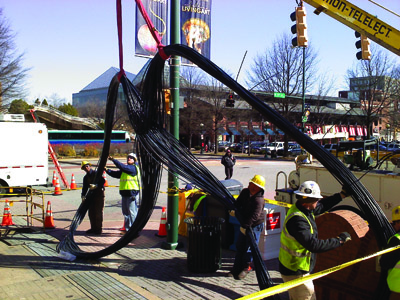
EPB Installs Fiber Cables in Chattanooga Others have already followed these lessons but are not able to offer their gig for such a low prices. To understand why, let's start with some basics. I'm hypothetically starting Anytown Fiber Net in my neighborhood and I want to offer a gig.
Google Fiber Unveiled in Kansas City

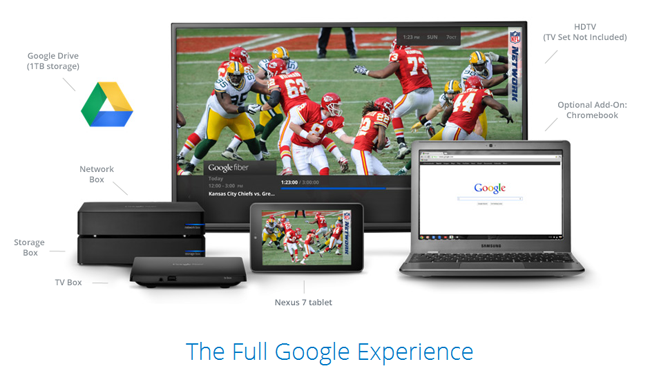
Google Fiber is unveiled. And it sucks to be Time Warner Cable right now. But they already knew that. Google is offering 3 packages in Kansas City - a gigabit Internet connection for $70/month, a TV + Gigabit Internet connection for $120/month, and a free Internet tier of 5/1Mbps (subject to a one time $300 connect cost). The first two packages also have the $300 connect fee but it is waived with a contract. The details are available via DSL Reports and The Verge. There are several interesting enticements along with the connectivity. Plans and pricing is here. I'm surprised at the number of television channels that are available on that package. Notable channels missing include Disney and ESPN, probably because ABC was trying to rake Google over the coals on pricing. Neighborhoods will be competing to get enough presubscriptions to get connected (at $10 per potential subscriber). It will be interesting to see how this goes - the approach makes sense from a business perspective but could result in a patchwork of neighborhoods lacking access. Google Fiber In short, this will be interesting to watch. How will Time Warner Cable respond? How enthusiastic will ordinary people be? Google's marketing talent is considerably more advanced than that of the local governments and small companies (Sonic.net) that first blazed this trail. Speaking of which, I have not yet seen how other service providers will be able to use this network, if at all. The free 5/1 connection is interesting. For a massive company like Google, providing hundreds or thousands of 5/1 connections essentially has zero cost. This is also true of Comcast and CenturyLink, which is why they are profitable on those $10/month low-income packages. This is not a Google experiment. Those running this project are expected to earn a profit.

Google Congratulates Longmont on Referendum

Update: A contact at Google cast doubt on whether the call below was made -- but also reiterated that Google is on the record opposing state laws like that in Colorado that take authority away from communities.  

We have learned that Google called Longmont Power to congratulate them on regaining their authority via the successful referendum.  Apparently, Longmont was a top contender for the Google Gigabit project but Google was unable to determine whether Longmont had the authority to work with them due to the anti-competitive 2005 Qwest law.  

Presumably this places Longmont back on the list of places Google may try to build a network depending on the outcome in Kansas City.  

This is yet another example of why state restrictions on local broadband authority is entirely counter-productive to spurring broadband investment.  We previously speculated that Texas law prevented Austin from being Google's partner.

States: STOP taking broadband authority away from communities. Local authority is essential for investment in next-generation networks.  Communities: make sure you are making smart partnerships!  Don't just jump at anyone pretending to offer a free lunch.