
Fast, affordable Internet access for all.
Google Fiber
Content tagged with "Google Fiber"
The Dalles Pays off Its Network Debt Ahead of Schedule
Of the more than 400 communities around the country that have built and benefitted from community networks, the town of The Dalles in Oregon may have a case for the title of “most bang for the buck.” Their commitment of $10,000 12 years ago to leverage a $1.8 million “QLife” fiber optic network has lead to a massive, $1.2 billion dollar investment from Google in the form of a huge data center, employing nearly 200 people and generating millions in tax revenues for the local community. And at the end of September, the QLife board of directors announced that they had paid off the loans used for network construction more than three years ahead of schedule.
We covered part of The Dalles’ network story two years ago: a small city of just 13,000 was told by Sprint in 2000 that it would have to wait 5 to 10 years for broadband Internet access. Meanwhile, local manufacturing was declining and employers were overlooking the town due to its outdated infrastructure. Before building the QLife network, The Dalles had no access to the major long haul fiber pathway that happened to run right through town. As city manager Nolan Young told Andrew Blum in an interview for his book “Tubes,” it was like “being a town that sits next to a freeway but has no on ramp.”
The city decided enough was enough, and partnered with the county and the local public utility district on a plan for a $1.8 million, 17 mile fiber optic loop through the community that would connect anchor institutions and offer middle mile access to private providers.
Free High-Speed Internet Coming to North Kansas City, Missouri
Last year we reported on a deal between Google Fiber and North Kansas City. The provider entered into a long-term lease to use LiNKCity dark fiber to incorporate into its area deployment. The City recently announced it will now enter into a public-private partnership with DataShack to bring fiber to local businesses and residents. Residents will receive free high-speed access. From the City's announcement:
The partnership between these two companies will enable residents to experience Gigabit speeds for FREE. On January 1st, 2015 all existing residential customers will be upgraded to free monthly 100 mb internet service. New customers after January 1st will have the opportunity to choose between three service options; free monthly gigabit internet service with a $300 installation fee, free monthly 100 mb internet service with a $100 installation fee, or free 50 mb internet service with a $50 installation fee.
A Kansas City Biz Journal article reports that North Kansas City will retain ownership of the infrastructure and DataShack will bring free gigabit Internet service to the public library, city churches, and all public schools. Profits and losses will be shared equally but the City's losses are capped at $150,000, including the capital investment. DataShack will operate and maintain the network.
"It's a win-win for the city," said Byron McDaniel, the city's communications utility director. "It's really giving back to the community what they've invested into the network."
According to the Kansas City Star, the network has a lot of business customers, which is the core of DataShack's strategy:
Department of Delusion: Comcast Takes Credit for Google Fiber, Unicorns, and Kittens
In what can only be assumed as a fit of insanity or confusion, several dozen US Mayors came out Friday with a letter to Chairman Wheeler, praising Comcast and demanding that the cable monopoly be allowed to take over Time Warner Cable. Given that Comcast and Time Warner Cable are among the most hated corporations in America, perhaps these math wiz mayors think two negatives will produce a postive?
In light of all the evidence against Comcast’s track record for customer service, its glacial pace at upgrading Internet access, and its false promises for investment, we find the letter absurd, at best. But then it contains this gem:
Since the Comcast Time Warner Cable transaction was proposed, Google has announced plans to expand its high-speed Fiber service to 34 new communities.
Wow! Comcast wants to take credit for Google's investment in fiber networks? An investment by Google that is only necessary because the big cable companies have refused to meet the growing demand of our communities with better services?
This got us thinking, what else can Comcast take credit for since it announced the merger?
- Since Comcast announced the merger, the Large Hadron Collider has not created a black hole large enough to destroy the Earth. #thankyouComcast
- Since Comcast announced the merger, millions of kittens have been adopted #thankyouComcast
- Since Comcast announced the merger, we have a potential Ebola vaccine #thankyouComcast
- Since Comcast announced the merger, Bruce Willis has not had to blow up an asteroid to save our planet. #thankyouComcast
Check out our #ThankYouComcast hashtags on Twitter, Retweet them, add your own, and share with friends, family, and all your local officials. And if you’re living in one of the cities where your mayor sold you out for Comcast’s bottom line, make sure they know just how ludicrous their letter is, they’re clearly very out-of-touch with their constituencies.
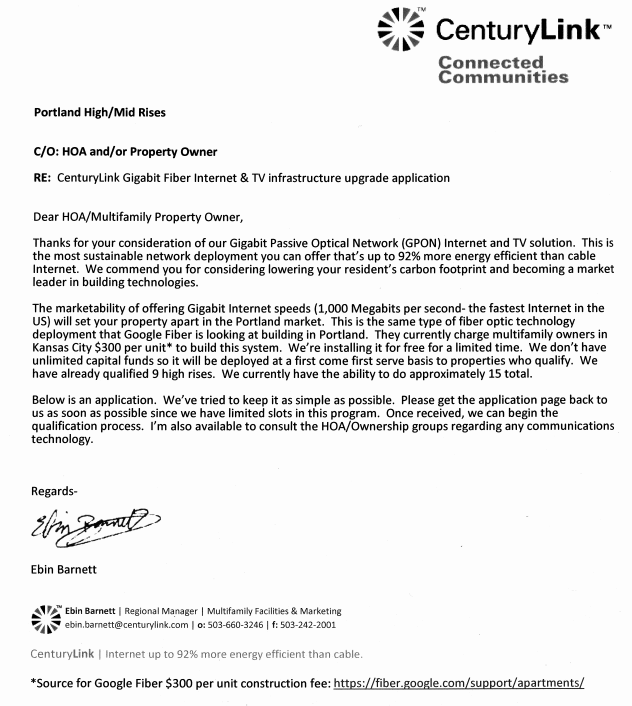
CenturyLink Seeks Apartment Buildings for Gigabit in Portland
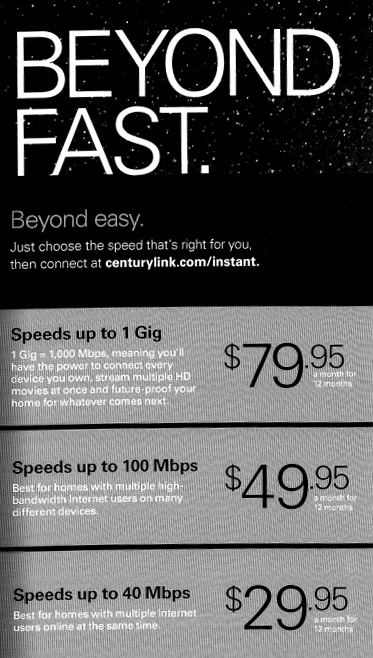
The promotional sheet claims CenturyLink will offer speeds "up to" 1 Gig for $79.95/month for 12 months. 100 Mbps runs $49.95 and 40 Mbps is $29.95 - each for 12 months. No mention of upload speeds but CenturyLink has demonstrated a real aversion to symmetry so users can expect far slower upstream than what modern municipal networks and Google fiber deliver.
The standard operating procedure in apartment buildings will be for CenturyLink to try to lock up the internal wiring to buildings and deny it to competitors. FCC rules make exclusive agreements with landlords unenforceable, but there are a host of tricks that incumbents use to prevent any competition and landlords getting a kickback often have little reason to encourage competition.
The CenturyLink copy notes that its fiber optic GPON option is "up to" more than 92 percent energy efficient than cable modem Internet access. I have to wonder how it compares to DSL energy efficiency and whether that number holds up better than the "up to" 12 Mbps claims they make on DSL circuits that seldom peak at 5 Mbps.
At any rate, it is more than we can expect in the many communities CenturyLink is serving where there the local government have done nothing to spur competition by investing in publicly owned assets that could form a municipal network or be used to entice independent service providers to enter the market. In particular, I would be curious where else CenturyLink is rolling out fiber to buildings without any upfront charges.
Kansas Community Benefits from Community Owned Networks
Even though the Kansas cable lobby have temporarily retracted their competition-killing telecom bill, we still want to highlight the benefits of preserving full home rule, local authority by focusing on a number of communities, including Chanute, Ottawa, and Erie.
Chanute
We have reported on Chanute's municipal network for years. The community leveraged its electric utility assets and incrementally built an extensive publicly owned gigabit fiber network. Over several decades, the community expanded its network to serve schools, libraries, local government, and businesses. Chanute took advantage of every opportunity and created a valuable asset with no borrowing or bonding.
Several business, including Spirit AeroSystems, chose to locate in Chanute because of its incredible fiber network. Spirit brought approximately 150 new jobs. The network also retained jobs when incumbents refused to provide needed upgrades to local businesses. Rather than leave town, the businesses connected to the City's network and increased their productivity.
Former City Manager J.D. Lester referred to municipal broadband as “the great equalizer for Rural America,” saying: “You don’t have to live in Kansas City to work there.” (See our case study Chanute's Gig: One Rural Kansas Community's Tradition of Innovation Led to A Gigabit and Ubiquitous Wireless Coverage [PDF])
Kids in Chanute have access to connectivity other schools can only dream about. The local community college has expanded its distance learning program with higher capacity broadband. Free Wi-Fi hotspots are all over town; money otherwise sent to distant providers stays in the community. Chanute has invested in a WiMAX wireless system that serves public safety all over the region, not only in town. Their other utilities use the network for automatic metering and SCADA applications, saving energy and allowing customers the chance to reduce utility bills.
Kansas Anti-Competition Bill Authored by Cable Lobbyists
That's a lobby group with members such as Comcast, Cox, Eagle Communications, and Time Warner Cable. The bill was introduced this week, referred to the Committee on Commerce, and scheduled for discussion for Tuesday of next week.That hearing will now be delayed as the cable lobbyists strategize on a bill that less transparently serves only their interests. As usual, we see the cable lobbyists claiming that municipal networks use taxpayer dollars, despite the reality that most do not. Much of what I see in Kansas points to Time Warner Cable being behind this - a lame attempt to stop Google Fiber using lobbying power rather than innovating and investing. However, the bill has tremendously negative implications for rural Kansas because local governments are often the only entities that care if their communities have the Internet access they need in the modern economy. It stretches credulity to think Kansas would pass a bill that would prevent Google from expanding its network in the region.
Businesses Mount Opposition to Anti-Competition Cable Bill in Kansas
In a very quick turnaround, a number of prominent companies have signed on to a letter opposing the Kansas bill to block competition for existing Internet providers, like Time Warner Cable. Firms signing the letter sent to the Commerce Committee include Alcatel-Lucent, American Public Power Association, Atlantic Engineering Group, Calix, CTC Technology & Energy, Fiber to the Home Council, Google, National Association of Telecommunications Officers and Advisors, OnTrac, Telecommunications Industry Association, Utilities Telecom Council. The Committee will hear the bill on Tuesday morning. We understand that no recording or live streaming is planned.
Update: When originally posting this, I failed to credit Jim Baller - who organized the letter and works to preserve local authority, so communities themselves can decide whether a network is a wise investment.
Early Reactions to Anti-Competition Broadband Bill in Kansas
The city opposes the bill because it’s legislation that allows lawmakers in Topeka to define what local communities can or cannot do. “It’s about home rule, local choice,” Chanute Utilities Director Larry Gates said. “It’s not about what happens in Topeka.”And a local business weighed in, noting that the City service is essential because the private providers have refused to upgrade and offer modern services:
Phil Jarred of Jarred Gilmore & Phillips PA said the two private companies providing internet services, CableOne and AT&T cannot meet the needs his business requires. “Both services are not fast enough,” Jarred said. “It costs us too much not to have the fiber optics.”Stacey Higginbotham at GigaOm noted that it curiously bans both municipal networks and the types of partnerships that Google and Kansas City formed, finishing with "it looks like incumbent providers are fighting back with politics." This is nothing new of course - companies have sought for years to protect their businesses with laws limiting the competition rather than investing or being innovative. But when it comes to an essential infrastructure, we should be particularly careful.