regulation

Content tagged with "regulation"

Displaying 91 - 100 of 134

State by State Campaign to Gut Consumer Telecom Protections

In most states, telephone companies are required to serve everyone and when there are problems with the service, the state can mandate that the company fix them. But AT&T and ALEC are leading the charge to let these massive companies decide for themselves who should have access to a telephone, taking state regulators out of the loop. These big companies use several arguments we are well familiar with - that mobile wireless is already available (in many rural areas, it actually is not available) and there is plenty of competition. If only that were the case. I was thrilled to see David Cay Johnston cover this in a column on Reuters:
AT&T and Verizon, the dominant telephone companies, want to end their 99-year-old universal service obligation known as "provider of last resort." They say universal landline service is a costly and unfair anachronism that is no longer justified because of a competitive market for voice services. The new rules AT&T and Verizon drafted would enhance profits by letting them serve only the customers they want. Their focus, and that of smaller phone companies that have the same universal service obligation, is on well-populated areas where people can afford profitable packages that combine telephone, Internet and cable television.
What happens when the states hand over authority to these companies? David has an answer:
AT&T and Verizon also want to end state authority to resolve customer complaints, saying the market will punish bad behavior. Tell that to Stefanie Brand. Brand is New Jersey's ratepayer advocate whose experience trying to get another kind of service - FiOS - demonstrates what happens when market forces are left to punish behavior, she said. Residents of her apartment building wanted to get wired for the fiber optic service (FiOS) in 2008. Residents said, "We want to see your plans before you start drilling holes, and Verizon said, 'We will drill where we want or else, so we're walking,' and they did," Brand told me. Verizon confirmed that because of the disagreement Brand's building is not wired. And there's nothing Brand can do about it. Verizon reminded me the state Board of Public Utilities no longer has authority to resolve complaints over FiOS.
Better broadband is not just about technology.

Poor State of US Broadband a Result of Poor Regulation

I recently stumbled across a great point regarding the spectacular failure of the US (mostly the FCC, but Congress should certainly share some of the blame) to properly regulate broadband connections to the Internet. US policy results in a few massive providers dominating the market. Fred Goldstein, a principal of Interisle Consulting Group, wrote the following:
In truly competitive markets that display some degree of commodity-like characteristics, large and small vendors tend to coexist. I'm drinking coffee right now, which is a good example. Maybe Maxwell House and Folgers (and their parent companies) have a large share of the market, competing on price for their swill. But there is plenty of room for others to differentiate their product. Dunkin and Starbucks have built huge chains on their own style of semi-premium product, while another couple of niches of premium and superpremium beans are easy enough to find. Food markets tend to be like this; check out any Whole Foods (a/k/a The Museum of Modern Vegetables) for a supply of priced-above-commodity products. I feel foolish for selling most (not all, thankfully) of my Whole Foods stock when it was in the dumps a couple of years ago. The same thing happens in many fields. Apple itself sells computers above commodity price levels. There's a whole "high end" audio business catering to those who like to show off how much they can afford to spend. The automobile industry has mass-market commodity cars and several premium tiers. Internet access in the US lacks that because the natural monopoly on outside plant is not properly regulated. If it were treated here by EU norms, then any number of ISPs could access the wire. Some would just be cheap; some would offer premium help desks among their services. That doesn't happen, however, when the usual number of "competitors" is two. Even more so when those competitors agree that they should divide up markets between themselves rather than overbuild, or (heaven forbid) let outside information providers onto their facilities. The wire should be regulated. ISPs shouldn't.
Amen. Physical connections are a natural monopoly. Even if the economics supported many physical providers, having so many would be terribly inefficient. Much better to have networks that are owned by the community and have independent service providers competing to deliver services -- just like the roads.

DC Revolving Door, Comcast, and Campaign Finance Reform

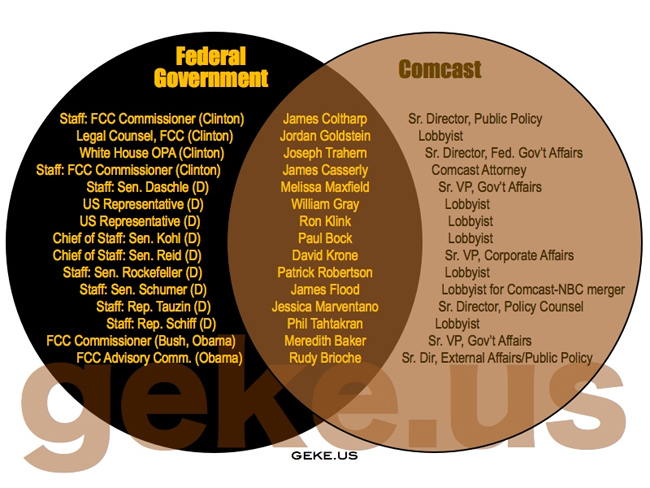
One of the reasons community broadband networks face so many unique hurdles (often created deliberately by states in response to cable/dsl lobbying) is because of the many ways in which campaign finance corrupts our national and state governments. Community broadband networks are focused on meeting community needs, not sending lobbyist armies into Washington, DC, and state capitals (though one of things we do at the Institute for Local Self-Reliance is offer help to those that do push pro-community agendas in these areas). To understand why DC is so focused on furthering the corporate agendas of AT&T, Comcast, Time Warner Cable, and others, is to understand the revolving door. (Also, understanding capture -- which we have explained previously.) In short, many of the people who make decisions about telecommunications policy in DC have worked, will work, or are presently working for the massive companies that effectively control access to the Internet in most of America's communities. The good folks at Geke.US have created the following Comcast Venn Diagram illustrating a small piece of the DC revolving door. Comcast and DC's revolving door Venn Diagram Reforming this system is a deep, seemingly intractable problem. But for those looking for answers, a good place to start is with the work of Lawrence Lessig. I just finished his Republic, Lost, which offers a grand tour of the problems resulting from the present system of campaign finance. You can also see a number of his presentations here. His organization, the Rootstrikers aim to get to the root of problems rather than being distracted by trying to fix symptoms of deeper problems. This is precisely what we do with our focus on community networks. Many focus solely on resolving digital divide issues, improving rural access to the Internet, lowering the cost of broadband, or the various other problems that result from narrowly-focused private corporations owning and controlling essential communications infrastructure with inadequate regulations.


New Year, Same Lame Cable and DSL Monopolies

It's a new year, but most of us are still stuck with the same old DSL and cable monopolies. Though many communities have built their own networks to create competition and numerous other benefits, nearly half of the 50 states have enacted legislation to make it harder for communities to build their own networks. Fortunately, this practice has increasingly come under scrutiny. Unfortunately, we expect to see massive cable and telephone corporations use their unrivaled lobbying power to pass more laws in 2012 like the North Carolina law pushed by Time Warner Cable to essentially stop new community broadband networks. The FCC's National Broadband Plan calls for all local governments to be free of state barriers (created by big cable and phone companies trying to limit competition). Recommendation 8.19: Congress should make clear that Tribal, state, regional and local governments can build broadband networks. But modern day railroad barons like Time Warner Cable, AT&T, etc., have a stranglehold on a Congress that depends on their campaign contributions and a national capital built on the lobbying largesse of dominant industries that want to throttle any threats to their businesses. (Hat tip to the Rootstrikers that are trying to fix that mess.) We occasionally put together a list of notable achievements of these few companies that dominate access to the Internet across the United States. The last one is available here. FCC Logo As you read this, remember that the FCC's National Broadband Plan largely places the future of Internet access in the hands of these corporations.

The Real Government Takeover of the Internet

If you aren't familiar with SOPA - the "Stop Online Piracy Act" or its companion in the Senate (called PIPA or Protect IP), you should be. This is legislation that would allow the US government to require Internet Service Providers block web sites without due process. Sascha Meinrath and James Losey from the New America Foundation explain the threat in Slate:
The interconnected nature of the Internet fostered the growth of online communities such as Tumblr, Twitter, and Facebook. These sites host our humdrum daily interactions and serve as a public soapbox for our political voice. Both the PROTECT IP Act and SOPA would create a national firewall by censoring the domain names of websites accused of hosting infringing copyrighted materials. This legislation would enable law enforcement to take down the entire tumblr.com domain due to something posted on a single blog. Yes, an entire, largely innocent online community could be punished for the actions of a tiny minority. If you think this scenario is unlikely, consider what happened to Mooo.com earlier this year. Back in February, the Department of Justice and Department of Homeland Security seized 10 domains during a child-porn crackdown called “Operation Protect Our Children.” Along with this group of offenders, 84,000 more entirely innocent sites were tagged with the following accusatory splash page: “Advertisement, distribution, transportation, receipt, and possession of child pornography constitute federal crimes that carry penalties for first time offenders of up to 30 years in federal prison, a $250,000 fine, forfeiture and restitution." Their only crime was guilt by association: They were all using the Mooo.com domain.
From our point of view, what is most interesting is not who is pushing this bill (Hollywood and the usual suspects that tried to kill the VCR because it would obviously destroy the movie industry) but who is not resisting.

Susan Crawford Identifies Problems/Solutions with Broadband in America

Susan Crawford published an excellent essay in the New York Times presenting her Looming Broadband Monopoly argument as a discussion of the coming digital divide between those with access to next-generation networks and those without.
These numbers are likely to grow even starker as the 30 percent of Americans without any kind of Internet access come online. When they do, particularly if the next several years deliver subpar growth in personal income, they will probably go for the only option that is at all within their reach: wireless smartphones. A wired high-speed Internet plan might cost $100 a month; a smartphone plan might cost half that, often with a free or heavily discounted phone thrown in. The problem is that smartphone access is not a substitute for wired. The vast majority of jobs require online applications, but it is hard to type up a résumé on a hand-held device; it is hard to get a college degree from a remote location using wireless. Few people would start a business using only a wireless connection.
She identifies the problem as a lack of competition in the market while highlighting the role of lobbying from the wealthy cable companies to keep it that way:
The bigger problem is the lack of competition in cable markets. Though there are several large cable companies nationwide, each dominates its own fragmented kingdom of local markets: Comcast is the only game in Philadelphia, while Time Warner dominates Cleveland. That is partly because it is so expensive to lay down the physical cables, and companies, having paid for those networks, guard them jealously, clustering their operations and spending tens of millions of dollars to lobby against laws that might oblige them to share their infrastructure.
In this essay, her preferred solution is better federal regulation that would require companies that own networks to share parts of their infrastructure with competitors (to significantly reduce the problems of natural monopoly). Unfortunately, she did not explicitly discuss the solution of the communities building their own networks - a topic she has discussed at great length elsewhere in very positive terms.

Kill Network Neutrality, Get Slower Networks

If you want to predict the future, it helps to understand the incentives that guide action. Unsurprisingly, if a corporation has the option of being more profitable by investing less, it will do so. This is the smart conclusion of Bill Snyder at InfoWorld:
To understand their logic, consider this thought experiment: Imagine that you own a freeway -- say, Highway 101 through Silicon Valley -- and you had the power to pluck a car from a traffic jam with a helicopter and deposit it on a clear stretch of the road. Naturally, drivers who could afford the service would be happy to sign up. "That highway is like the Internet, and the individual cars are the packets of data. The ISP is essentially the gatekeeper that controls the flow of cars on the highway. If the ISP is allowed to snatch any car from the back of a very long line and put it in front of everybody else when the driver of the car pays a priority delivery fee, would the ISP have an incentive to keep the road congested or to expand the road capacity?" they wrote. The answer is pretty obvious: If you can make more money by keeping your network congested, why would you invest money to make it less crowded?
He was riffing on a paper, "The Debate on Net Neutrality: A Policy Perspective" by H Kenneth Cheng, Subhajyoti Bandyopadhyay, and Hong Guo. I think many of us view this as a "well, duh" paper, but it is good to see a rigorous academic paper verifying our gut instincts. There is a very real danger to letting a few massive corporations control access to the Internet, which is one major reason we see so many communities building their own networks. They want to ensure everyone has fast, reliable, and affordable access to the Open Internet.

How the FCC Killed Broadband Competition

Dane Jasper, the CEO of Sonic.net, one of the few ISPs to survive the death of broadband competition over the past ten years, wrote about "America's Intentional Broadband Duopoly."  It is a short history of how the FCC's flawed analysis (helped along by incredible amounts of lobbying dollars, no doubt).

He starts by asking when the last time anyone offered to sell you broadband over power lines (BPL).  The FCC decided that cable and telephone companies shouldn't have to share their wires (which are a natural monopoly) with competitors (creating an actual marketplace for services) because BPL, satellite, and wireless would put so much competitive pressure on DSL and cable.  FAIL.

Then, in the Brand X decision, they ruled that Cable would not be required to allow competitors to lease their lines either. The FCC did this by reclassifying broadband Internet access as an “information service”, rather than a “telecommunications service”. As a result, common carriage rules could be set aside, allowing for an incumbent Cable monopoly. This decision was challenged all the way to the supreme court, who ruled in 2005 that the FCC had the jurisdiction to make this decision. To close out Powell’s near-complete dismantling of competitive services in the U.S., the FCC took up the issue of ISPs resale of DSL using the incumbent’s equipment, also known as wholesale “bitstream” access. If Cable is an information service under Brand X, why shouldn’t Telco have the same “regulatory relief”? The result: the FCC granted forbearance (in other words, declined to enforce its rules) from the common carriage requirements for telco DSL services.
For those who are thinking that wireless is finally competitive with cable and DSL, don't forget that while 4G appears much faster (because so few people are using it presently), it still comes with a 2GB monthly cap. So if you want to do something with your connection aside from watching one movie a month, 4G is not competitive with a landline connection.

Senate to Vote on Giving Internet Governance to Comcast, AT&T

Update: The Senate voted against turning the Internet over to Comcast, AT&T, and other major carriers. How did your Senators vote? The US Senate began debating network neutrality yesterday - the historic governing principle of the Internet that ISPs should not be allowed to tell their users where they may or may not go and should not prioritize some connections over others merely because it generates more revenue for the ISP. As Al Franken has said several times, this is the 1st amendment for the Internet - protecting everyone's speech. It prevents a few massive companies (or even local governments where they offer access to the Internet) from exerting too much influence over what subscribers are able to do on the Internet. Unfortunately, many Senators are campaigning against this principle, in part because they have been misinformed as to what it means and in part because they are getting a ton of campaign cash from corporations that recognize how much more profitable they would be if they could charge users extra to go to YouTube. There will be a vote today on a resolution of disapproval for the mild network neutrality rules proposed by the FCC last December (which the FCC Chairman chose to water down in part because he thought it would be less controversial -- FAIL). We would like to recognize some of those who have stood up to protect the open Internet, starting with Free Press. The American Sustainable Business Council authored an op-ed:
The truth is that if we want to make sure small businesses can grow with the assistance of broadband, the Internet must remain open.

Lafayette Dealing with Expected Headaches

No matter how much community broadband advocates prepare the community and elected officials for the expected difficulty of building a successful local project, in the midst of the deployment, times are tough. A local paper in Lafayette claims "LUS Fiber [is] at a crossroads" but starts with an admission that these problems were forecast and expected:
Competitors will pay less for programming than you do, and in turn play hard ball by lowering rates for customers. Good luck keeping up with technological advances, expansion needs and growth costs; it's a risky proposition for a public entity used to maintaining rather than adapting. Your opportunities will be limited because you can't provide services outside the city limits. You'll be criticized for offering programming such as adult movies, and you'll be told you really should be focusing on your core business: running power, water and wastewater plants.
Terry Huval delivered that message in 2000, long before Lafayette committed to building their community fiber network -- a network that delivers some of the fastest speeds in the nation at the lowest rates and has already delivered hundreds of jobs. Nonetheless, LUS Fiber is behind the take rate goals they had set in the business plan. The expenses are higher than forecast because Lafayette was unfairly denied entry to a coop that secures lowers rates for television contracts for members. The only discernible reason for rejecting Lafayette is that Cox joined the coop after Lafayette committed to building its network. There is little doubt that Cox was influential in denying Lafayette's application, likely increasing LUS Fiber expenses for offering cable channels by more than 20%. This is just one of the many ways that the telecommunications market is rigged to benefit incumbents at the expense of all of us -- residents and small businesses alike. We will not have real choices in competition until government policy treats telecom like the essential infrastructure it is. Mike Stagg, a long time supporter of the network is quoted in the article, challenging LUS Fiber to improve its marketing:
Can they do better? Probably so. Part of it is the fact that, just from a mindset standpoint, LUS is a utility and utilities generally do not compete," Stagg said.