regulation

Content tagged with "regulation"

Displaying 111 - 120 of 135

Another Example of Regulatory Capture

As you observe (or hopefully, participate in), the debates around network neutrality or universal service fund reform, remember that many of the loudest voices in support of industry positions are likely to be astroturf front groups.  Between extremely well-financed astroturf organizations and industry-captured regulatory agencies, creating good policy that benefits the public is hard work.  It helps to study how industry has gamed the FCC in the past -- as documented by David Rosen and Bruce Kushnick in a recent Alternet article.

At the risk of being sarcastic, we can thank the FCC for working with the industry to make our phone bills to easy to read - an example is available here.

Qwest Renews Push to Gut Local Authority over Cable Television

It's 2011 and time for Qwest to renew a push to gut local authority in a number of states - Idaho and Colorado to start. An article for the Denver Post explains the argument:

Phone companies say state-level oversight of video franchising fosters competition because it is less cumbersome for new entrants to secure the right to offer services.
Many states have also eliminated the condition that new video competitors must eventually offer service to every home in a given municipality, a requirement placed on incumbent cable-TV providers.

Gutting local authority is the best way to increase the disparities between those who have broadband and those who do not. Qwest and others are only interested in building out in the most profitable areas -- which then leaves those unserved even more difficult to serve because the costs of serving them cannot be balanced with those who can be served at a lower cost.

The only reason that just about every American living in a city has access to broadband is because franchise requirements forced companies to build out everyone. Without these requirements, cable buildouts would almost certainly have mirrored the early private company efforts to wire towns for electricity -- wealthier areas of town had a number of choices and low-income areas of town had none.

In Idaho, those fighting back against this attempt to limit local authority are worried that statewide franchising will kill their local public access channels - a reality that others face across the nation where these laws have passed.

The channels, which are also used to publicize community events, provide complete coverage of Pocatello City Council, Planning and Zoning and School District 25 board meetings, as well as candidate forums before elections.

Without these local channels, how could people stay informed about what is happening in the community? Local newspapers are increasingly hard to find. In many communities, these channels are the last bastion of local news. 

Dave Burstein Reflects on FCC Policy

Dave Burstein of DSL Prime is interviewed on a recent episode of America's Report on TelecomTV.

This video is no longer available.

The Economist Again Blasts US Anti-Competitive Telecom Policy

The Economist has again editorialized about US telecom policy, in this case specifically about network neutrality.
This debate is loudest in America, uncoincidentally the developed market with the least competitive market in internet access. Democrats, who are in favour of net-neutrality rules, insist regulation is needed to prevent network operators discriminating in favour of their own services. A cable-TV firm that sells both broadband internet access and television services over its cables might, for example, try to block internet-based video that competes with its own television packages. Republicans, meanwhile, worry that net neutrality will be used to justify a takeover of the internet by government bureaucrats, stifling innovation. (That the internet’s origins lie in a government-funded project is quietly passed over.)
They take a fairly middling approach, regarding the network neutrality rules as decent, arguing that some measure of discrimination should be allowed and could be beneficial (one wonders if they truly thought deeply about this: before YouTube, connections would have been optimized against streaming traffic and YouTube may never have succeeded). In any event, they answer their own question: the real problem in the U.S. is lack of competition among Internet service providers.
These details are important, but the noise about them only makes the omission more startling: the failure in America to tackle the underlying lack of competition in the provision of internet access. In other rich countries it would not matter if some operators blocked some sites: consumers could switch to a rival provider. That is because the big telecoms firms with wires into people’s homes have to offer access to their networks on a wholesale basis, ensuring vigorous competition between dozens of providers, with lower prices and faster connections than are available in America. Getting America’s phone and cable companies to open up their networks to others would be a lot harder for politicians than prattling on about neutrality; but it would do far more to open up the net.
Unfortunately, they do not consider another remedy: local ownership that is accountable to the public.

Problem of Scale Hurts Frontier with FiOS

Frontier has been bitten by the same disadvantage many communities face when building their own networks -- little market power means having to overpay for everything. When Frontier bought millions of Verizon rural lines, it bought a few FiOS connections as well. But not enough to gain any bargaining power with channel owners. So Frontier had to raise the costs of its video services up for 46%. Lest anyone feel too sorry for Frontier, they are doing just fine. It is their customers who suffer. But it is a reminder that the issue of scale and market power are barriers to all competition, not just community networks. If we want to have real competition in this country, the Congress and the FCC need to stop ignoring the problems caused by massive players distorting the market. This unregulated market is an invitation for big players to join together and screw everyone else.

The Short Memory of Network Neutrality Sell-Outs

Today, the FCC is poised to pass a half-ass attempt to preserve the open Internet against the interests of massive gatekeepers like AT&T and Comcast. Tim Karr rightly calls it Obama's "Mission Accomplished" moment. Fortunately, the likely result will be a couple of years in the courts before the rule is thrown out because the FCC has not properly ground its half-ass actions in any authority it has received from Congress. Perhaps when the FCC next has to deal with this, we'll have an FCC Chairperson with a backbone and a stronger interest in what is best for hundreds of millions of Americans than what is best for AT&T and a few other corporations. The FCC and supporters of this let's-keep-the-Internet-partly-open "compromise" will lump all critics as being extremist looneys. (Okay, the Republicans who oppose this might fit that description as they are literally making things up or totally confused about what is being decided). But let's look at the crazy looney rhetoric of FCC Chair Genachowski last year:
Genachowski proposed that the FCC formalize its four principles of network openness. To encourage broadband deployment and preserve and promote the open and interconnected nature of the public Internet, consumers are entitled:
  • to access the lawful Internet content of their choice.
  • to run applications and use services of their choice, subject to the needs of law enforcement.
  • to connect their choice of legal devices that do not harm the network.
  • to competition among network providers, application and service providers, and content providers.
To these, Genachowski proposed adding two more: The first would prevent Internet access providers from discriminating against particular Internet content or applications, while allowing for reasonable network management.

FCC on Net Neutrality: More Bush than Obama

Whenever the discussion of Network Neutrality comes up, we like to remind everyone that when the network is locally owned and accountable to the community, anti-subscriber discrimination is not a problem. That said, we are strong supporters of proper safeguards to ensure massive companies like AT&T cannot abuse their market power and discourage innovation. As the FCC prepares to discuss a half measure to preserve parts of the open Internet, a number of us have been frustrated that while we cannot read the proposal, AT&T appears to be helping write it. Karl Bode's take:
[T]he question shouldn't be whether or not consumers can now view a neutrality proposal after it was hashed out in private meetings (predominately with only the largest, wealthiest carriers), it should be: why weren't consumers absolutely integral in crafting it? AT&T has met with the FCC half a dozen times in the course of three weeks and likely knows precisely what's in this plan -- do you?
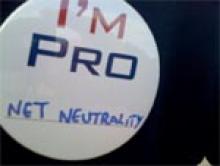
We've written to FCC Commissioners to make it clear that they must not compromise on the future of the open Internet. You should too. Photo used under Creative Commons license from AdamWillis.