
NDIA

Content tagged with "NDIA"

Related Topics
Displaying 1 - 10 of 56

IN OUR VIEW: Statement on Federal Court Decision to Reinstate Digital Equity Act Grant Funding

Yesterday a federal district court judge ruled that Digital Equity Act programs should resume, although without any of the Act’s original race-based factors, which the judge deemed to be unconstitutional.

In response to the ruling in the on-going lawsuit filed by the National Digital Inclusion Alliance (NDIA), Christopher Mitchell, Director of the Community Broadband Networks initiative at the Institute for Local Self-Reliance (ILSR), made the following statement:

“Yesterday’s ruling on the Digital Equity Competitive Grant Program is, on balance, a victory. The National Digital Inclusion Alliance deserves enormous credit for fighting to get to this point. The court affirmed what should have been obvious all along: the Trump administration had no legitimate basis to hold this program hostage. The only real question now is how quickly NTIA moves to actually implement it.”

“The removal of racial and ethnic minorities as a designated ‘covered population’ are  a loss because the Trump Administration continues to find ways to undermine populations that have been historically disadvantaged.  But I don’t think it will significantly change who the program actually serves or what work gets done on the ground. The Digital Equity Act’s continued focus on low-income communities, older adults and veterans means that the people who most need to be prioritized will still be prioritized. Due to historic discrimination, many racial minorities will remain the focus of the program due to their disproportionately low income.”

“Digital equity work does not cost the federal government money – our taxpayer dollars are used inefficiently when millions of people cannot access telehealth and similar services. Additionally, the benefits of federal investments into new Internet networks are greatly enhanced when more people are able to take advantage of modern technology.” 

AT&T vs California: The Life-and-Death Battle Over Landline Service

California residents are engaged in a protracted, ugly battle with telecom giant AT&T over their ability to receive life-saving communications during an emergency. 

The battle comes as the telecom monopoly attempts to eliminate most meaningful oversight of the company’s communications networks, actively putting human lives – and state rights – at risk.

At the heart of the standoff is California’s Carrier Of Last Resort (COLR) obligations, which mandate that state residents maintain reliable access to voice calls, 911, toll free calls, deaf and disabled assistance services, customer service support, protection from unwanted charges, operator services, directory help, and flexible billing options.

AT&T lobbyists have worked tirelessly to eliminate such requirements in 20 of its 21 state service territories, falsely claiming the regulations stifled the company’s ability to install next-generation fiber access. In reality, AT&T has long been criticized for cheaping out on fiber investments, and is primarily interested in eliminating any dwindling oversight.

As COLR obligations are eliminated, customers are frequently shoveled from traditional copper-based landlines – which operate even during power outages – to frequently less reliable and significantly more expensive wireless alternatives. In many cases that results in California elderly residents losing access to essential lifesaving services entirely, particularly in areas where cellular connectivity is spotty or unavailable.

Too Easy to Reach Orbit? - Episode 16 of Unbuffered

Unbuffered Logo - Two text bubbles

In this episode of Unbuffered, Chris is joined again by Douglas Dawson for a conversation about the challenges and opportunities shaping the future of broadband.

Chris and Doug begin by discussing the latest developments in the National Digital Inclusion Alliance's lawsuit against the Trump administration over the Digital Equity Act, examining what the case could mean for digital equity efforts and the communities working to expand access, affordability, and digital skills.

From there, they turn to the results of a recent survey examining how rural Americans use the Internet, exploring what it reveals about changing consumer habits, growing bandwidth demands, and the ways AI and other emerging technologies are reshaping how people connect online.

The conversation then shifts to the practical realities of building broadband networks, including the rising cost of Fiber construction, permitting delays, make-ready work, and why better pole inventories could significantly reduce deployment costs and speed up network expansion.

Chris and Doug also take a closer look at the Federal Communications Commission's evolving approach to satellite broadband, discussing recent regulatory changes, what they could mean for the industry, and whether the agency's approach strikes the right balance as more companies look to launch satellite broadband services. They also explore how satellite fits alongside Fiber and other technologies as communities work to expand reliable Internet access.

Throughout the episode, Chris and Doug connect today's policy debates with broader questions about technology, infrastructure, and what it will take to ensure communities have reliable, affordable Internet in the years ahead.

This show is 48 minutes long and can be played on this page or via Apple Podcasts or the tool of your choice using this feed

You can also check out the video version via YouTube.

Transcript below.

We want your feedback and suggestions for the show-please e-mail us or leave a comment below.

Listen to other episodes (formerly Community Broadband Bits) or view all episodes in our index. See other podcasts from the Institute for Local Self-Reliance.

Thanks to Whitedrift for the song Operator, licensed Creative Commons Attribution (3.0).

Digital Equity Act Program Can Proceed Without Race Criteria, Trump Attorneys Say

*The following story by Broadband Breakfast Reporter Jericho Casper was originally published here.

Trump administration attorneys told a federal judge that the Digital Equity Act's competitive grant program could likely continue if a challenged provision is struck down.

During a hearing before U.S. District Judge John Bates, Commerce Department attorney Patrick Butler argued that a statutory provision identifying certain racial and ethnic groups as “covered populations” could be severed from the law if found unconstitutional.

(Should that happen, it would allow) the rest of the program to move forward without considering race. 

The clarification came during a motion hearing in a suit brought by the National Digital Inclusion Alliance (NDIA), which challenged the administration's decision to halt the Digital Equity Act program after President Donald Trump characterized it as unconstitutional.

The hearing, held in the U.S. District Court for the District of Columbia on June 11, was made public Monday.

During the hearing, Bates repeatedly questioned both sides about whether the constitutional issue could be resolved now, at the motion-to-dismiss stage, and whether any part of the case would remain if the challenged provision were severed and the grant program continued.

Justice Department and Commerce Department attorneys argued that the disputed provision could be removed while leaving the rest of the program intact.

“It's our position that the racial classification is severable,”  Butler told the court. “If you decide that the racial classification is unconstitutional ... and then you sever it, we would obviously apply the grant program without considering race.”

Critics Say Trump Administration Lifeline 'Reforms' Will Harm Most Vulnerable

Consumer and civil rights groups last week told the Trump administration that their proposed “reforms” of the FCC’s Lifeline program would undermine efforts to ensure equitable, affordable access to the internet for all Americans, and are based on lies about immigrant fraud.

Last January, the Trump FCC under Brendan Carr proposed a series of “reforms” to the agency’s Lifeline program, which, as part of the broader bipartisan Universal Service Fund (USF) program, provides qualifying low-income US households with a modest $9.25 monthly subsidy for telecom services (which jumps to $34.25 for tribal homes).

At the time, Carr insisted that the reforms were necessary to improve government efficiency.

“The FCC has an obligation to be a good steward of federal dollars,” Carr said in a prepared statement. “And that is why the agency will be taking a comprehensive look at the FCC’s nearly $1 billion dollar a year Lifeline program, which subsidizes phone and Internet services for low-income Americans.”

To further sell his pitch, Carr made the false claim that the program was somehow awash with illegal immigrants who were exploiting U.S. taxpayers. To “prove” his claim, Carr stated that more than $5 million in Lifeline money funded 116,000 dead people across three states, with the heaviest “fraud” occurring in California.

Image
FCC Commissioner Brendan Carr on CSPAN

“Over 80% of those scams took place in California alone,” Carr said. “That type of waste, fraud, and abuse is completely unacceptable. It should go without saying that only beneficiaries that are both living and here legally should qualify for benefits under this program,” Carr said.

Another Blow to Digital Equity: Court Kills FCC's Anti Digital Discrimination Rules

In yet another bruising blow in the fight to ensure equitable access to high-speed Internet service, an appeals court struck down federal rules this week that aimed to combat digital redlining.

The ruling came despite a mandate from the bipartisan infrastructure law passed during the Biden administration that directed the FCC to develop “rules to facilitate equal access to broadband internet access service” that would prevent “digital discrimination of access based on income level, race, ethnicity, color, religion, or national origin.”

Not adopted until 2023 after a lengthy rulemaking process and public comment period, when the FCC published its final digital discrimination rules it gave the agency the authority to penalize Internet Service Providers (ISPs) whose policies resulted in “disparate impact,” even if the agency couldn’t prove deliberate discriminatory intent.

Among the real-world “disparate impact” examples advocates presented to the FCC were instances such as when residents of Hope Village, a mostly Black neighborhood in Detroit, experienced a 45-day Internet outage during the height of the pandemic lockdowns – as well as studies that found many large providers charge poor, minority neighborhoods significantly more money for slower broadband access than their more affluent, less diverse counterparts.

New Law Would Force FCC To Restore Communications Equity And Diversity Council

Lawmakers are pressuring the FCC to restore a council dedicated to ensuring that broadband availability is both equitable and affordable, especially for marginalized communities that have historically been overlooked and overcharged when it comes to Internet access.

A cornerstone of the Trump administration has been the wholesale (and at times illegal) termination of any and all digital equity initiatives aimed at making broadband more uniformly available and affordable for those long stuck on the wrong side of the digital divide.

That included last year’s dismantling of the federal Digital Equity Act, which mandated the creation of three different grant programs intended to shore up equitable, widespread access to affordable Internet, while providing the tools and digital literacy education needed to help neglected U.S. communities get online.

It also included the Trump FCC’s dismantling of the Communications Equity and Diversity Council (CEDC), which has operated in some capacity since 2003 under multiple partisan administrations to make the communications sector more equitable and reduce digital discrimination. Until FCC Chair Brendan Carr arbitrarily disbanded it in January 2025.

Image
FCC Commissioner Brendan Carr on CSPAN

Carr has historically been allied with the nation’s biggest telecom giants, consistently siding with regional monopolies on nearly all policy initiatives. But he’s also dutifully loyal to President Trump, who has targeted efforts to combat systemic racism.

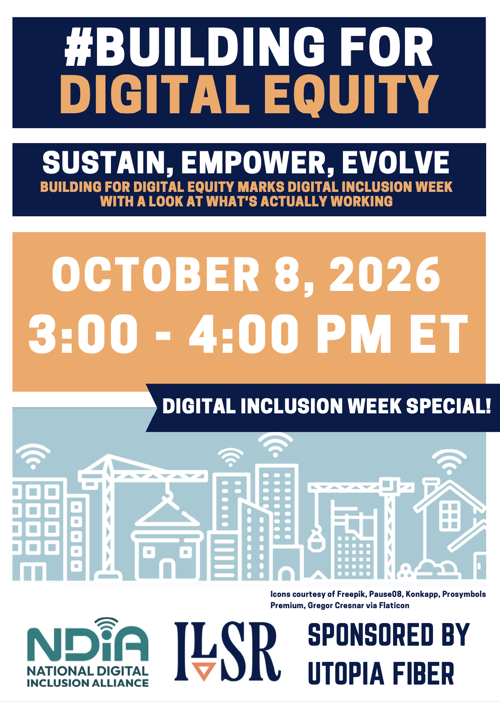
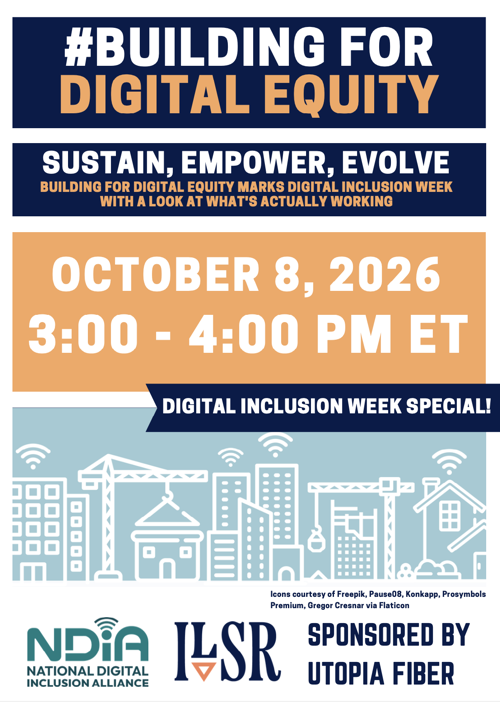
B4DE Reprise: Following the Money on Digital Equity and AI Data Centers

With tax day as a backdrop, the Institute for Local Self-Reliance (ILSR) Community Broadband Networks Initiative and the National Digital Inclusion Alliance (NDIA) convened its quarterly Building for Digital Equity (B4DE) livestream yesterday that shined a light on how public dollars and tax policy intersect with digital equity.

The event – an ongoing series sponsored by UTOPIA Fiber – brought together community organizers, policy experts, and local government leaders on the frontlines of working to expand opportunities for those being left in the digital dust.

What set yesterday's B4DE apart was its featured focus on how the emergence of AI hyperscale data centers are impacting communities and how communities can fight for a better deal.

The Data Center Boom — and Its Costs

MediaJustice Senior Campaign Lead Brandon Forester and Jordana Barton-García, Connect Humanity Director of the Texas Rio Grande Valley Broadband Coalition, heated up the afternoon’s fireside chat with an unflinching look at the rapid expansion of AI infrastructure.

Forester was direct about what's really driving the surge: “The only idea they have left is scale” and warned that data center developers often arrive in communities – particularly in the South –  promising economic benefits that rarely deliver. “They just need your space, they need your resources, and they need you just to let them do what they want to do,” he said.

Forester pushed back on the idea that data centers generate meaningful local tax revenue, noting how in Prince George's County, Maryland, where he lives, the projected annual return from a single data center amounts to roughly $6 million after state tax breaks, which are a fraction of what communities are led to expect.

Barton-García emphasized how communities have more power than they realize – but only if they act early. Her core message: get to the negotiating table before the deal is done.

Court Asked to Pause Digital Equity Act-Related Lawsuit, Pending Key Court Decision

*The following story by Broadband Breakfast Reporter Kelcie Lee was originally published here.

The lawsuit over the Trump administration’s suspension of grants from the $2.75 billion program to close the digital divide may come to a pause. 

The National Digital Inclusion Alliance (NDIA) filed a motion Wednesday to put its lawsuit suing President Donald Trump on hold, because there is a similar case further along that would control the outcome. 

NDIA was a key player in the Digital Equity Act (DEA), having been one of 65 recommended awardees that were blindsided after having spent two years building plans approved by the federal government. 

The DEA was a Biden-era program from the bipartisan Infrastructure Investment and Jobs Act of 2021 (IIJA) that worked to ensure Americans could access, afford and fully participate in the increasingly digital society. 

In May 2025, Trump halted $1.25 billion in DEA competitive grants, explaining that the act was unconstitutional, racist and illegal.

On Tax Day, Advocates Spotlight How Local Tax Dollars Can Close the Digital Divide and Hold AI Data Centers Accountable

As Americans file their taxes this Tax Day, digital equity leaders across the nation will gather for a timely exploration of how public dollars are being used to strengthen communities – and how local advocates can negotiate better deals as AI data centers rapidly expand, lured with tax breaks.

Co-hosted by the Institute for Local Self-Reliance Community Broadband Networks Initiative and the National Digital Inclusion Alliance (NDIA), the next Building for Digital Equity (B4DE) livestream promises to offer insights from frontline forces working to ensure broadband and technology investments serve public needs rather than distant corporate interests.

With the series sponsored by UTOPIA Fiber, the upcoming B4DE livestream – “Local Dollars, Local Solutions: Digital Equity Tax Money & How to Negotiate Better AI Data Center Deals” – is slated for April 15 at 3 p.m. ET and will bring together national policy experts, local leaders, and community advocates working in the trenches of digital inclusion.

Registration is now open here.

“Tax day should serve as a reminder that public money should work for the public,” organizers said. 

“Communities are asking how to use their tax dollars to expand access to the Internet, digital skills, and devices – and how to effectively negotiate, or in some cases, stop data center developers from harming or extracting wealth from cities and towns without public benefit.”

The agenda for the free event will include a brief framing conversation before kicking things off with a creative segment highlighting the power of artistic collaboration and community storytelling, underscoring how digital access supports cultural expression and civic life.