
muni

Content tagged with "muni"

Displaying 751 - 760 of 977

Lafayette Republicans and Democrats Joined Forces for Fiber

Earlier this year, we published a case study that examined the LUS Fiber network and its origins. In it, we noted that both Republicans and Democrats backed the plan but here we focus on their resolutions in support. Back in early 2005, Lafayette was preparing for a referendum on whether the city owned utility should issue bonds to build a FTTH network. Though Cox cable and BellSouth (now AT&T) were running a fierce campaign to scare voters, both Republican and Democrat parties in the community came together to support the community owned network -- both found ways of incorporating this important investment into their political philosophies. In February, the Democrats were the first to pass a resolution supporting the city's fiber optic plan [pdf]. Recall that Joey Durel (the mayor then and now) is an ardent Republican.
We, the members of the Lafayette Democratic Parish Executive Committee, believe the project will enhance businesses, enrich our lives, and prepare our children for the future. With proper planning, future generations will see profits generated by this project stay in this community and improve businesses and lives for generations to come. Improving local communities has been the traditional purpose of the Democratic Party. With that in mind, we commend City-Parish President Joey Durel for his bold initiative to make this plan a success.
A few weeks later, the Lafayette Republican Party endorsed the network [pdf] as well: Lafayette Republican Party seal
...

Wilson's Greenlight Leads North Carolina in Fast Internet

Image
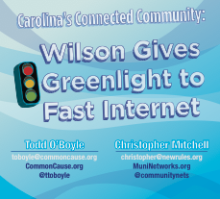
Following the collapse of key industries, a town of 50,000 in eastern North Carolina had to make a hard choice. It wanted to support existing businesses and attract new ones but the cable and telephone companies were not interested in upgrading their networks for cutting edge capacity. So Wilson decided to build its own fiber optic network, now one of the fastest in the nation, earning praise from local businesses that have a new edge over competitors in the digital economy. In response, Time Warner Cable lowered its prices and modestly boosted available Internet speeds, contributing to the $1 million saved by the community each year. Download Carolina's Connected Community: Wilson Gives Greenlight to Fast Internet here. The Institute for Local Self-Reliance and Common Cause have just released a case study of how and why Wilson built Greenlight, a citywide next-generation fiber-to-the-home network that set the standard for connectivity in North Carolina. The report is authored by Todd O'Boyle of Common Cause and Christopher Mitchell of the Institute for Local Self-Reliance. The network, owned and operated by the municipal utility, offer telephone, television, and Internet services to every resident or business in the city. Over 6,000 households and businesses have subscribed, a take rate of over 30% and growing. Additionally, the network has connected all of the schools with at least 100 Mbps connections. Downtown has free Wi-Fi and the library has benefited with a higher capacity connection for people looking for jobs and taking computer classes. The Federal Communications Commission ranks North Carolina last in the nation in percentage of households subscribing to at least a "basic broadband" service, largely because Time Warner Cable, CenturyLink, and AT&T have declined to upgrade their networks to modern standards. Only 13% subscribe to a connection that is at least 4 Mbps downstream and 1 Mbps upstream -- the minimum required to take advantage of basic Internet applications according to the FCC. This story was originally posted on the ILSR website. This report is the first of two.

Community Broadband Bits 22 - Jason Grey from Danville, Virginia

While I was in Danville, Virginia, for the Broadband Community Magazine Economic Development Conference, I had a chance to sit down with Jason Grey, nDanville Network Manager. This interview is our 22nd episode of the Community Broadband Bits podcast. Jason and I met five years ago when I first visited Danville to learn about its municipal open access fiber-optic network. Danville is located in southern Virginia and was hit hard by the demise of tobacco and the loss of manufacturing jobs. But the municipal utility loaned itself enough capital to build a fiber network connecting the schools -- by provisioning its own service, they were able to pay back the loan, make contributions to the general fund, and still have enough money left over to expand the network to connect local businesses. The network has been a tremendous success, attracting new employers and helping existing businesses to expand. And the network is just starting to connect residents in a few neighborhoods. Read our stories about nDanville. Read the transcript from this episode here. We want your feedback and suggestions for the show - please e-mail us or leave a comment below. Also, feel free to suggest other guests, topics, or questions you want us to address. This show is 15 minutes long and can be played below on this page or subscribe via iTunes or via the tool of your choice using this feed. Search for us in iTunes and leave a positive comment! Listen to previous episodes here. You can download the Mp3 file directly from here. Find more episodes in our podcast index. Thanks to mojo monkeys for the music, licensed using Creative Commons.

Community Broadband Bits 21 - Benoit Felten on Stokab

For this week's Community Broadband Bits, we venture outside the U.S. to interview Benoit Felten of Diffraction Analysis about the Stokab muni fiber network in Stockholm, Sweden. Stokab appears to be the most successful open access fiber network in the world. Benoit has just published a case study of Stokab and is an expert on broadband networks around the planet. Our discussion covers how Stokab was built and what lessons it has for other cities. Because Stokab was started so long ago, other local governments will find they cannot simply duplicate it -- times have changed. Benoit also writes regularly at Fiberevolution and can be found on twitter @fiberguy. Benoit and I last appeared together in a roundtable discussion about bandwidth caps. Read the transcript from this episode here. We want your feedback and suggestions for the show - please e-mail us or leave a comment below. Also, feel free to suggest other guests, topics, or questions you want us to address. This show is 30 minutes long and can be played below on this page or subscribe via iTunes or via the tool of your choice using this feed. Search for us in iTunes and leave a positive comment! Listen to previous episodes here. You can download the Mp3 file directly from here. Find more episodes in our podcast index. Thanks to Fit and the Conniptions for the music, licensed using Creative Commons.

Indianola Partners for Blazing Connections in Iowa

We have covered developments in the town of Indianola, Iowa, where the community decided to build their own network in 1998. The original purpose for investment was to use the network to enhance public safety and increase efficiency with SCADA applications. In 2005, however, the network began offering telecommunications services to local businesses. As of October, Indianola Municipal Utilities (IMU) began offering fiber-to-the-home to residents as it gradually begins expanding the use of its fiber asset.

You can now hear firsthand about the network, its history, and how the municipal utility navigated the journey to its next-generation open access network. Craig Settles interviewed Todd Kielkopf, General Manager of IMU, in an August Gigabit Nation podcast. The two discuss IMU's evolution since 1998. They also talked about the unique advantages that exist when a community considering network infrastructure investment already has a municipal utility in place.

Kielkopf tells how the driving factor for the fiber installation was to allow easier management and communication between utilities. When a 1990 franchise agreement with MediaCom was about to expire, the city investigated options. Hopes were that that the city could build a fiber network and MediaCom would offer services over that network, but that vision was never embraced by MediaCom.

Iowa law allowed the city to hold a referendum asking residents for permission to provide telecommunications services through the municipal utility's network. The referendum passed and they created a five year financial plan. Financing was with taxable and tax exempt bonds. The electric utility would build and own the network and a new telecommunications utility would license to a private partner that would offer retail services. Now, IMU and Mahaska Communication Group (MCG) have an agreement whereby MCG provides retail services over the network. While the agreement is not exclusive, no other providers currently use the network.

MI-Connection Embraces New Strategies, Increases Speeds for Free

MI-Connection, the North Carolina community-owned network serving Davidson, Cornelius, and Mooresville, is upgrading network speeds and unveiling a new marketing campaign. MI-Connection was formed when a few towns north of Charlotte purchased the old, dilapidated Adelphia cable network out of bankruptcy and began rehabbing it.

According to David Boraks of the DavidsonNews.net:

The company on Dec. 10 will begin selling a new top speed internet service tentatively called “Warp Speed Broadband,” though the name could change. It will offer 60 mbps downloads and 10 mbps uploads. Customers can get it for $80 to $100, depending on whether they bundle it with TV and telephone.

Existing customers also will get faster speeds Dec. 10, at no extra charge (Download speed x upload speed): 8×4 becomes 10×5, 12×4 becomes 15×5, 16×4 becomes 20×5 and 20×4 becomes 30×10.

Notice that this community network offers faster upstream speeds than most privately owned cable networks -- because they recognize the importance of empowering subscribers rather than hoping they will just consumer video and do little else.

The DavidsonNews.net article also covered MI-Connection's last quarter financial audit report. The network has faced chronic financial problems but things continue to improve. From the article:

The financial report for the quarter that ended Sept. 30 showed that the company grew revenues in all three of its businesses – cable TV, telephone and internet. Altogether, revenues were up 6.5 percent from the first quarter a year ago, to $4,114,992. Expenses fell 8.7 percent, in part because of savings on what the company pays its high-speed internet providers.

The company’s earnings from day-to-day operations continued to grow.

Community Broadband and Economic Development Fact Sheet

Community Broadband Networks have a very good track record in creating jobs, and we have just released a fact sheet [pdf] that collects some exciting success stories -- where a publicly owned network attracted new businesses or helped existing businesses to thrive. Though the telecommunications needs of local businesses have swelled dramatically in recent years, the DSL and cable networks have not been able to keep up. Businesses are often stuck between a connection that does not meet their needs and a connection they cannot afford -- but local, publicly owned networks have stepped in to provide the ultra-fast, super reliable services at affordable prices. This fact sheet discusses the jobs that were enabled by public investments in Chanute, Kansas; Chattanooga and Tullahoma, Tennessee; Lafayette, Louisiana; Bristol, Martinsville, and Danville, Virginia; and Springfield, Missouri. This should be a great resource for those educating their community about the importance of having a network that is directly accountable to the community. Hand it out, include it in conference materials, email it to legislators, whatever. We are developing additional fact sheets, but are always interested in what would be most helpful to you, so don't be afraid to tell us.

On the Media Devotes Segment to Municipal Broadband Networks

You may recall that we reported on Johnston's last book, The Fine Print: How big companies use plain english to rob you blind. In this short interview from On the Media called "America's Lagging Internet," Johnston and Gladstone touch on how gigantic corporate interests and their political affiliates try to put a stop to municipal networks.

The two also discuss successes in municipal networks, proposed policy changes, and how we need to recognize that access to broadband is a key to our future economic health. Johnston stresses once again how our refusal to accept the value of broadband infrastructure contributes to our slow networks, our low adoption rates, and the lack of competition.

Worth listening to!

Burlington Telecom Announces a Gig and Computer Repair Services

We have covered happenings at Burlington Telecom, both positive and negative, extensively. We are glad to report some interesting new developments of this Vermont municipal network. BT is rolling out faster connections and using its competitive advantage in customer service to offer some computer repair services. Joel Banner Baird at the Burlington Free Press reported:

Without cash reserves and promotional enticements available to BT’s commercial competitors, the fiber-optic Internet/phone/cable provider will focus on its strength in customer service, said interim General Manager Stephen Barraclough.

As our readers know, BT is in the midst of a pending lawsuit with Citibank, wherein the financial giant says the city still owes it $33.5 million. The network's troubles, including misuse of public funds by the previous Mayor, have hurt its ability to generate income and Burlington's credit rating has suffered.

While fixing PCs certainly won't pay mounting legal fees, it will make life easier for customers. Details include a $25 diagnostic fee and a rate of $45 per hour plus materials. More about the service is available on the PDF of the official anouncement.

A more recent announcement puts Burlington among the few communities with citywide access to a gig. Burlington Telecom is in the midst of upgrades and will be offering 1 Gbps service and 40 Mbps service starting on December 1, 2012. Both options are symmetrical.

40 Mbps - $99.99 per month

1 Gbps - $149.99 per month when committing for one year; or $199.99 per month with a month-to-month arrangement

burlington-gig-sheet.PNG

View a PDF of the official announcement flyer.

Travel Back in Time with Trent Lott

"I think the rural electric associations, the municipalities, and the investor-owned utilities, are all positioned to make a real contribution in this telecommunications area, and I do think it is important that we make sure we have got the right language to accomplish what we wish to accomplish here." - Fmr. Sen. Trent Lott (R-Mississippi)

Former Senate Majority Leader, now affiliated with DC powerhouse lobbying firm Patton Boggs, spoke those words in 1994. At the time, he particiapted in Senate hearings on S. 1822, known as the Communications Act of 1994 (Mr. Lott's comments are at pg. 370). Clearly former Majority Leader Lott had an early grasp on how important community and municipal networks would be to the future of telecommunications. 

As reported from the Sunlight foundation, and covered in numerous publications, Lott has since lobbied on behalf of AT&T and others, spending $150,000 alone in the first quarter of 2010. 

While Mr. Lott now works to influence his former colleagues on behalf of the gigantic telcos, we want to remind him and thank him for previously taking a stand for local authority because these decisions should be made at the local level.