Fast, affordable Internet access for all.
muni
Content tagged with "muni"
Community Leaders Testify Against HB 282, Bill Passes Anyway
Community leaders from several Georgia cities made the trek to Atlanta to oppose HB 282 on Thursday, February 28th. Opposition to this bill to limit investment in Internet networks includes community leaders, high tech companies, and citizens all over the state. Nevertheless, legislators on the House Energy, Utilities, and Telecom Committee chose to ignore the needs of communities, prefering to tell them from afar how to run their towns. Winners? Incumbents Windstream, AT&T, CenturyLink, and Comcast.
A substitute bill [PDF] was introduced that exempts communities with municipal electric utilities from the prohibition to provide telecommunications. Additionally, the bill's definition of "broadband service" is now defined as service equal to or greater than 3.0 Mbps. "in the faster direction." While these look like compromises at first blush, they do very little to change the real world application of the bill.
Our earlier analysis of the bill addressed the fact that the expense and time required to prove locations of unserved areas as defined by the bill, would foreclose the possibility of communities making investments in this essential infrastructure. Likewise, communities that already have networks would be similarly burdened.
Publicly Owned LUS Fiber Network Attracts Another Business to Lafayette
We recently learned that Tapes Again, a company that specializes in media reproduction and packaging, is moving to Lafayette, Louisiana, from Boulder, Colorado. The company is leaving its 20 year home to take advantage of LUSFiber's incredible network. According to a Business Brief from TheAdvertiser.com:
Tapes Again, a company started in Boulder, Colo., more than 20 years ago is moving to Lafayette next month. The decision to move is attributed to the bandwidth capacity available in Lafayette through LUS Fiber, according to a news release.
The company's clients include musicians and others that have a need for media reproduction and packaging. Much of the company's interactions are through the internet, so the time that it takes to upload and download large files has a direct impact on daily production schedules.
While the presence of a high-speed network is often citied as one contributing factor enitcing businesses to move, less often do we see connectivity as the sole reason. Tapes Again is also changing its name to Lafayette Media Services.
Special thanks to the Lafayette Pro Fiber Blog for sharing this story.
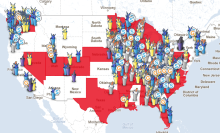
New Community Owned Network Map
We have updated and expanded our interactive Community Owned Network Map [Non-interactive screen shot above]. The map continues to track the FTTH, cable networks, and partial fiber networks owned by local governments in the U.S. Now it also tracks dark fiber networks, publicly owned stimulus funded networks, and which networks are already advertising and/or delivering gigabit services. We are presently tracking networks in 342 communities, including:
- 89 communities with a publicly owned FTTH network reaching most or all of the community.
- 74 communities with a publicly owned cable network reaching most or all of the community.
- 179 communities with some publicly owned fiber service available to parts of the community.
- 35 communities in 10 states with a publicly owned network offering at least 1 Gigabit services.
LaGrange Muni Network Serves Business and Government in Georgia
As the Georgia legislature considers HB 282, a bill that will restrict local governments from investing in telecommunications networks, we are continuing coverage of the communities that will be harmed by passage of the legislation.
Should the restrictions become law, existing networks will not be able to expand. No expansion means fewer opportunities to reap the benefits that flow naturally from community networks. While this means few residents will receive access in places like Thomasville and Moultrie, it also means fewer businesses will receive access in places where networks exclusively serve commercial customers and government offices.
LaGrange's IT Director, Alan Slaughenhaupt, told us a little about its municipal network that began in 1996. The community decided to build its own network when no private provider would. The first goal was to get the K-12 schools connected. Bonds funded the network build out and were paid off within five years. At the time, the city partnered with ISN (Later Earthlink) to get the schools connected. LaGrange now partners with Charter Communications to bring connectivity to students.
The LaGrange network now connects hospitals, most city, county, and state government facilities, and provides connectivity for businesses. Alan describes how a T1 connection cost local businesses $2,300 per month in 1996. Now, thanks to competition created by the community owned network, local businesses can pay just $100 for a connection with better capacity. The municipal network serves about 400 commercial customers.

Alan explained that the automaker Kia moved a manufacturing facility near LaGrange in 2009 that used Just-In-Time inventory control. It needed a high-speed connection between the main plant and suppliers that LaGrange could deliver.

Georgia Mayor: "I Hate to Think What Our Community Would Be Like Without Our Network"
Recently on Gigabit Nation, host Craig Settles visited with Mayor Max Beverly from Thomasville, Georgia. As our readers know, the Georgia General Assembly is again considering a bill to limit municipal efforts to bring connectivity to local residents and businesses. That bill is currently scheduled to be heard on Tuesday afternoon, 2/26, but many people have already expressed their anger at it in Facebook comments on the bill page.
HB 282 sets a very low bar for what is considered "served" - 1.5 Mbps - and prohibits municipal networks from serving those areas while also imposing a new heavy cost on investing in unserved areas.
Mayor Beverly discusses how he and other Georgia community leaders are fighting HB 282 through education. Speaking from first-hand experience, he finds that elected officials often turn from support to opposition when they hear about the incredible success of Thomasville.
Mayor Beverly finds himself sharing the story of Thomasville's victories that are all tied with the network, created in 1999. In Thomasville:
Chattanooga's Network On Knoxville News
We recently came across a news report from Knoxville's WBIR.
The video touches on how the city has gone from a town that used to rely on the choo-choo to a metropolitan wonder that flies over fiber optic cables. Walter Cronkite called Chattanooga the "dirtiest city in America" but the network is transforming it into a technology capitol. Reporter Eleanor Beck focuses on the network's many customers and how they use their connections. Among those customers are an increasing number of businesses who seek the 1 gig service.
Beck spoke with Jack Studer, one of the founders of Lamp Post Group, a downtown incubator. Studer raved about the 1 gig network as a selling point to new businesses. Chattanooga's investment continues to fuel economic development and bring fresh entrepreneurs to town.
The story is a little under four minutes.
FCC Chairman Issues Statement Opposing State Muni Broadband Limitations
As we’ve recognized in law and policy for many years, public-private partnerships are also essential for driving broadband deployment. Public-private partnerships like the Connect America Fund, which drives universal broadband deployment, and municipal and public -private projects like those in Chattanooga, Tennessee and San Leandro, California are also vital components of our national broadband strategy. Our Gigabit City Challenge and the important work of Gig.U to drive ultra -fast broadband centers for innovation can also benefit from innovative local approaches to broadband infrastructure. That’s why the National Broadband Plan stated that, when private investment isn’t a feasible option for broadband deployment, local governments ‘have the right to move forward and build networks that serve their constituents as they deem appropriate.’ If a community can’t gain access to broadband services that meet its needs, then it should be able to serve its own residents directly. Proposals that would tie the hands of innovative communities that want to build their own high-speed networks will slow progress to our nation’s broadband goals and will hurt economic development and job creation in those areas. I urge state and local leaders to focus instead on proposals that incentivize investment in broadband infrastructure, remove barriers to broadband build-out, and ensure widespread access to high-speed networks.”This is a welome development as the FCC has long opposed such barriers (thank you Commissioner Clyburn as well for long speaking out on this issue) but the Chairman himself has not been as direct as this. The Chairman regularly uses Chattanooga as an example of a tremendously successful network and again noted that community in this statement.
Billy Ray, Community Broadband Pioneer, Joins us For Community Broadband Bits #33
Cedar Falls Utility Increases Speeds For Free
Customers of Cedar Falls Utilities (CFU), in Iowa, have recently been treated to an increase in fiber Internet service speeds with no increase in price.
We have reported on CFU for several years with news on its upgrades and expansions to unserved areas. The most popular CFU home service, 12/1 Mbps, is now at 16/8 Mbps. That service is available for a reasonable $43.50 in the city and $48.50 in rural areas. Residential plans range from $29.95/$34.95 (city/rural) for 2/1 Mbps for FiberHome Basic to $137.50/$142.50 (city/rural) for the 120/60 Mbps FiberHome Extreme.
According to the CFU blog:
We’re able to make this upgrade now because we are in the final neighborhoods connecting customers to our new all-fiber cable and internet system. The all-fiber system allows us to deliver faster connection speeds and better reliability. Upgrading speeds now is also good timing because we just activated a new high speed upstream internet link. This high speed link gives us the capacity needed at a very affordable cost, and also provides geographic and provider redundancy. With this in place no single fiber cut, hardware failure or weather event will impact our ability to deliver our normal peak internet usage.
Note that while Cedar Falls has decided not to offer fully symmetric services (same upload as download speed), the ratio is 2:1 rather than the 6:1, 10:1, or even bigger gap that we often see from the national providers. CFU recognizes the benefits of faster upstream connections that allow subscribers to be more productive by being better able to share their creations with the world.