mapping

Content tagged with "mapping"

Related Topics

Old /tags-176

Displaying 71 - 80 of 155

Monopoly Providers Mire NTIA Broadband Grant Process With Costly, Empty Challenges

Over 230 communities have applied for National Telecommunications and Information Administration (NTIA) Broadband Infrastructure Program grants. But community leaders increasingly say they’re facing costly, unnecessary challenges from incumbent broadband providers, who are exploiting unreliable U.S. broadband maps to overstate existing coverage and defend the status quo.

The NTIA’s $288 million grant program - and the looming $42 billion broadband infrastructure investment plan - will help bring affordable broadband to the roughly 20-30 million Americans without broadband, and the 83 million Americans currently living under a broadband monopoly.

In Grafton County, New Hampshire, 39 municipalities are part of a growing list of communities exploring home-grown broadband alternatives. They represent a grassroots movement driven by frustration with market failure that accelerated during the Covid-19 crisis. In response they’ve bonded together to apply for a $26.2 million NTIA grant to improve the region’s substandard broadband.

A Little Something Called Competition

Grafton hopes to use the NTIA funding to provide a middle mile fiber network, making it easier for Internet Service Providers (ISPs) to service each municipality and the county’s 90,000 residents. The network will be open access, inviting numerous ISPs to compete over the same shared infrastructure. Studies have repeatedly shown such open access models result in better, cheaper, faster service

USDA ReConnect Round 3 Rewards High-Speed, Open Access, Locally Driven Networks

The USDA’s ReConnect program has disbursed more than $1.5 billion since its inception in December 2018. On the whole, the USDA seems to have done a better job than the FCC of leading to new broadband infrastructure which is fast, affordable, and locally controlled. Much of the money it has given out has gone to community-driven solutions, with Tribes, electric and telephone cooperatives, and local governments applying for and winning awards. The program has also seen partnerships between counties and other public as well as private entities. 

But there’s a lot to like about the newest round of funding, totaling $1.2 billion more (representing a full 80 percent of all money given out so far). The application process for Round 3 began at the end of November, with applications due by February 22, 2022.

Announced at the end of October, the new scoring metric represents a significant step in the right direction, increasing speed definitions on both sides of the application. But there are other things to like here as well. 

Watch Shreveport, Louisiana CTO Keith Hansen Describe Mapping Broadband Access With Garbage Trucks

If you missed the most recent episode of the Connect This! Show, Keith Hansen described the moment he realized he could map the city's digital divide by putting low-power computers attached to GPS chips on the city's garbage trucks. It's a fascinating discussion, and exactly the kind of innovation you get to hear about live when you subscribe to the Connect This! show using this feed.

Watch the short clip below, or the full episode here, and don't forget to tune in tonight at 5p ET for the next episode on digital redlining and microtrenching.

Community Broadband Legislation Roundup – June 7, 2021

Snapshot

Michigan broadband package repeals law prohibiting state grants from going to government entities

Montana Legislature duplicates federal limitations against schools and library self-constructing networks

U.S. House Republicans bill would give USDA authority over rural broadband, in place of FCC 

The State Scene 

Michigan

Michigan Gov. Gretchen Whitmer issued an executive directive on Wednesday establishing the Michigan High-Speed Internet (MIHI) Office, a new state office tasked with developing a strategy to make high-speed Internet more accessible to Michiganders. 

Gov. Whitmer has argued that more than $2.5 billion in potential economic benefit is left unrealized each year due to a lack of Internet access across the state. MIHI will be housed inside the state’s Department of Labor and Economic Opportunity (LEO). Speaking of the new office, LEO Acting Director Susan Corbin said, “We need to make major investments to support digital inclusion and this office will be focused on leveraging every dollar available through the American Recovery Plan and other federal programs,” reports WILX.

Michigan lawmakers are moving to answer Corbin’s call and recently proposed a $400 million one-time allocation of incoming federal relief funds to the newly created MIHI to work toward expanding access to broadband. With the funds, LEO would be tasked with maintaining a statewide broadband grant program, the Connecting Michigan Communities Broadband Grant. 

Minnesota Cities Partner with Local Telephone Cooperative to Build Fiber for Economic Development

Last week we wrote about the partnership between Long Prairie, Minnesota and the  forward-thinking and locally minded local telephone cooperative CTC to build a citywide fiber network and bring affordable, high-speed Internet to everyone in town.

Long Prairie isn’t alone, however, among north-central Minnesota communities needing better options, and for at least two others CTC has become a natural partner. This is both because of its location - offering service across the region in Sullivan Lake, Randall, Pillager, Outing, Nokay Lake, Nisswa, Motley, Mission, Lincoln, Leader, Freedhem, Ely, Brainerd, Baxter, and Crosby -  and because it has become one of the most aggressive fiber builders in the state.

Two other cities, specifically, Ely and Little Falls, have also partnered with CTC to bring fiber loops to their business districts. Both communities have faced challenges when it came to building and connecting their residents and businesses to a fiber network.

Dealt a Poor Hand, Ely Forged Ahead

The City of Ely sits on the Southern side of Shagawa Lake with a population of 3,500. While iron used to be what drove the economy, today Ely is a tourist destination and is known as the entry point for the Boundary Waters

Community Broadband Legislation Roundup - May 11, 2021

Snapshot

Florida Legislature rewrites utility pole bill to include language backed by municipal electric utilities

North Carolina’s County Broadband Authority Act includes clause drawing criticism from electric co-ops

Oklahoma Governor signs mapping bill, vetoes measure adding Tribal representation to state broadband council

The State Scene

Florida

A Florida bill, which included provisions that would have forced Florida’s municipal electric utilities and their ratepayers to pay private Internet Service Providers’ utility pole make-ready costs, was significantly revised before passing the State House by a unanimous vote of 115-0 on April 28.

H.B. 1239, which no longer includes the make-ready costs provisions, initially read like a regulatory wishlist for incumbent cable monopolies until it was redrafted to become a legislative package aimed at improving broadband deployment across the state. The revised bill now heads to the State Gov. Ron DeSantis for approval.

The final version of the bill establishes additional duties for Florida’s Office of Broadband, creates a state broadband grant program, and requires the Office to conduct mapping of unserved and underserved areas of the state -- a significant deviation from the version that was first introduced in February.

How Long Prairie, Minnesota and a Local Cooperative Partnered to Build a Citywide Fiber Network

Tired of waiting for connectivity solutions to come to town, one Minnesota community has instead partnered with a local telephone cooperative to build a fiber network reaching every home and business in the city.

In embarking on its journey to improve local Internet access six years ago, Long Prairie (pop. 3,300) ended up partnering with one of the most aggressive fiber network builders in the state - Consolidated Telephone Company (CTC) - on a solution that meets local needs. The two finished a ubiquitous Fiber-to-the-Home build in 2018, with CTC now owning and operating the network. 

Looking for Solutions

The City of Long Prairie (pop. 3,300), the county seat in Todd County, Minnesota, has long struggled with connectivity. It has manifested in issues with connecting students from their homes, with losing parts of the local workforce, and in a lack of access to support larger healthcare institutions for their aging population. 

In 2014, the city met with state officials as well as broadband providers to discuss the results of a feasibility study that was done back in 2011. Todd County stressed that this was a pressing issue that couldn’t wait anymore - they needed state support with funding and potentially help setting up a partnership with a local co-op. But this kind of partnership couldn’t just be with any co-op, it had to be a mutually beneficial partnership that could connect all of Long Prairie’s businesses and residents. It would take 2 more years before the community entered into an agreement with the right one.  

CTC started in the 1950s as a telephone cooperative, and began offering Internet access via DSL service in the late 1990s and early 2000s. Around 2008, CTC’s Board of Directors decided that the best long-term strategy for providing strong, reliable connectivity would be to build out Fiber-to-the-Premise (FTTP) for all of its members. 

Building on that initial network, the main vision and mission driving the co-op over the last 10 years has been getting as many people in the area fast and reliable connectivity as possible. But because CTC is just one firm, that has meant developing relationships with other towns, cities, and counties that bloom into successful partnerships. 

Community Broadband Legislation Roundup – April 27, 2021

Snapshot

Washington Governor pledges to sign Public Broadband Act

Maine hearing will reveal State Legislature’s willingness to introduce competition to incumbent ISPs

California bill amended to remove bond initiative backing public infrastructure projects of local communities 

The State Scene

Washington

Two pieces of legislation aimed at expanding public broadband authority, H.B. 1336 and S.B. 5383, have been delivered to Washington Gov. Jay Islee to consider signing into law. Rep. Drew Hansen, the primary sponsor of H.B. 1336 recently told GeekWire that he “expects the governor to sign both.”

H.B. 1336 would give Washington’s cities, towns, counties, district ports and Public Utility Districts (PUDs) unrestricted authority to provide Internet services directly to end-users, while S.B. 5383, as a result of a series of amendments, deals largely with what information PUDs and ports have to provide to the state broadband office before offering service in unserved regions. 

There will be a meeting between the governor and the sponsors of the two bills on Thursday, which will likely determine their fate. Although arguments about how the two bills will interplay are continuing throughout the halls of the State Legislature in Olympia, the prevailing legal interpretation is that the finalized versions of the bills do not conflict. If both bills are signed, and discrepancies are later discovered to be an issue, it will prompt the State Legislature to convene in the future to standardize differences between the legislation. 

In Our View: FCC Making Improvements to Data Collection But Not There Yet

Welcome to In Our View, a new series here at MuniNetworks. From time to time, we'll use this space to explore new ideas and share our thoughts on recent events playing out across the digital landscape, as well as take the opportunity to draw attention to important but neglected broadband-related issues.

Special thank you to ILSR Data and Visualization Researcher Michelle Andrews for noticing the Michigan discrepancy, and for her contributions to this piece.

Earlier this month, the Federal Communication Commission (FCC) released updated Form 477 data, the primary source of information used for the FCC’s broadband coverage maps and the basis upon which federal agencies and states make major funding decisions.

With new interim leadership from FCC Chair Jessica Rosenworcel – who has been well-aware of the FCC’s dubious track record of publishing imprecise, insufficient, and often inaccurate broadband coverage data – you will be disappointed if you were expecting any improvements in the newest data set. 

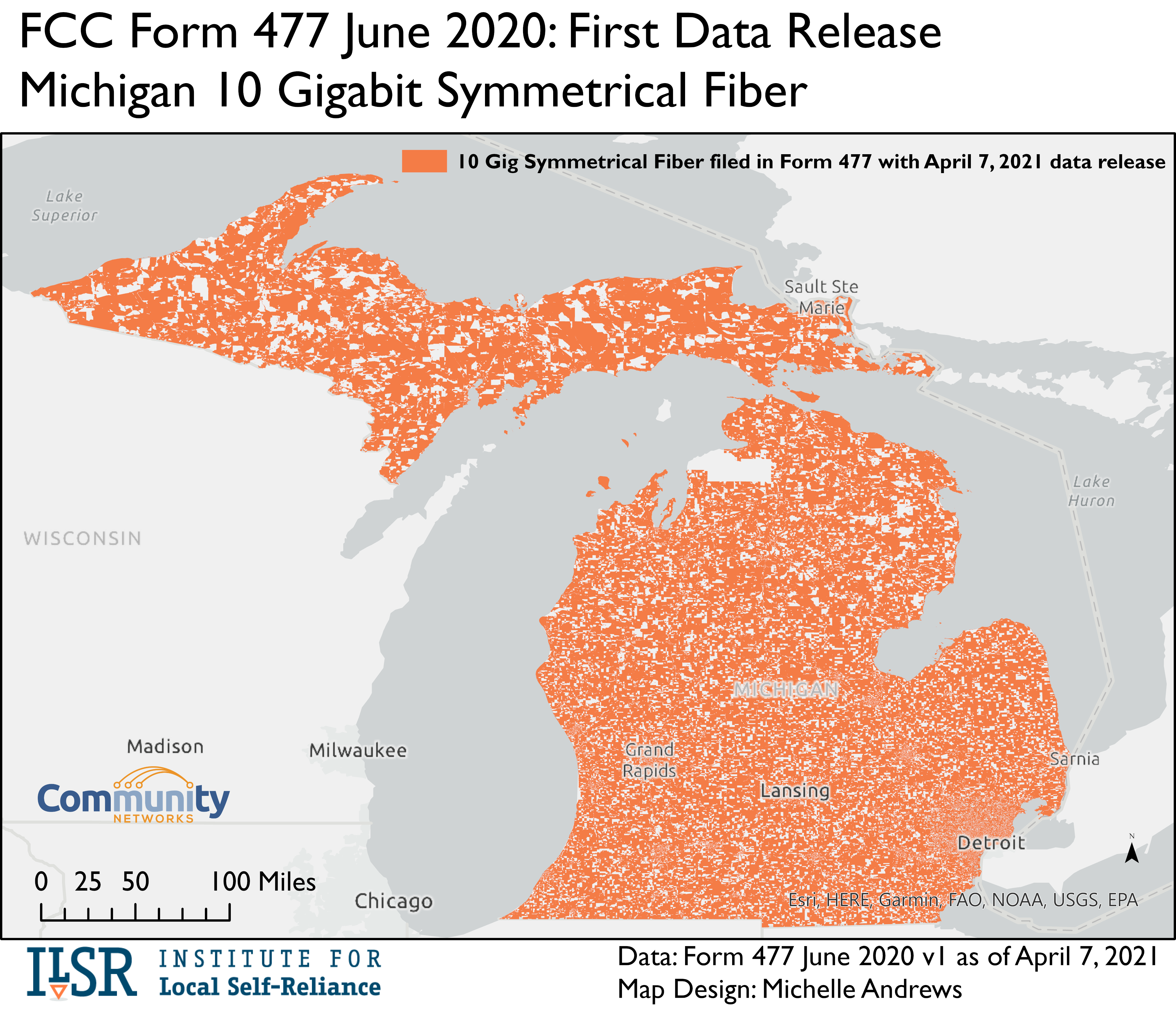
Filers had until March 26, 2021 to make revisions to data that was submitted by September 1, 2020 for service they provided as of June 30, 2020. When the updated data was first released on April 7, it indicated that nearly the entire state of Michigan had access to 10 Gbps (Gigabit per second) broadband, thanks to Form 477 data provided by Strategic Alliance CDC (see map below, or a high-resolution version here).

Historical Error Repeats Itself

AAIA Sets Positive Standards by Requiring Local Approval of Federally Funded Projects

With all the buzz around the prioritization of municipal and cooperative broadband networks in the American Jobs Plan unveiled by President Biden last week, let’s not forget about one leading voice in Congress calling for broadband for all. 

Last year, with assistance from the House Rural Broadband Task Force he created, Rep. James Clyburn, D-SC, introduced the Affordable, Accessible Internet for All (AAIA) Act, a bold bill that proposed a $100 billion investment to build high-speed Internet infrastructure in unserved and underserved parts of the country. 

Although the legislation stalled in the Mitch McConnell-led U.S. Senate prior to the 2020 election, it did set the Democratic agenda on broadband moving forward. Now, as the Biden Administration has settled into the White House and with Democrats in control of Congress, Clyburn has reintroduced a slightly slimmed down $94 billion AAIA, alongside companion legislation in the U.S. Senate sponsored by Sen. Amy Klobuchar, D-MN.

If it passes, the bill would be a game changer, as it goes beyond funding high-speed Internet infrastructure to attack the digital divide from essentially every angle. The bill includes funding and dedicated support to address barriers that prevent millions of Americans from having access to affordable, high-speed Internet connectivity. It backs measures that would encourage pricing transparency, promote Internet adoption and digital literacy initiatives, guarantee affordability, and protect the rights of workers who would build the networks. 

While all of these measures are critical, one of the most important requirements included in the revamped legislation is for input from local, state and Tribal governments to be taken into account when determining what projects AAIA will fund.