
competition

Content tagged with "competition"

Related Topics
Displaying 671 - 680 of 712

To communities that seize broadband initiative, benefits flow fast

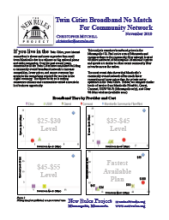
On November 29, 2010, MPR published our commentary about community broadband. The Twin Cities has slower and more expensive broadband Internet than the nearby town of Monticello. The Twin Cities metro area has a population of 2.8 million and the highest density of people and businesses in the state. So why is our broadband Internet slower and more expensive than that enjoyed by Monticello, population 12,000? Several years ago, the city of Monticello (45 miles northwest of Minneapolis) recognized the increasing importance of reliable, high speed, low cost broadband. After the incumbent telephone and cable companies declined to build the network city leaders had in mind, the community decided to build one itself. Now, FiberNet Monticello offers some of the best broadband packages available in the country, while the Twin Cities is lagging. A new analysis by the Institute for Local Self-Reliance compares the available broadband speeds in Monticello to those available in the Twin Cities metro. In the metro, as in most of the United States, broadband subscribers choose between DSL from the incumbent telephone company (Qwest) and cable broadband from the incumbent cable company (Comcast). Monticello's offerings are faster at every price point, but Comcast appears to offer comparable downstream speeds in the highest tier of service. This apparent equivalence, however, is like comparing dirt roads with interstates. Both are roads that allow you to travel from point A to B, but they have fundamentally different characteristics in carrying capacity and reliability. For a variety of reasons, DSL and cable almost always fall short (and often, well short) of the advertised "up to" speeds, whereas full fiber networks regularly achieve the speeds they promise. In the metro, cable offers most residents the fastest option for broadband, but only one choice of provider. The Monticello network not only created a new choice for its residents, it induced the incumbent telephone company to greatly upgrade its network to remain competitive. Now, Monticello residents can choose between two extremely fast broadband providers, as well as a cable internet connection. The community-owned network may have only been the third broadband option, but it fundamentally changed the market.
Verizon Calls for More Industry Consolidation

Remember our post that privately owned broadband networks tend toward consolidation? A Wall Street Journal article notes that Verizon CEO Seidenbuerg agrees:
Mr. Seidenberg also had some words for his smaller competitors like Sprint Nextel Corp. and T-Mobile USA, which claim to have their own 4G networks up and running already. He thinks the companies, along with other smaller wireless operators, should join forces. "There are too many players in the industry," he said. "I think it would be healthy if there's more consolidation."
So while most of want more competition (which is to say, actual competition rather than essentially the same limited choices from a few providers), they are working to eliminate the few choices we have. The same story also peeks into the super fast world of the 4G networks that some would have us believe will obviate the need for a faster, more reliable FTTH connection:
Mr. Shammo said Verizon's 4G network, which is based on technology called Long-Term Evolution, can deliver between 1 and 12 megabits per second of data, allowing for tiered pricing structure similar to home wired Internet service.
Call me crazy, but 4G seems like a step backward for most of us who care about fast broadband.

Salisbury's Fibrant Launches, TWC Responds With DOCSIS 3

In North Carolina, Salisbury has launched the state's second FTTH network, as communities continue to build the next-generation broadband infrastructure in which their massive incumbent providers decline to invest. We have offered in-depth coverage of Fibrant as they prepared to launch the new services. As of Tuesday, Nov 2, the network softly launched, which is to say they will slowly ramp up the number of paying customers as they gain experience and confidence. Stop the Cap! also covered the launch with extensive coverage as well as both praise and criticism for Fibrant's approach.

Some of the 115 early, free testers of Fibrant became the first paying customers Monday, with the utility scheduling installations for 200 other residents on a waiting list.

A local group has posted a number of videos about Fibrant, including a recent one that compares Fibrant's speeds to the pathetic offering of Time Warner Cable (see bottom of this post). In a totally unrelated development (or so Time Warner Cable would have us believe), TWC has rapidly increased its broadband tiers in the region. In this, TWC has joined Comcast in downplaying the role competition has in forcing incumbent investment. If you believe TWC, competition plays no role in their investment decisions, a fascinating approach to succeeding in an area they constantly claim is a very competitive market.

Comcast Customers Call for Competition

Two cities, located on opposite coasts, have recently cried out for cable competition in their communities. A few weeks ago, SunBreak ran a story under "Why Comcast Needs Competition...Badly." The post describes a significant outage in Seattle and Comcast's slow response to fix the problem.
You may think to yourself, Hey, come on, it's 90 minutes out of your day. But what I think about is how much time cumulatively was wasted in Seattle this morning, much of it simply because people would not have been sure where the problem was. An early, all-hands-on-deck announcement from Comcast would have been a big help. It seems slightly insane that a company that provides internet service isn't very good at using the internet.
The folks at Sunbreak apparently were not aware that the City is still slowly considering building a network to ensure everyone in the community has affordable high speed broadband access (which would likely be far more reliable than Comcast's network). After I noted this in the comments, they reprinted one of my posts about Seattle's deliberations. Meanwhile, the folks in Scranton, Pennsylvania, (immortalized in the television show The Office) have been asking when they get the faster broadband now available in Philly, Pittsburgh, and parts of the Lehigh Valley. The answer came bluntly from Stop the Cap: Sorry Scranton, You’re Stuck With Comcast Cable… Indefinitely An article from the Times Tribune explains why the private sector fails to provide competition:
"Offering out television service is expensive, too expensive for most smaller telephone companies," said telecom industry analyst Jeff Kagan. "So many are reselling satellite service to keep customers who want one bundle and one bill." Because of that, satellite television providers, who were never a formidable challenge to conventional cable companies, gained market share, Mr.

Wilson's Greenlight Ahead of Schedule, Deals with TWC Predatory Pricing

Wilson's Greenlight community fiber network is ahead of schedule. They continue to operate ahead of the business plan, despite a few difficulties that offer lessons to up and coming community networks. We recently covered the fallout from their application to the broadband stimulus program where they had to disclose network information to their competitors. Fortunately, that was not the only news last month from North Carolina's first all-fiber citywide network. They also surpassed 5000 subscribers and remain 6-9 months ahead of their business plan in take rate, according to the Wilson Times.
The number of customers is expected to reach 5,300 by the end of the fiscal year if the current trend continues, according to Dathan Shows, assistant city manager for Broadband and Technical Services. The city's current business plan calls for Greenlight to reach 5,000 customers by the end of the third full year of operation, which will be June 2011.
This is not the first time the network has exceeded projections;
the network was built faster than expected and quickly jumped out ahead of take rate expectations. One of the reasons Greenlight may be growing is its attention to local needs, as illustrated by the network finding a way to televise local football matches that otherwise would not have been available. However, the Wilson Times story goes into much greater detail regarding the competition from Time Warner Cable. As we regularly see, Time Warner Cable is engaging in what appears to be predatory pricing to retain customers and starve Greenlight of new subscribers. A lesson to other community networks, Wilson is documenting the deals TWC uses to keep subscribers. All communities should keep these records.
"Time Warner Cable's market tactics include anti-competitive pricing that interferes with Wilson's ability to secure customers through normal marketing," the application [for broadband stimulus] states.

Salisbury's Fibrant Deals with Incumbent B.S. Before Launch

As Salisbury prepares to officially launch its publicly owned FTTH network offering triple-play services, it offers lessons for other communities that want to follow in its footsteps. As we wrote a month ago, Fibrant has candidly admitted it cannot win a price war with incumbents. Companies like Time Warner Cable have a tremendous scale advantage, which allows them to price below cost in Salisbury because the large profits from all the non-competitive markets nearby can subsidize temporary losses. On October 10, the Salisbury Post ran a story "Fibrant can't match cable company specials." Alternative possible titles for the article could have been "Cable Co cuts prices to drive competition from market," or "Time Warner Cable admits customers pay different prices for same services." Interestingly, when Fibrant unveiled its pricing originally, the headline read "Fibrant reveals pricing" rather than "Fibrants offers speeds far faster than incumbents." A lesson for community networks: do not expect the media to cover you fairly. The big companies have public affairs people with relationships with the press and they often buy a lot of local advertising. This is not to say all local media is bought off -- far from it -- but local media will have to be educated about the advantages of community networks. Quick question: When you hear this quote, who do you first think of?
"We always work with customers to meet their needs and budget."
The cable company, right? Well, that is Time Warner Cable's claim in the above Salisbury Post article. Later in the article, a local business owner expressed a different sentiment: "Time Warner has the worst customer service I have ever dealt with." The business owner goes on:
“Fibrant may have these same kind of issues, however I can actually go to the source to deal personally with someone who is vested in the community, not spend two hours on the phone and never solve the problem as I do with TWC,” he said. “Even if pricing is higher, I would make the change.

In Broadband Networks, Private Ownership Leads to Consolidation

In all the talk of the need for competition in broadband (or in the mobile space), there is remarkably little attention paid to the difficulties in actually creating competition. A common refrain from the self-interested industry titans (and their many paid flacks) is: "keep the government out of it and let the market decide." Unfortunately, an unregulated market in telecom tends toward consolidation at best, monopolization at worse. Practicioners of Chicago economics may dispute this, but their theories occur in reality about as frequently as unicorn observations. In our regulatory environment, big incumbents have nearly all the advantages, allowing them to use their advantages of scale to maintain market power (most notably the ability to use cross-subsidization from non-competitive markets to maintain predatory pricing wherever they face even the threat of competition). The de-regulatory approach of telecom policy over the past 10 or more years has resulted in far less competition among ISPs, something Earthlink hopes to change with a condition of the seeming inevitable NBC-Comcast merger. Requiring incumbents to share their lines with independent ISPs is one policy that would greatly increase competition - but the FCC has refused to even entertain the notion because big companies like AT&T and Comcast are too intimidating for the current Administration to confront. In the Midwest, Windstream is cutting 146 jobs as part of its acquisition of Iowa Telecom. When these companies consolidate, they can cut jobs to lower their costs... but do subscribers ever see the savings? Not hardly. The result is less competition, which leads to higher prices. Consider that Comcast is the largest cable company, but they are known better for their poor record of customer service than low prices enabled by economies of scale. We need broadband networks that are structurally accountable to the community, not private shareholders located far outside the community. The solution is not more private companies owning broadband infrastructure, but more private companies offering competing services over next-generation infrastructure that is community owned by coops, non-profits, or local governments.

Private Sector Broadband Providers are Anti-Competition

We previously covered Qwest's admitted attempts to drive out competition in Utah, but the story has continued with the personal story of another subscriber forced to leave his independent service provider for Qwest's services.
I called XMission and they said the speed problem was with Qwest. I called the Utah PSC and got an expert on the line who explained the Telecommunications Act of 1996. He confirmed Qwest being able to choke out other ISPs on substandard speed-limited connections, while Qwest offers much higher speeds than our earlier DSL if Qwest is ISP. We sadly switched, after calling XMission and commiserating with them about this monopolistic practice. The PSC acknowledged this seems anti-competitive, but it’s the law. Who made such a law for Utah!?
As we have said on numerous occasions, without community broadband networks, the future of broadband competition is quite bleak... at least in the U.S. Canada's telecom regulator has shown far more courage than our FCC.

Canada Joins Rest of World With Open Access Requirement

Last year, when the Berkman Study (pdf) by Harvard (commissioned by the FCC) revealed the secret behind impressive broadband gains in nearly every country over the past decade, we hoped the FCC would learn something from it. Maybe it did, and maybe it didn't -- what is clear is that it did not have the courage to embrace pro-competition policies. Canada's telecom regulator, the Canadian Radio-television and Telecommunications Commission (CRTC) has shown more courage in confronting powerful interests that want to monopolize the future of communications. They have decided to require the big telecom carriers share their network with independent ISPs in an open access type arrangement.
Until this decision, the established telecom companies could "throttle" third-party services, by slowing them down or limiting downloads.
In Canada, these huge companies also claim that such regulations will decrease their investment in next-generation networks, likely a hollow threat. Regardless, it is a strong argument for public ownership of essential infrastructure. How many communities should be denied next-generation communications because some massively profitable global company is having a snit with the regulator? Far better for communities to be self-determined, by building their own networks. When networks are run as infrastructure, they are open to independent service providers, just as the roads are open to shipping companies on equal terms. Canada's regulator has made a difficult decision - but as Karl Bode reminds us, let's wait to see if they actually enforce it.