
Fast, affordable Internet access for all.
competition
Local governments are often looking for low-risk options for expanding broadband access to residents and local businesses. There are not many. Seattle put some extra conduit in the ground as a part of a different project that was tearing up the streets but Comcast was the only provider interested.
The problem with a haphazard program of putting conduit in the ground is that while it benefits existing providers, it does very little to help new entrants. And conduit is inherently limited -- only a few providers can benefit from it and when used up, there is no space for more providers.
In short, more conduit may slightly improve the status quo but it does little to get us to a future where residents and local businesses have a variety of choices from service providers offering fast, reliable, and affordable access to the Internet.
Smart conduit policy can lay the groundwork for lowering the cost of a community network, which can get us where we want to be. It may take time, but will create benefits far more rapidly than private providers will be building next-generation networks in most of our communities.
John Brown, a friend from Albuquerque, New Mexico, has offered some tips for communities that want to develop smart conduit policies. Brown runs CityLink Telecommunications, an impressive privately owned, open access, FTTH network that connects residents, businesses, schools, muni buildings, etc.
We tend not to support privately owned networks because for all the great work a companiy like CityLink Fiber does, one does not know who will own it in 5, 10, or 20 years. However, we recognize that CityLink Fiber is a far better partner for communities than the vast majority of companies in this space.
The following comments are taken from an email he shared with me and is permitting me to republish. Direct quotes are indented and the rest is paraphrased.
Not all conduit is created equal. A 2 inch pipe will be sufficient for perhaps 2 providers. If conduit does not have inter-duct, it is much harder for multiple providers to share it. Inter-duct creates channels within the conduit that allows a provider to pull its fiber cables through without disturbing other cables in the conduit.

We Told You So: Subscribers Abandon DSL
We have long been arguing that the telephone and cable companies are not sufficiently investing in the connections needed by communities.
Quarter after quarter, companies offering DSL see decreases in their lines as subscribers jump to cable or fiber-optic alternatives (where available, which is not many places). Recall that AT&T's CEO himself believes DSL to be obsolete.
As this trend continues, most communities will find that a single cable company has a monopoly on high speed broadband access and those willing to settle for slower, less reliable alternatives will have a choice between DSL and wireless options. Susan Crawford has written about this, terming it the Looming Cable Monopoly.
The main reason is that cable is cheaper to upgrade to higher capacity connections than the telephone lines. Unfortunately, due to the reality of natural monopoly, the big cable companies will almost certainly continue to dominate in their communities. It is just too hard and risky for other businesses to challenge their market power.
This is why smart communities are evaluating all their options and determining if a long term public investment in fiber-optic infrastructure would generate enough benefits to justify the high upfront cost.
Media Coverage Roundup: Georgia AT&T Bill to Kill Community Broadband
In the wake of a bill in Georgia to revoke local authority and substitute it with state say-so over whether a community can build a broadband network, multiple outlets have covered the situation.
As usual, Stop the Cap! was quick on the ball, offering original in-depth commentary. Phil digs into the campaign cash history to find the real motivations behind this bill:
Rogers’ legislation is exceptionally friendly to the state’s incumbent phone and cable companies, and they have returned the favor with a sudden interest in financing Rogers’ 2012 re-election bid. In the last quarter alone, Georgia’s largest cable and phone companies have sent some big thank-you checks to the senator’s campaign:Phil also refutes the supposed failures cited by those pushing the bill. Not only do such stories misrepresent what really happened, some actually cite EPB's incredible 1Gbps service as demonstrating that munis are out of touch. What else would you expect from the Heartland Institute, which made its name fighting against the radical claim that cigarettes are linked to cancer? Government Technology's Brian Heaton also covered the story in "Georgia Community Broaband in Legislative Crosshairs."A review of the senator’s earlier campaign contributions showed no interest among large telecommunications companies operating in Georgia. That all changed, however, when the senator announced he was getting into the community broadband over-regulation business.
- Cable Television Association of Georgia ($500)
- Verizon ($500)
- Charter Communications ($500)
- Comcast ($1,000)
- AT&T ($1,500)
In addition, Mitchell [me] said that SB 313’s requirement of the public entity paying the same taxes or the same cost of capital as the private sector is another red herring.
New Year, Same Lame Cable and DSL Monopolies
It's a new year, but most of us are still stuck with the same old DSL and cable monopolies. Though many communities have built their own networks to create competition and numerous other benefits, nearly half of the 50 states have enacted legislation to make it harder for communities to build their own networks.
Fortunately, this practice has increasingly come under scrutiny. Unfortunately, we expect to see massive cable and telephone corporations use their unrivaled lobbying power to pass more laws in 2012 like the North Carolina law pushed by Time Warner Cable to essentially stop new community broadband networks.
The FCC's National Broadband Plan calls for all local governments to be free of state barriers (created by big cable and phone companies trying to limit competition). Recommendation 8.19: Congress should make clear that Tribal, state, regional and local governments can build broadband networks.
But modern day railroad barons like Time Warner Cable, AT&T, etc., have a stranglehold on a Congress that depends on their campaign contributions and a national capital built on the lobbying largesse of dominant industries that want to throttle any threats to their businesses. (Hat tip to the Rootstrikers that are trying to fix that mess.)
We occasionally put together a list of notable achievements of these few companies that dominate access to the Internet across the United States. The last one is available here.
As you read this, remember that the FCC's National Broadband Plan largely places the future of Internet access in the hands of these corporations.


As you read this, remember that the FCC's National Broadband Plan largely places the future of Internet access in the hands of these corporations.The Internet is More Important than Broadband
I encourage readers to visit Doc Searls post "Broadband vs. Internet" for a discussion about things that matter regarding the future of Internet access for most Americans.
The Internet is no more capable than the infrastructures that carry it. Here in the U.S. most of the infrastructures that carry the Internet to our homes are owned by telephone and cable companies. Those companies are not only in a position to limit use of the Internet for purposes other than those they favor, but to reduce the Net itself to something less, called “broadband.” In fact, they’ve been working hard on both.There is a difference between the Internet and "broadband." Broadband is a connection that is always on and tends to be somewhat faster than the dial-up speeds of 56kbps. Broadband could connect you to anything... could be the Internet or to an AOL like service where some company decides what you can see, who you can talk to, and the rules for doing anything. The Internet is something different. It is anarchic, in the textbook definitional sense of being leaderless. It is a commons. As Doc says,
The Internet’s protocols are NEA:Because no one owns it, few promote it or defend. Sure, major companies promote their connections to it (and when you connect to it, you are part of it) but they are promoting the broadband connection. And the biggest ones (Comcast, AT&T, Verizon, Time Warner Cable, etc) will do anything to increase the profits they make by being one of the few means of connecting to the Internet -- including charging much more and limiting what people can do over their connection, etc. This is one reason the connections from major corporations are so heavily tilted toward download speeds -- they want consumers to consume content. Just about every community network built in the last 3-4 years offers symmetrical connections by contrast.
- Nobody owns them.*
- Everybody can use them, and
- Anybody can improve them.
Last I heard, the fastest cable offering in the upstream direction was 12Mbps. Cox, our cable provider in Santa Barbara, gives us about 25Mbps down, but only 4Mbps up. Last time I talked to them (in June 2009), their plan was to deliver up to 100Mbps down eventually, but still only about 5Mbps up.
Susan Crawford Identifies Problems/Solutions with Broadband in America
Susan Crawford published an excellent essay in the New York Times presenting her Looming Broadband Monopoly argument as a discussion of the coming digital divide between those with access to next-generation networks and those without.
These numbers are likely to grow even starker as the 30 percent of Americans without any kind of Internet access come online. When they do, particularly if the next several years deliver subpar growth in personal income, they will probably go for the only option that is at all within their reach: wireless smartphones. A wired high-speed Internet plan might cost $100 a month; a smartphone plan might cost half that, often with a free or heavily discounted phone thrown in. The problem is that smartphone access is not a substitute for wired. The vast majority of jobs require online applications, but it is hard to type up a résumé on a hand-held device; it is hard to get a college degree from a remote location using wireless. Few people would start a business using only a wireless connection.She identifies the problem as a lack of competition in the market while highlighting the role of lobbying from the wealthy cable companies to keep it that way:
The bigger problem is the lack of competition in cable markets. Though there are several large cable companies nationwide, each dominates its own fragmented kingdom of local markets: Comcast is the only game in Philadelphia, while Time Warner dominates Cleveland. That is partly because it is so expensive to lay down the physical cables, and companies, having paid for those networks, guard them jealously, clustering their operations and spending tens of millions of dollars to lobby against laws that might oblige them to share their infrastructure.In this essay, her preferred solution is better federal regulation that would require companies that own networks to share parts of their infrastructure with competitors (to significantly reduce the problems of natural monopoly). Unfortunately, she did not explicitly discuss the solution of the communities building their own networks - a topic she has discussed at great length elsewhere in very positive terms.
AT&T Defunds 9-11 To Undercut Competitors
There are definitely times when you learn of a business practice where you think, "Wow, my opinion of AT&T could not go any lower." And then, BOOM. You find out that AT&T was intentionally underfunding a 9-11 call center in order to undercut its competitors in bids.
Yikes.
Did we mention that this is not an isolated case? AT&T has been busted in several jurisdictions for this practice.
Hat tip to Stop the Cap! for bringing my attention to a lawsuit brought by Hamilton County against AT&T for its practice of under-reporting the number of business lines it provides.
This practice allows it to undercut all competitors in the market, including the community fiber network run by Chattanooga's Electric Power Board. From the Times Free Press article:
It is an incredible racket.
The lawsuit claims that, since at least July 2001, AT&T has filed monthly and annual reports listing fewer business phone lines than they actually provide. Under Tennessee law, phone companies must pay $3 per month per line to pay for 911 access. ... In a March phone service bid proposal for Hamilton County, AT&T stated it would not collect the $3 rate and instead collect $2 per line per month. That allowed the company to underbid the next lowest bidder by 69 cents per line per month, “unlawfully increasing its profits at the expense of revenue to support the critical emergency services that” 911 provided, according to court records.A difference of $.69 may not seem like much, until you consider they may be providing 1,000 lines - which is a difference of $690/month or $8,280/year.
It is an incredible racket.Longmont Astroturf Opposition Gone in Puff of Smoke
Any hint that the Comcast-funded effort in Longmont to oppose authorizing the City to provide broadband services was anything but an astroturf campaign of lies has evaporated in the wake of its overwhelming defeat.
If there had been a shred of local legitimacy among the "Look Before We Leap" group that was run by Denver-based strategists, it probably would have kept its website up for longer than a few days after the election. If I were them, I would want to keep a record for the future.
But they don't. Because they were just a bunch of paid public relations people working a job. They didn't oppose Longmont's initiative, they didn't know anything about it. They were collecting a paycheck. And this is what they left behind:
The Times-Call has a hopeful reflection about the broadband battle (somewhat classier than the hilarious Neener Neener Neener poke at Comcast).
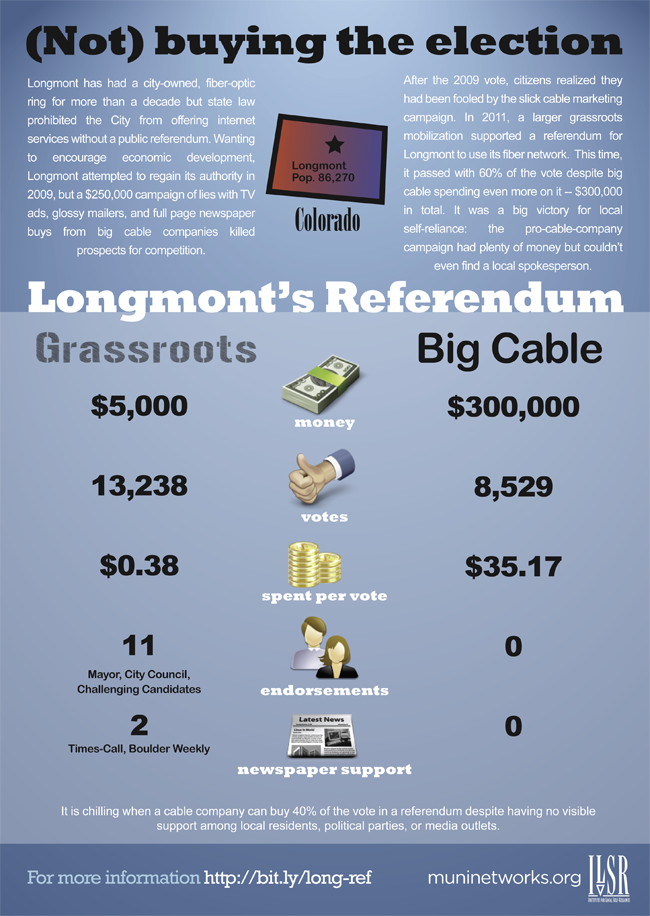
This time, lobbyists for the telecommunications industry spent even more than they did last time -- about $300,000 -- in trying to convince residents that the city having control over its own property was somehow "risky." Obviously, the lobbyists, including the euphemistically monikered Americans for Prosperity, were only concerned about the welfare of Longmont residents and the health of the local economy. They spent so much money to show just how concerned they were. But the majority of the voters weren't buying what they were selling. People had the audacity to think for themselves and make up their own minds. Personally, I would thank the anti-2A folks for pouring so much money into the local economy, except most of its spending was elsewhere. They did pop for a few ads in this newspaper, though, so for that they have my gratitude.The author, Tony Kindelspire, goes on to note just how amazing it was to see everyone unified on an issue.
How the FCC Killed Broadband Competition
Dane Jasper, the CEO of Sonic.net, one of the few ISPs to survive the death of broadband competition over the past ten years, wrote about "America's Intentional Broadband Duopoly." It is a short history of how the FCC's flawed analysis (helped along by incredible amounts of lobbying dollars, no doubt).
He starts by asking when the last time anyone offered to sell you broadband over power lines (BPL). The FCC decided that cable and telephone companies shouldn't have to share their wires (which are a natural monopoly) with competitors (creating an actual marketplace for services) because BPL, satellite, and wireless would put so much competitive pressure on DSL and cable. FAIL.
Then, in the Brand X decision, they ruled that Cable would not be required to allow competitors to lease their lines either. The FCC did this by reclassifying broadband Internet access as an “information service”, rather than a “telecommunications service”. As a result, common carriage rules could be set aside, allowing for an incumbent Cable monopoly. This decision was challenged all the way to the supreme court, who ruled in 2005 that the FCC had the jurisdiction to make this decision. To close out Powell’s near-complete dismantling of competitive services in the U.S., the FCC took up the issue of ISPs resale of DSL using the incumbent’s equipment, also known as wholesale “bitstream” access. If Cable is an information service under Brand X, why shouldn’t Telco have the same “regulatory relief”? The result: the FCC granted forbearance (in other words, declined to enforce its rules) from the common carriage requirements for telco DSL services.For those who are thinking that wireless is finally competitive with cable and DSL, don't forget that while 4G appears much faster (because so few people are using it presently), it still comes with a 2GB monthly cap. So if you want to do something with your connection aside from watching one movie a month, 4G is not competitive with a landline connection.