
You Are Cordially Invited: June 17th Discussion on Cable Companies, Monopolies, and Community Networks
On Tuesday June 17th, Chris will be participating in a conversation hosted by the Media Consortium as part of its Media Policy Reporting and Education Program (MPREP). You are invited to sit in on what is sure to be a spirited discussion on community networks and the lack of competition in the cable industry.
What: Community Fiber Networks: A Realistic Solution to Cable Monopoly?
When: Tuesday, June 17, 3pm ET/ 12 PT
Who: Joining Chris will be:
Ryan Radia, Associate Director for Technology Studies at the Competitive Enterprise Institute. He is critical of government-run or regulated projects in general, and specifically critical of community networks.
Wayne Pyle, City Manager and CEO of West Valley City, Utah's second largest municipality, and also chair of the board of UTOPIA, the Utah Telecommunications Open Infrastructure Agency, a community network serving 11 cities.
This is the first of several monthly briefings hosted by MPREP to discuss media policy issues. Everyone is welcome to participate. Register online for this discussion.





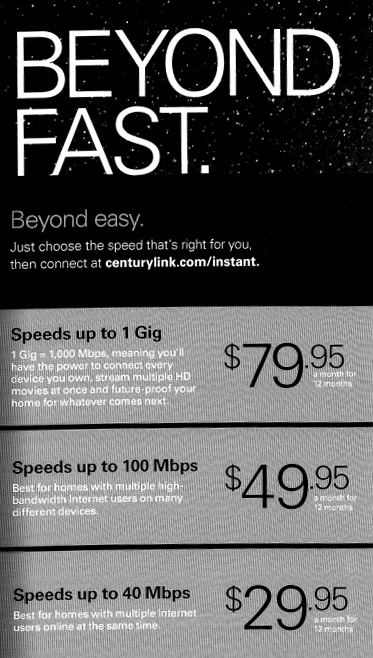 The promotional sheet claims CenturyLink will offer speeds "up to" 1 Gig for $79.95/month for 12 months. 100 Mbps runs $49.95 and 40 Mbps is $29.95 - each for 12 months. No mention of upload speeds but CenturyLink has demonstrated a real aversion to symmetry so users can expect far slower upstream than what modern municipal networks and Google fiber deliver.
The standard operating procedure in apartment buildings will be for CenturyLink to try to lock up the internal wiring to buildings and deny it to competitors. FCC rules make exclusive agreements with landlords unenforceable, but there are a host of tricks that incumbents use to prevent any competition and landlords getting a kickback often have little reason to encourage competition.
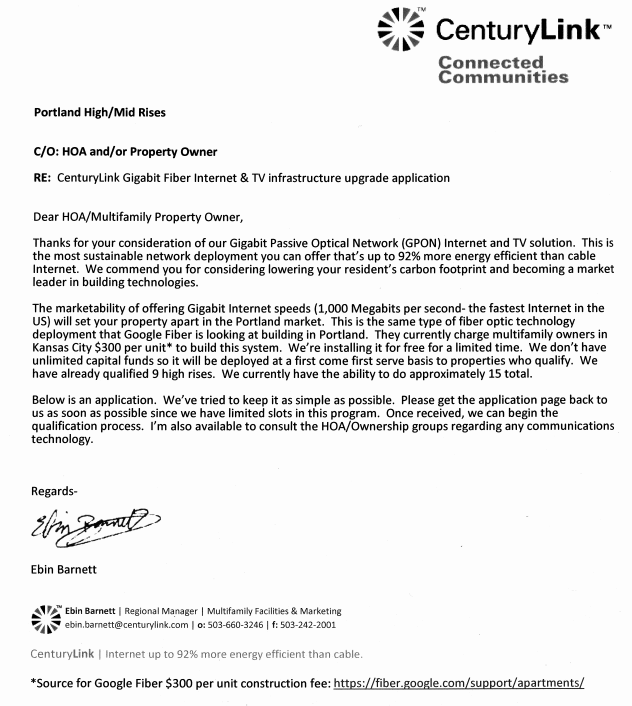
The CenturyLink copy notes that its fiber optic GPON option is "up to" more than 92 percent energy efficient than cable modem Internet access. I have to wonder how it compares to DSL energy efficiency and whether that number holds up better than the "up to" 12 Mbps claims they make on DSL circuits that seldom peak at 5 Mbps.
At any rate, it is more than we can expect in the many communities CenturyLink is serving where there the local government have done nothing to spur competition by investing in publicly owned assets that could form a municipal network or be used to entice independent service providers to enter the market. In particular, I would be curious where else CenturyLink is rolling out fiber to buildings without any upfront charges.
The promotional sheet claims CenturyLink will offer speeds "up to" 1 Gig for $79.95/month for 12 months. 100 Mbps runs $49.95 and 40 Mbps is $29.95 - each for 12 months. No mention of upload speeds but CenturyLink has demonstrated a real aversion to symmetry so users can expect far slower upstream than what modern municipal networks and Google fiber deliver.
The standard operating procedure in apartment buildings will be for CenturyLink to try to lock up the internal wiring to buildings and deny it to competitors. FCC rules make exclusive agreements with landlords unenforceable, but there are a host of tricks that incumbents use to prevent any competition and landlords getting a kickback often have little reason to encourage competition.
The CenturyLink copy notes that its fiber optic GPON option is "up to" more than 92 percent energy efficient than cable modem Internet access. I have to wonder how it compares to DSL energy efficiency and whether that number holds up better than the "up to" 12 Mbps claims they make on DSL circuits that seldom peak at 5 Mbps.
At any rate, it is more than we can expect in the many communities CenturyLink is serving where there the local government have done nothing to spur competition by investing in publicly owned assets that could form a municipal network or be used to entice independent service providers to enter the market. In particular, I would be curious where else CenturyLink is rolling out fiber to buildings without any upfront charges.