
competition

Content tagged with "competition"

Related Topics
Displaying 181 - 190 of 711

Siloam Springs, Arkansas Is Weighing Its Options For Citywide Fiber Build

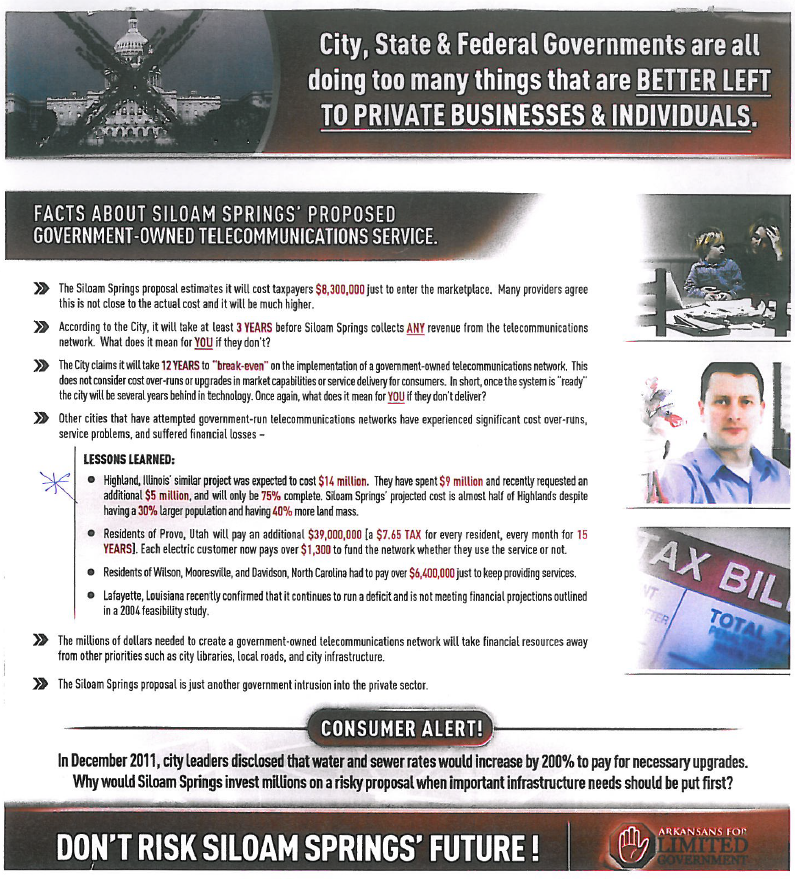
In 2012 the residents of Siloam Springs, Arkansas voted against building their own fiber network after some misleading electioneering by the regional cable monopoly Cox Communications. A decade later and local residents are still frustrated by high prices and a lack of competition, as city leaders are still contemplating what exactly they should try to do about it. 

In June, the city released a new report by Finley Engineering and CCG Consulting showing the width and depth of the city’s broadband issues. That report was formally presented at an August city meeting before the city’s recently-formed Broadband Advisory Committee.

Survey Said … 

Image

The survey showed that 11 percent of Siloam Springs residents still lack access to broadband, 77 percent of city residents want greater broadband competition, and 88 percent say they’re paying way too much for broadband service. While residents also complained about sluggish upload speeds and outages, the biggest consistent complaint was high prices. 

“The number one issue that came through loud and clear in the surveys is broadband pricing – practically every resident we heard from thinks current broadband is too expensive,” the study authors noted. 

Siloam Springs is heavily dominated by a duopoly of just two providers: Centurylink and Cox Communications. But even calling it a duopoly is generous; the city’s survey found that Cox enjoys a 92 percent broadband market share within city limits. The lack of competitive threat reduces any real incentive for the cable giant to lower prices or expand service. 

Rescue Plan Dollars Resuscitate an Open Access Fiber Network Buildout in Erie County, New York

Plans for an open access fiber backbone in Erie County, New York (pop. 951,000) are being readjusted after having been stymied by the pandemic. The county will use Rescue Plan funding to cover the cost of building the backbone, which will be owned by the county and operated by ErieNet, a nonprofit local development corporation. The backbone will make connectivity directly available to anchor institutions and enterprise businesses, but the county hopes the project will draw private providers to build out last-mile infrastructure to residents. With the new fiber ring, Erie County seeks to increase both broadband availability and competition in the area. 

The project began in spring 2019, when the county announced its plan for a $20 million open access network, which at that time it was looking to have up and running before 2022. ErieNet’s original plan was a response to an acute need for connectivity among the county’s southern and eastern rural towns, as well as much of Buffalo – despite these areas’ proximity to relatively well-connected wealthier suburban communities nearby. The county is for the most part monopoly domain, served by Charter Spectrum, Lumen (formerly CenturyLink), and in some small patches, Verizon. Verizon has cherry picked wealthier areas like Kenmore, Williamsville, and Amherst, as well as a few blocks in Buffalo by the company’s hub there, but has not found the rural or high-density and low-income areas profitable enough to build to. Relatively smaller providers like Crown Castle and FirstLight have also made infrastructure investments in parts of the county, but do not appear to have expansion plans.

Pharr, Texas Leads Regional Effort to Build Municipal Fiber Network

On the southern border of Texas in the Rio Grande Valley, Pharr Texas is the home of the largest commercial bridge from Mexico into the U.S. Now, the city is working on building an equally impressive virtual bridge to every home in Pharr with the construction of a municipal fiber-to-the-home (FTTH) network.

The progression has been steady despite pandemic induced setbacks, as city leaders are determined to solve the connectivity challenges in Pharr by leveraging the assets the city already owns while taking advantage of the unprecedented amount of federal funds now available to help communities expand access to broadband. To that end, the city has created regional partnerships, completed a feasibility study, and launched a pilot project. Now, Pharr officials are moving ahead with the construction of a city-wide municipal network. 

Wake Up Call in Rio Grande Valley

Pharr has a population of almost 80,000 people of which 94 percent identify as Hispanic or Latino with over 30 percent of families living below the poverty line. Their public meetings are often bilingual. But, it was in 2015 that the Federal Reserve Bank of Dallas reported that the Rio Grande Valley was on the wrong end of the digital divide. The report also highlighted the impact that had on the communities in the region:

The study involved focus groups with colonia residents. One theme that arose from the conversations with residents was the lack of access to the internet. The report found that the digital divide was a factor preventing residents from accessing regional labor market opportunities. Additionally, the report described the challenges colonia students face in school because of their inability to complete homework assignments due to lack of internet service and computers at home.

When earlier this week ILSR caught up with Jordana Barton Garcia, author of the report, she explained that “colonias” are informal neighborhoods where people live with no (or limited) infrastructure. Residents are sold lots without existing infrastructure, from water to broadband. 

The Future of Community Networks and Fixed Wireless | Episode 53 of the Connect This! Show

Join us live on Friday, September 16, at 1pm ET for the latest episode of the Connect This! Show. Co-hosts Christopher Mitchell (ILSR) and Travis Carter (USI Fiber) will be joined by Deborah Simpier (Co-founder at Althea Networks, Sommelier Finance, and Gravity Bridge) and Sascha Meinrath (Palmer Chair in Telecommunications at Penn State University, Founder of X-Lab). They'll discuss the advantages of different wireless deployments (LTE vs. licensed spectrum vs. unlicensed spectrum) as compared to fiber, the present and future of distributed, member-owned networks, and more.

Email us at [email protected] with feedback and ideas for the show.

Subscribe to the show using this feed or find it on the Connect This! page, watch on YouTube Live, on Facebook live, or below.

The Future of Community Networks and Fixed Wireless | Episode 53 of the Connect This! Show

Join us live on Friday, September 16, at 1pm ET for the latest episode of the Connect This! Show. Co-hosts Christopher Mitchell (ILSR) and Travis Carter (USI Fiber) will be joined by Deborah Simpier (Co-founder at Althea NetworksSommelier Finance, and Gravity Bridge) and Sascha Meinrath (Palmer Chair in Telecommunications at Penn State University, Founder of X-Lab). They'll discuss the advantages of different wireless deployments (LTE vs. licensed spectrum vs. unlicensed spectrum) as compared to fiber, the present and future of distributed, member-owned networks, and more.

Email us at [email protected] with feedback and ideas for the show.

Subscribe to the show using this feed or find it on the Connect This! page, watch on YouTube Live, on Facebook live, or below.


Recent Broadband News | Episode 51 of the Connect This! Show

Join us live on Thursday, August 25th, at 5pm ET for the latest episode of the Connect This! Show. Co-hosts Christopher Mitchell (ILSR) and Travis Carter (USI Fiber) will be joined by regular guests Kim McKinley (UTOPIA Fiber) and Doug Dawson (CCG Consulting. They'll dig into recent news - from Starlink announcing uncharacteristic price drops to "to reflect parity in purchasing power across our customers," to big cable companies and telcos going after BEAD grants, to a reflective look on how well (or not) we did with the broadband stimulus.

Email us [email protected] with feedback and ideas for the show.

Subscribe to the show using this feed or find it on the Connect This! page, watch on YouTube Live, on Facebook live, or below.

Brownsville, Texas and Lit Communities partner to Build Citywide Fiber Network

Brownsville recently took a Texas-sized step toward the creation of better broadband options for its residents and businesses, as city commissioners voted in late July to enter into a public-private partnership to build a city wide fiber network known as BTX Fiber

As reported by The Brownsville Herald:

At a Wednesday morning ceremony in city commission chambers, Brownsville Mayor Trey Mendez and Brownsville Public Utilities Board CEO and General Manager John Bruciak signed an agreement with Brian Snider, CEO of Lit Communities, that will allow the fiber infrastructure to be completely built out.

The city commission at its July 19 regular meeting approved the public-private partnership between the city, LIT Texas LLC and its subsidiary BTX Fiber, “for the construction, operations and maintenance of city-wide broadband infrastructure, including but not limited to incorporation and approval of a Right of Way and Encroachment Agreement; Engineering, Procurement and Construction Contract; and Middle Mile Connection Agreement and Grant of Indefeasible Rights of Use Agreement.

Wake up call for Brownsville

From the outside it may seem like an overnight success. But, like most stories, the planning started years ago.

Grant Challenges in Louisiana, 25 Gbps service in Chattanooga, and the Future of Video | Episode 51 of the Connect This! Show

Join us live on Thursday, August 25th, at 5pm ET for the latest episode of the Connect This! Show. Co-hosts Christopher Mitchell (ILSR) and Travis Carter (USI Fiber) will be joined by regular guests Kim McKinley (UTOPIA Fiber) and Doug Dawson (CCG Consulting). They'll dig into recent news - from big cable companies and telcos going after BEAD grants, to the announcement of 25 Gigabit per second service across the footprint of Chattanooga's municipal network, to the future of streaming video, to a reflective look on how well (or not) we did with the broadband stimulus.

Email us [email protected] with feedback and ideas for the show.

Subscribe to the show using this feed or find it on the Connect This! page, watch on YouTube Live, on Facebook live, or below.

NTIA Rejects Grafton County, New Hampshire Bid, Officials Seek Other Funding for Middle Mile Network

One way or another, Grafton County, New Hampshire is lining up funding to build a massive new middle-mile network county officials hope will drive broadband competition—and more affordable fiber—into long underserved New Hampshire communities. 

Grafton was one of 230 U.S. communities that applied for a National Telecommunications and Information Administration (NTIA) Broadband Infrastructure Program grant. Grafton’s specific application asked for $26.2 million to help fund the creation of the 353 mile broadband middle mile network they’re calling Grafton County Broadband Now.

Costly Challenge from National Incumbent Providers

Charter Communications filed costly challenges with the NTIA challenging the application, falsely claiming that the county’s proposal was “duplicative” and Charter already provided broadband to the region. Most of the claims were based on older, unreliable data provided to the FCC by Charter dramatically overstating broadband availability.

Image

Grafton County surveys actually indicate the majority of county residents still can’t get access to the FCC’s base definition for broadband, 25 Megabits (Mbps) per second downstream, 3 Megabits per second upstream. Availability data across the county will likely look even worse should the FCC pass a new proposal to boost the definition of broadband to 100 Mbps.

Cleveland Seeks Partner to Turn ‘Worst-Connected City’ into Smart Fiber City

Three years ago, the National Digital Inclusion Alliance (NDIA) ranked Cleveland as the worst-connected city in the United States (with more than 100,000 households).

City leaders are now using its American Rescue Plan funds to make that dishonorable distinction a thing of the past with a plan to invest $20 million to get the “Comeback City’s” digital future rockin’ n rollin’.

Although the city (pop. 383,000), home to the Rock & Roll Hall of Fame, is currently underserved by AT&T, Charter Spectrum, and T-Mobile, earlier this summer the city issued a Request for Proposals (RFP) that “seeks one or more partners” to help bridge Cleveland’s digital divide following a two-phased approach that first addresses the city’s immediate needs before tackling its longer-term strategic goals.

More specifically, the RFP details “the Phase I goals: ensuring that individuals who do not engage online can become full Internet users as quickly as possible, relying on digital adoption and affordable access strategies. (While) the Phase II goals (envision) —ubiquitous fiber optic connections and Smart City deployments.”

Or, as Cleveland Mayor Justin Bibb told Cleveland.com:

The first phase is on making sure on the short-term basis we connect as many families as we can to high-speed broadband, and the second phase will consist of making sure we lay fiber all across the city so we can be competitive, not just five years from now, but 20, 30 years from now, as a city and as a region.

Technically, the RFP that was issued is to fully implement the first phase of the city’s vision and set the table for the second phase. Work beyond the $20 million the city has set aside would require the issuance of a second RFP.