
Fast, affordable Internet access for all.
AT&T
Content tagged with "AT&T"
The Real Impact of the AT&T&T-Mobile Merger Isn't Funny
But that doesn't mean we can't use humor to illustrate the very serious impact of more consolidation in the mobile market! Check out four short commercials prepared by Free Press and vote on your favorite. Our favorites are below.
More Consolidation, Fewer Jobs, No Duh
"AT&T and Verizon have slashed the frontline workforce, and there simply are not enough technicians available to restore service in a timely manner, nor enough customer service representatives to take customers' calls. Let me share some statistics. Since 2004, AT&T reduced its California landline frontline workforce by 40%, from about 29,900 workers to fewer than 18,000 today. The company will tell you that they need fewer wireline employees because customers have cut the cord going wireless or switched to another provider, but over this same period, AT&T access line loss has been just under nine percent nationally. I would be shocked if line loss in California corresponds to the 40 percent reduction in frontline employees. "Similarly, since 2006 Verizon California cut its frontline landline workforce by one-third, from more than 7,000 in 2005 to about 4,700 today. I venture that Verizon has not lost one third of its land lines in the state."Note that AT&T, Verizon, and other massive incumbents like Comcast have been wildly profitable over this term. The same trend holds in cellular wireless - as noted by the Wall Street Journal:
The U.S. wireless industry is booming as more consumers and businesses snap up smartphones, tablet computers and billions of wireless applications.
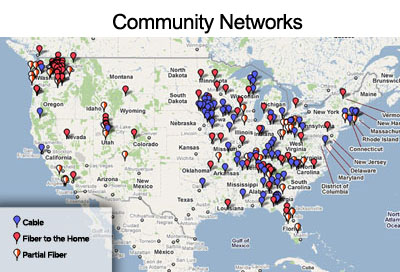
Community Networks Provide Cable/Broadband Competition That is Otherwise Unlikely
New Video: Community Fiber Networks Better than Phone, Cable Networks
The Short Story of AT&T's Attack on Schools, Libraries in Wisconsin
I wrote the following synopsis of AT&T's attack on schools and libraries in Wisconsin for SaveTheInternet.com. We are still waiting for the Governor to sign the bill, something that may take another week or longer apparently.
WiscNet is an Internet services co-op that provides Internet access to the vast majority of schools and libraries in Wisconsin, as well as a number of local governments. Because it’s a co-op, it can deliver lower-cost broadband to public entities than they could negotiate on their own. The arrangement between WiscNet schools and governments saves Wisconsin taxpayers millions of dollars each year and offers services that private companies like AT&T won’t provide.
Despite WiscNet’s proven utility throughout the state, AT&T and its incumbent allies (a group called Access Wisconsin) attempted to murder WiscNet in the back alleys of Madison, Wisconsin’s capital. But following a dramatic outpouring of public support for the network, lawmakers compromised and merely placed it on death row.
AT&T dumps millions into Wisconsin politics for a reason — to enact its agenda. When it furtively inserted a few provisions into a budget bill in the 11th hour a few weeks ago, legislators went merrily along without asking any questions.
These provisions would have effectively shut WiscNet down, and they would have required the University of Wisconsin, a premier research institution globally, to withdraw from Internet2 and other research networks. They also would have forced the University of Wisconsin Extension to return federal broadband stimulus grants that had already been used to break ground on projects to improve connections in rural areas with inadequate connections. Returning those grants would have cost $27.7 million over 5 years to the involved communities and killed almost 500 jobs.
AT&T Stumbles in Purchase of "Grassroots" Support
WiscNet Under Continued Attack, Contact Elected Officials
Positive Update from Wisconsin on WiscNet, Stimulus Awards
Access Wisconsin Supported Broadband Stimulus Before They Opposed It
"This is by far the greatest assault we've ever felt from the University of Wisconsin Extension," said Mark Weller, president and CEO of Access Wisconsin, which represents 30 mostly small, rural telecommunications providers.