
Fast, affordable Internet access for all.
AT&T
Content tagged with "AT&T"
Shareholders Matter in Network Neutrality Rules
The SEC has moved network neutrality from the murky back rooms of day-to-day operations into the bright light of of shareholder resolutions.
This is a significant turn for the SEC and it opens up a new avenue in the campaign for net neutrality. As the SEC helpfully reminds us, “One of the key rights of shareholders is the right to vote their shares on important matters that affect the companies they own.” The SEC gives companies a fair amount of discretion on resolutions. In previous years, the SEC’s Division of Corporation Finance ruled that similar net neutrality proposals pertained to “ordinary business” and could be excluded from shareholder ballots.
The telcos have reason to be afraid. Proxy fights have derailed business plans and taken down CEOs. Most successful campaigns have been carried out by activist fund managers with substantial stakes in relatively small companies (by stock exchange standards).
The Benedictine Sisters of Mount St. Scholastica, the Nathan Cummings Foundation, and Trillium Asset Management have led the effort to put this on shareholder ballots. They will need help to move it forward. Proposals must claim a minimum percentage of support in order to be allowed on the ballot next year.
This time of year about 20 percent of U.S. households receive proxy voting forms, and most are promptly discarded. If you ask your parents and grandparents, chances are good someone owned some shares of Ma Bell at one time and now has voting rights in a telco.
If your only investments are in mutual funds, you can still make your voice heard. Contact the fund management company, tell them you support net neutrality, and ask them how they are planning to vote on the issue.
Bloomberg: The Case for Publicly Owned Internet Service
Today, the Institute for Local Self-Reliance, which advocates for community broadband initiatives, is tracking more than 60 municipal governments that have built or are building successful fiber networks, just as they created electric systems during the 20th century. In Chattanooga, Tennessee, for example, the city’s publicly owned electric company provides fast, affordable and reliable fiber Internet access. Some businesses based in Knoxville -- 100 miles to the northeast -- are adding jobs in Chattanooga, where connectivity can cost an eighth as much.Though I encourage readers to read the full column, I love the conclusion:
Right now, state legislatures -- where the incumbents wield great power -- are keeping towns and cities in the U.S. from making their own choices about their communications networks. Meanwhile, municipalities, cooperatives and small independent companies are practically the only entities building globally competitive networks these days. Both AT&T and Verizon have ceased the expansion of next-generation fiber installations across the U.S., and the cable companies’ services greatly favor downloads over uploads. Congress needs to intervene. One way it could help is by preempting state laws that erect barriers to the ability of local jurisdictions to provide communications services to their citizens. Running for president in 1932, Franklin D. Roosevelt emphasized the right of communities to provide their own electricity. “I might call the right of the people to own and operate their own utility a birch rod in the cupboard,” he said, “to be taken out and used only when the child gets beyond the point where more scolding does any good.” It’s time to take out that birch rod.
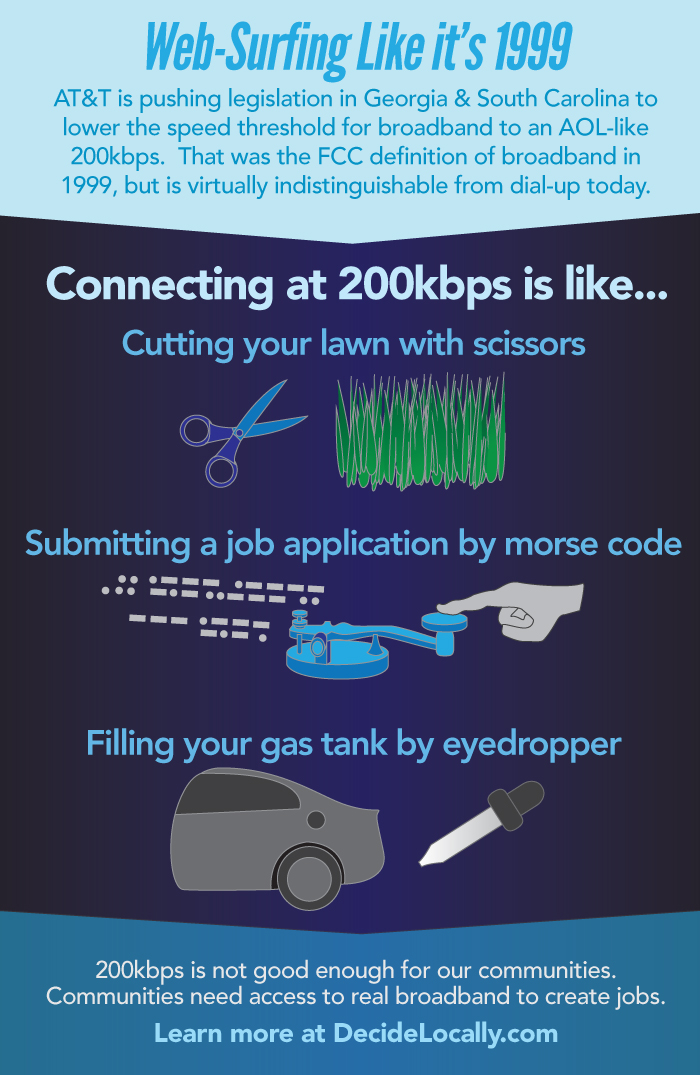
AT&T Trying to Redefine Broadband in Georgia, South Carolina
Feel free to spread it around. Higher quality pdf below.South Carolina Cable Association Also Wants to Limit Competition
The SCCTA has been actively following the AT&T-backed legislation that would amend the Government-Owned Telecommunications Service Providers Act. House Bill 3508 would impose the same requirements on government-owned broadband operations that are currently imposed on telecommunications operations.Of course, H.3508 goes far beyond applying the "same requirements." It enacts a host of requirements that only apply to public providers, which are already disadvantaged by being much smaller than companies like Time Warner Cable and AT&T. We have long ago debunked the myth of public sector advantages over the private sector. The second quarter newsletter [pdf] identifies this bill as the highest priority of the cable association:
H3508, the AT&T backed legislation, has been our dominate piece of legislation in 2011.
Pay Attention to the Man Behind the Curtain: Listen to AT&T's CEO, not Lobbyists
The other is rural access lines; we have been apprehensive on moving, doing anything on rural access lines because the issue here is, do you have a broadband product for rural America? We’ve all been trying to find a broadband solution that was economically viable to get out to rural America, and we’re not finding one to be quite candid. The best opportunity we have is LTE.Whoa! LTE is what you more commonly hear called 4G in mobile phone commercials. The best they can do is eventually build a wireless network that allows a user to transfer just 2GB/month. That is fine for hand-held devices but it does nothing to encourage economic development or allow residents to take advantage of remote education opportunities. But even the CEO admits they are not bullish on LTE as the solution:
[W]e’re looking at rural America and asking, what’s the broadband solution? We don’t have one right now.Some may be wondering about "U-Verse" -- AT&T's super DSL that competes with cable in the wealthy neighborhoods of bigger cities. U-Verse cannot match the capacity or quality of modern cable networks but is better than older DSL technologies. But U-Verse is not coming to a rural community near you. For those who missed the fanfare last year, AT&T's U-Verse build is done. AT&T's lobbyists have probably forgotten to tell Georgia and South Carolina Legislators that the over 20 million AT&T customers without access to U-Verse are not going to get it.
Rural Wisconsin Residents Struggle to Connect to the Internet
But several attendees asked why the government can't play a role in making high-speed service available everywhere, in the same way that the government helped bring about rural electrification and telephone service.This is a very good question. They may decide not to follow that path, but given the importance of access to the Internet, they should look at options for building a network that puts community needs first.
We Told You So: Subscribers Abandon DSL
Media Coverage Roundup: Georgia AT&T Bill to Kill Community Broadband
Rogers’ legislation is exceptionally friendly to the state’s incumbent phone and cable companies, and they have returned the favor with a sudden interest in financing Rogers’ 2012 re-election bid. In the last quarter alone, Georgia’s largest cable and phone companies have sent some big thank-you checks to the senator’s campaign:Phil also refutes the supposed failures cited by those pushing the bill. Not only do such stories misrepresent what really happened, some actually cite EPB's incredible 1Gbps service as demonstrating that munis are out of touch. What else would you expect from the Heartland Institute, which made its name fighting against the radical claim that cigarettes are linked to cancer? Government Technology's Brian Heaton also covered the story in "Georgia Community Broaband in Legislative Crosshairs."A review of the senator’s earlier campaign contributions showed no interest among large telecommunications companies operating in Georgia. That all changed, however, when the senator announced he was getting into the community broadband over-regulation business.
- Cable Television Association of Georgia ($500)
- Verizon ($500)
- Charter Communications ($500)
- Comcast ($1,000)
- AT&T ($1,500)
In addition, Mitchell [me] said that SB 313’s requirement of the public entity paying the same taxes or the same cost of capital as the private sector is another red herring.