


Elon Musk’s Starlink is making new demands of states with an eye on eroding accountability and oversight, reheating concerns about whether spending big money on the Low Earth Orbit (LEO) network is the best possible use of taxpayer resources.
Last year, the Trump administration made revisions to NTIA rules surrounding the $42.5 billion Broadband, Equity, Access, And Deployment (BEAD) program, demanding that states de-prioritize fiber and dole out significantly more money to LEO satellite providers – a move broadly seen as a personal gift to one of the President’s biggest financial donors.
This subsidy reward, slated to be at least $733 million to start, is money that in some cases is being redirected away from higher-capacity, more affordable local options like open access community-owned fiber networks.
The NTIA changes introduced significant new delays in a program already rife with them. The Trump administration’s threat to withhold grant awards from states that focus on affordability – and the high consumer costs, environmental impact, and capacity constraints of the LEO network – risks undermining BEAD’s promise of faster, more affordable access.
Standoff Orbits 'LEO participation'
Last week, Broadband.io and the Benton Institute for Broadband & Society obtained a copy of a letter Starlink parent company SpaceX sent to individual states, demanding freedom from state oversight and monitoring should they bungle installs or fail to deliver acceptable bandwidth.

Among the concessions being demanded by the Musk-owned company include freedom from all financial auditing, no oversight of its labor practices, and minimal checks and balances to ensure that the network has reserved adequate capacity to handle a massive influx of users.
SpaceX is also demanding that it be able to exclude subscribers from network tests if the company determines subscribers have malfunctioning gear, “improperly installed equipment,” or the service is obstructed by trees or environmental obstacles (something that’s often the case with satellite broadband access and has marred many early Starlink reviews).
“SpaceX seeks to minimize states’ ability to penalize LEO grantees for defaulting or failing to comply with contract requirements,” wrote Benton Director Drew Garner.
Starlink’s demand for less accountability than ever isn’t sitting well with many states that had already balked at demands they choose LEO satellite over more reliable, future-proof options, including far-less capacity constrained community-funded open access fiber networks.
The request also comes after Elon Musk and DOGE actively helped dismantle federal regulatory oversight of corporate power. Numerous court rulings under the Trump administration have left federal regulators with less authority than ever to regulate telecom companies, often leaving states as the last line of defense against monopolies and corporate power.
While state broadband plans are ever-shifting in the wake of the Trump administration changes, SpaceX is poised to receive $733.5 million in grants to connect 472,600 locations. Jeff Bezos’ Amazon’s Leo satellite service (formerly Project Kuiper) is poised to receive $311 million to service 415,000 locations, despite most of the network’s satellites having yet to be launched.

In some instances, many of these users would have received access to LEO broadband regardless of whether taxpayer money was spent. In its letter to states, Starlink claims that it will walk away from the BEAD program if states attempt more strict oversight.
“Clearly, efforts have been made to adapt underlying program documents to LEO within the initial timelines available,” the company said. “However, a number of issues remain that, if unaddressed, could render LEO participation in the program untenable.”
The contentious new standoff between Starlink and the states comes as the company is asking the Trump administration permission to launch more than 1 million new satellites operating in "narrow orbital shells" of up to 50 kilometers each. Such a massive expansion, which may or may not actually happen, comes despite ongoing concerns about the LEO satellite’s impact on astronomical research and the ozone layer.
Big Growth, Limited Capacity, No Serious Oversight
Starlink’s orbital network is inherently already difficult for regulators to physically monitor, and poised to see significant slowdowns as network demand increases.
Last year, four leading broadband scholars working with X-Lab released analysis showing that in areas where Starlink is required to cover more than 6.66 households per square mile, the platform may fail to deliver the minimum service level defined as “broadband access” by the FCC (100 Megabits per second downstream, 20 Mbps upstream)
“Within the geographic coverage area of a single Starlink satellite – an estimated 62.9 square miles or roughly the area of Tacoma – hitting 419 Starlink customers could become a problem,” the researchers found. “That’s an average 6.7 Starlink customers per square mile [which] has implications for Starlink customers and for the New Deal-style government program to expand internet access to everyone.”
The researchers indicated that research highlighted the need for “independent verification of capacity limits to the Starlink infrastructure, and the crucial need for detailed engineering, propagation, and capacity analysis to be conducted for any area where Starlink and other satellite broadband solutions are proposed.”
Exactly the sort of thing Starlink is now, unsurprisingly, arguing against.
Starlink recently surpassed two million U.S. subscribers. If finalized, the 470,000 subscriber infusion would represent a sudden explosion in growth. That likely means slower overall speeds, greater network limitations and management technologies (like the deprioritization of higher definition video) to help the company manage the load.
“In the past, subscriber growth has caused Starlink’s service to slow due to increased network congestion,” wrote Garner. “Will the network be able to accommodate BEAD’s influx of subscribers, especially considering BEAD’s speed and latency requirements?”
Ideally, a useful broadband subsidy program would prioritize driving fiber as deeply into American communities as possible. From there, significant gaps can be covered by fixed wireless and 4G. Only then does it make sense to pepper the landscape with capacity-constrained LEO satellite service, which is ideal for locations with no other options.
The Trump administration’s reconfiguration of the BEAD program turns that logic on its ear to the benefit of one of the country’s richest men – who is now hard at work hoovering up taxpayer money while ensuring less oversight than ever. Historically that’s not a recipe that works in favor of the public interest or those stuck on the wrong side of the digital divide.
Listen to our most recent Community Broadband Bits podcast for more on Starlink’s behind-the-scenes push to rewrite BEAD rules and what it means for accountability and public dollars below:
Header image of Starlink satellite orbiting Earth courtesy of Wikimedia Commons, CC0 1.0, CC0 1.0 Universal
Inline image of Elon Musk speaking at CPAC conference in 2025 courtesy of Gage Skidmore on Flickr, CC BY-SA 2.0, Attribution-ShareAlike 2.0 Generic
Inline image of Starlink satellite constellation courtesy of Wikimedia Commons, Creative Commons, Attribution 2.0 Generic
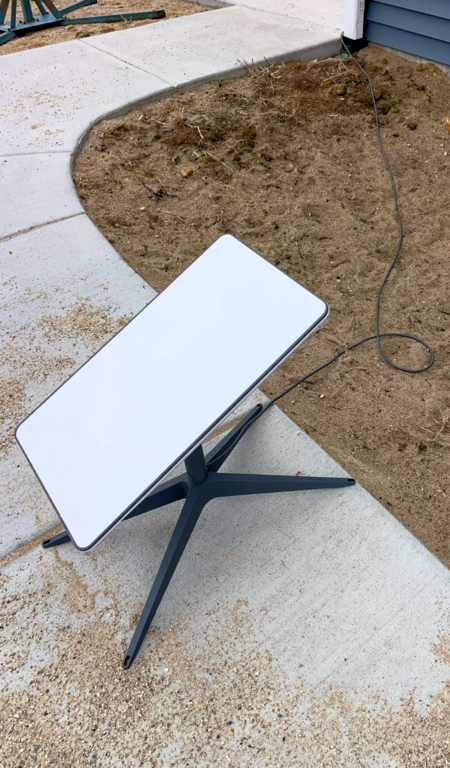
Inline image of Starlink home satellite dish courtesy of Wikimedia Commons, Creative Commons license, CC0 1.0 Universal