

RiverStreet Networks has been removed from multiple broadband deployment projects by the Virginia Broadband Office after years of delays, leaving the state scrambling to find a replacement suitor for projects intended to bring affordable Internet access to more than 30,000 rural customers across The Old Dominion state.
The company was stripped of its state contracts after it repeatedly failed to meet deadlines and struggled to find additional funding needed to complete promised state deployments. Most of the state contracts heavily subsidized RiverStreet via the American Rescue Plan Act (ARPA).
But state officials say RiverStreet repeatedly failed to deliver promised connectivity to counties all across the state.
In Patrick, Henry, and Franklin counties, for example, RiverStreet was selected in 2022 and 2023 by the West Piedmont Planning District to bring fiber Internet access to 14,547 households. But according to local news outlet Cardinal News, the ISP had delivered just 40 total connections across all three counties.
“Well, it’s certainly been frustrating, and I have dedicated a tremendous amount of my time to this project,” Henry County Administrator Dale Wagoner told the outlet. “I’ve served as lead [on the project] since day one and the first grant application. It’s most frustrating for our residents who we’ve been promising broadband to for many years now.”
According to Wagoner, officials from the West VATI, or Virginia Telecommunication Initiative project are collaborating with West Piedmont officials to secure a new ISP to take over deployment. The West VATI project was funded via a $33.5 million ARPA grant and $59.4 million in matching funds from Riverstreet and other government partners.
The story is much the same for territories covered by the West Piedmont East VATI project, which covers Internet access expansion across Amelia, Bedford, Campbell, Charlotte, Nottoway, and Pittsylvania counties. There, RiverStreet had completed construction to only around 35 percent of the target area’s 27,997 potential subscribers.
Elsewhere Riverstreet had completed just 4 percent of the promised deployments in Campbell County, and none of the promised connections in Nottoway and Dinwiddie counties. In Pittsylvania County, officials say Riverstreet provided broadband access to 854 of 2,105 total locations. The East VATI project was funded by an $87 million ARPA grant, and $65.4 million in match funds from RiverStreet and local governments.
The Virginia state Department of Housing and Community Development says it’s working to reclaim unspent funding from Riverstreet and put it toward finishing the long-promised buildouts.
The provider did not respond to a request for comment.
Numerous Potential Reasons For Lagging Deployments
Doug Dawson, a municipal broadband and telecommunications expert who consults with municipalities, stated numerous potential factors could have resulted in RiverStreet’s inability to meet state obligations.
“I know they took on a huge number of projects in both Virginia and North Carolina, and they might have bitten off more than they can chew,” Dawson said. “On top of taking a lot of grant money, they’ve also bought several ISPs in the last few years.”
Many other ISPs are simply struggling to fulfill deployment promises due to higher costs related to tariffs, the Iran war, inflation, or other economic conditions.
“The other possibility is that they took on quite a few grants in the earliest days of ARPA and State grants and they might have found themselves being killed by costs that came in higher than they expected,” Dawson said. “It’s not hard to imagine them getting overextended because of increasing interest rates. I know a number of medium ISPs of their size who have scaled back simply due to interest costs.”
In addition to losing its ARPA funding, RiverStreet may be looking at losing its $44 million share of the state’s $1.4 billion share of the Broadband, Equity, Access, and Deployment (BEAD) program, made possible by the 2021 infrastructure bill.
“We were essentially kept in the dark about their finances and their search for additional financing until really just a couple of months ago,” West Piedmont Planning District Commission executive director Michael Armbrister told local news outlets. “Our goal all along has been to connect folks and give them access to broadband. That’s the reason that we jumped in and partnered with RiverStreet and the counties, was just to connect folks. That’s still our goal.”
Header image of breach of contract courtesy of Nick Youngson CC BY-SA 3.0 Pix4free
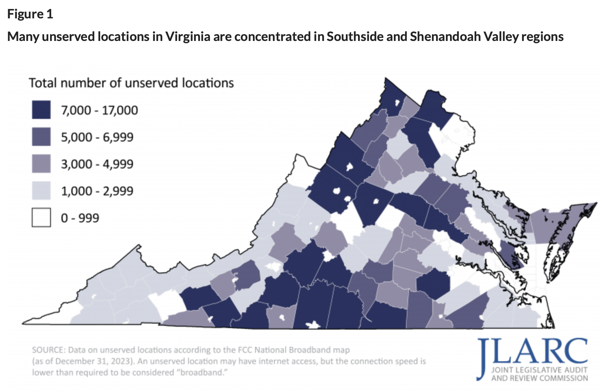
Inline map of unserved locations courtesy of the 2023 Joint Legislative Audit and Review Commission website
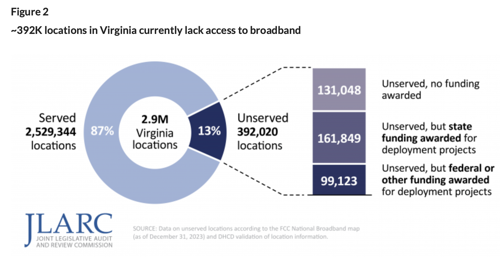
Inline graphic of unserved locations courtesy of the 2023 Joint Legislative Audit and Review Commission website