
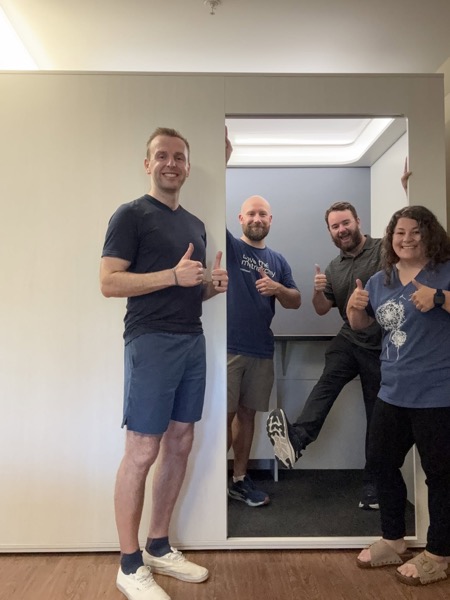
The soundproofed privacy pod tucked inside the first floor of the Rural Edge affordable housing development may be one of the most consequential pieces of infrastructure built in Vermont since the state’s Communications Union Districts (CUDs) first began deploying fiber networks.
With a population of just over 500 Vermonters living in the small town of Groton — where the nearest hospital is a 30-minute drive away and not every conversation can or should be overheard at home — the fiber-connected privacy pods are small enough to fit just two people, but private enough for life-enhancing online conversations to be had.
“Groton is where the largest percent of folks are without high speed Internet access. It’s highly unserved, except for downtown,” explained Christa Shute, Executive Director of NEK Broadband, which recently combined with the CVFiber CUD to form a 72-town telecommunication utility district now providing fiber Internet service across some of the most rural parts of the most rural state in the U.S.
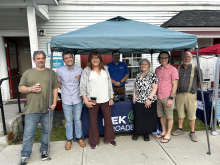
Thanks to the commitment of Groton volunteers and town leaders and their intimate knowledge of their community – backed with the resources of the Vermont Community Broadband Board (VCCB) — “we knew what addresses didn’t have service,” Shute tells ILSR, fresh off the weekend’s grand opening celebration of the Groton Connectivity Hub, which also featured a live fiber splicing demo, online safety presentations, and drop-in tech help for the public.
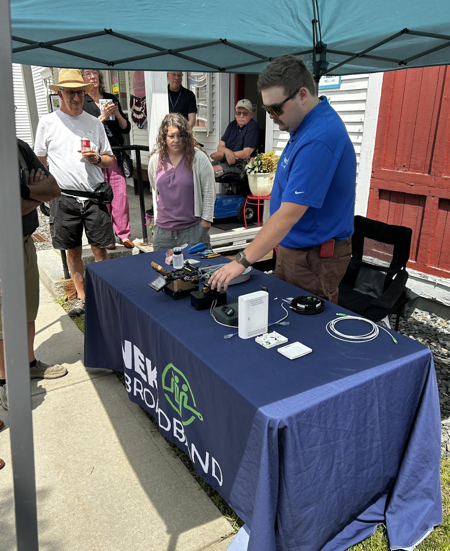
CUD officials describe it as “a new community technology center designed to expand digital access and help residents take advantage of reliable high-speed Internet, remote work opportunities, telehealth services, online education, and other digital resources.”
The initiative, funded on the back of a $2.9 million USDA Community Connect Grant, includes 2 gig symmetrical fiber connectivity to the main hub and four other satellite hubs: one in the town clerk’s office; one in the town garage; fire department; with the fifth hub located inside the Ryegate Library, in the town neighboring Groton. At the Rural Edge housing complex, residents can access the Connectivity Hub throughout the day into the evenings and weekends.
“When you are talking about rural America, you don’t always have a school or library so sometimes you have to get creative,” Shute said, explaining how each hub includes shared workspace, meeting space, computer workstations and a privacy pod equipped with an Internet-connected integrated computer, camera, and appointment booking software.
Privacy as Infrastructure
The Groton Connectivity Hub effort is part of a pilot project that brings together housing, library, town government, state leaders and regional healthcare providers with an eye on expanding and possibly replicating across the state.
In addition to supporting the multitude of services and opportunities Internet connectivity brings, Shute said, “the importance of telehealth has become really apparent.”
And not just for the more common healthcare uses. The free privacy pods can be used for other related scenarios, Shute learned. They could be a life-saver for those who might be dealing with domestic violence and who need to carve out some space for “privacy in their homes for these types of calls” — or for “folks recovering from substance abuse,” which is especially vital “because people in those situations also tend to be in difficult financial circumstances.”
Also, Shute added, the court systems are moving more of its daily business online and “this kind of community center can be important in expanding access to the court system.”
The CUD’s connectivity hub initiative is something that has the full support of the Vermont Community Broadband Board (VCCB) — the state’s broadband office that administers federal and state grant broadband funds.
When Government Gets It Right: The ‘Bottom-Up’ Sandbox Approach
“This is the real beauty of the CUDs, where you get a bottom-up approach and it’s the best solution. We will be glad to repeat those excellent solutions. These are those sandboxes that create the best products,” VCCB Executive Director Christine Hallquist tells ILSR.
Hallquist said connecting “community anchor institutions” such as housing developments, libraries, and community centers was part of the state’s original BEAD “non-deployment” plan. But, that portion of the federal BEAD funds owed to each state according to the bipartisan infrastructure law have been frozen as part of the Trump administration’s “Benefit of the Bargain” revamp of the program, leaving both blue and red states asking (and waiting) for the NTIA to issue its final guidance on how those funds will be allowed to be spent.
“Originally we wanted to be servicing these community anchor institutions and we still hope to do that with the nondeployment funds,” Hallquist said.
Thankfully, Shute and Hallquist noted, Vermont state leaders were wise in choosing to use its federal American Rescue Plan funding to supercharge its CUD-centric goal of ensuring every resident and business has access to high-performing, affordable, high-speed Internet service built, owned, and driven by the communities themselves.
“What the VCCB did was allocate some of its ARPA funds to be a match for towns who put in money for network deployment. It was a real motivation to get towns directly involved,” Shute said. “And, as a public, nonprofit community entity, all of our money goes back into either infrastructure, programming, or lowering prices.”
While the Groton Connectivity Hub is new, the fiber-to-the-home network the CUD is building across the Northeast Kingdom and the central part of the state has already brought service to a sizable number of its CUD-member towns.
So far, NEK has built out fiber that passes 13,000 locations and is on track for 41,000 passings by the end of 2029 — running parallel to the state’s other eight CUDs, most of whom are close to completing their own fiber deployments.
For Hallquist, the Groton Connectivity Hub project points to the real measure of the state's broadband buildout vision. It was never about how many miles of fiber could be deployed or how many locations could be passed. It’s about something harder to quantify and more important to get right.
“It’s one thing to connect people, it’s another thing to improve people’s lives. We didn’t do this just for the sake of building infrastructure. We did it to improve lives.”
In Vermont, the fiber is the foundation. But, it’s the privacy pods, the telehealth appointments, the evening hours, the court access, the recovery calls that can finally be made in confidence that is the real life-changing point of it all.
Header and inline images of Groton Connectivity Hub grand opening courtesy of the Vermont Community Broadband Board
Inline image of Groton Connectivity Hub privacy pod courtesy of NEK Broadband Facebook page