

Lenoir City, Tennessee officials say they’re making steady progress on their goal to deliver affordable fiber well beyond the Southern city of 12,998.
Under the collaborative umbrella of the Lenoir City Utilities Board (LCUB) and Tennessee Valley Authority (TVA), officials say they’re leveraging century-old experience in rural electrification to help bridge the digital divide across Knox and Loudon counties.
“We’re now in our fourth year of construction on our community broadband network, and we have 37,676 passings available at this time,” Allen Rollings, Director of Broadband at LCUB told ILSR.
“LCUB will continue to build until our entire electric service territory is able to access our broadband service.”
LCUB’s history dates back to 1938, when Lenoir City signed a contract with the TVA to provide public power. As with many municipalities and cooperatives, this foundational "public utility" mindset helped pave the way for eventually treating broadband as a 21st-century necessity rather than a luxury.
LCUB is the eighth largest utility among the 153 Tennessee Valley Authority distributors, serving over 96,000 electricity customers.
In 2016, LCUB built an 80-85 mile perimeter fiber ring designed to aid SCADA systems that monitor the electrical grid. Such upgrades improved the utilities’ automated metering, remote fault detection, substation monitoring and overall efficiency.
By 2019, the city had begun opening the door to the idea of leasing out excess capacity on its fiber loop to private companies, believing it made more sense to be a wholesaler than jumping directly into the residential broadband market.
Born from frustration with monopoly domination
In 2019, the city also hired Magellan Advisors to conduct a feasibility study to examine the potential for extending fiber access to the public. That study found broad local dissatisfaction at the high prices, spotty availability, and substandard customer service from local private telecom monopolies,
Much of the region is stuck under a broadband monopoly of Charter (Spectrum), AT&T, or Comcast (Xfinity). A lack of meaningful competition among the providers, combined with limited federal or state oversight of monopoly power, has broadly resulted in regional market failure. Many locals were unable to access broadband at even the (then) base FCC definition of broadband: 25 megabits per second (Mbps downstream, 3 Mbps upstream).

The city’s study estimated that Lenoir City building its own fiber optic broadband network to disrupt this competitive logjam would cost around $127.5 million, not far off from the final $132.7 million final budget. The survey noted that 13,000 customers were already within a quarter-mile of LCUB’s existing "dark fiber" ring.
On February 22, 2022, LCUB held a public town hall to present the formal plan for grid modernization and the launch of LCUB broadband services.
After approval, construction of the public utility’s next-gen fiber network began in August of 2022, and the first customers came online in June of 2023. The launch of residential fiber access came on the back of a $21.7 million loan from the electric division to the broadband division, with most deployment costs being borne by expanding subscriber fees.
Locals are now able to get fiber speeds at prices far less than any regional incumbent monopoly, including a symmetrical 1 gigabit per second (Gbps) fiber tier for $70 a month; a symmetrical 1 Gbps fiber tier with “managed WiFi” for $80 a month; and a symmetrical 2.5 Gbps fiber tier for $100 a month.
All of the utility’s broadband tiers come without usage caps and overage fees, hidden surcharges, or long-term contracts.
Powering Through Incumbent Astroturf Campaign

As is usually the case, the network drew the ire of proxy groups for regional monopoly providers, who falsely claimed in local editorials that the popular broadband expansion wasn’t necessary because regional providers already delivered access to the region.
But according to officials, the network has not only been deployed on a faster timeline than many similar projects, but it continues to expand well beyond the original confines of Lenoir City.
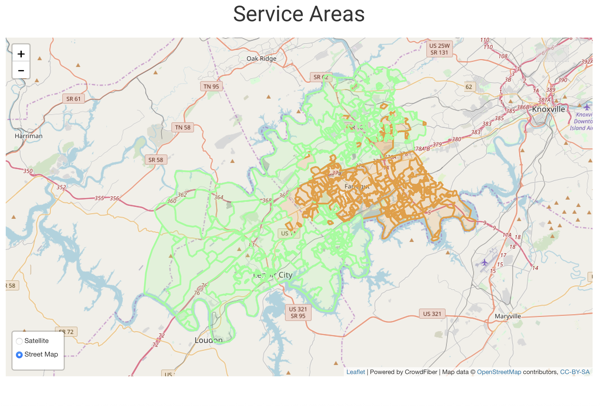
“We serve all of Lenoir city, the Hardin Valley community, a decent portion of Knox County, and most of Loudon County today,” Rollings said, sharing a service territory map in which the yellow portion are construction areas, and the empty outlines are the remaining territory to be built.
According to Rollings, LCUB is targeting around 18 to 24 months for network completion. Tennessee is also prepared to receive $813 million in additional BEAD subsidies to aid rural broadband deployment thanks to the 2021 infrastructure bill.
Header image of Lenoir City High School student getting tour of LCUB operations center courtesy of Lenoir City Utilities Board Facebook page
Inline image of LCUB broadband ad courtesy of Lenoir City Utilities Board Facebook page
Inline image of LCUB service van courtesy of Lenoir City Utilities Board Facebook page