
affordability

Content tagged with "affordability"

Related Topics
Displaying 1 - 10 of 279

HomeWorks Tri-County Electric Cooperative Acquires VEI’s Cable Broadband Network

HomeWorks Tri-County Electric Cooperative says it has acquired the cable and fiber broadband systems of private ISP Vogtmann Engineering (VEI) in order to expand its broadband footprint across central Michigan. The migration will result in faster, cheaper Internet access for rural Michigan subscribers long stuck on the wrong side of the digital divide.

HomeWorks was founded in 1937 by farmers in Eaton, Ingham and Jackson counties to bring electricity to rural areas left behind by the big-city utilities. It’s one of the country’s 250 electrical cooperatives (out of 900) that have leveraged a century of rural electrification experience to pivot into bringing affordable Internet access to long-neglected Americans.

In 2018, the cooperative launched HomeWorks Connect, which provides Michigan locals with three tiers of fiber service: a symmetrical 250 megabit per second (Mbps) tier for $65 a month; a symmetrical 500 Mbps option for $90 a month; and a symmetrical 1 gigabit per second (Gbps) tier for $100 a month. The tiers feature no usage caps, hidden fees, or long-term contracts.

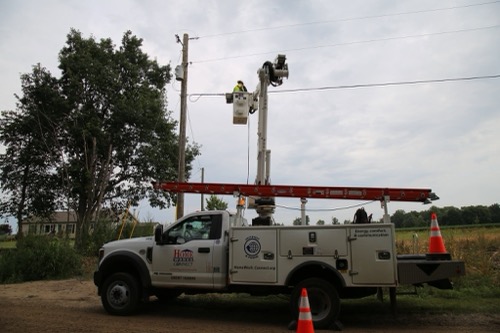
According to HomeWorks, the acquisition of VEI’s network assets includes 15 miles of cable in the neighboring villages of Nashville and Vermontville, passing just over 1,000 homes and businesses.

Image
Tri-County Electric Cooperative bucket truck with worker elevated into air checking fiber line on utility pole

Cooperative leadership says they’re just beginning the process to upgrade VEI’s coaxial cable to fiber connectivity, and integrate the existing system into its HomeWorks Connect network, which currently serves more than 14,000 homes and businesses across rural mid-Michigan.

DigitalC Beats 2025 Targets, Now Tests If ‘Cleveland Model’ Can Be Replicated

For years, Cleveland was labeled as one of the worst-connected cities in the nation despite the presence of AT&T and Charter Spectrum. But all of that is changing, thanks to an innovative nonprofit community network provider.

Even without getting a cent from the federal government’s flagship $42.5 billion dollar BEAD program, Cleveland is no longer just home to the Rock & Roll Hall of Fame. It’s now also the home of skyrocketing connectivity rates as DigitalC transforms the city’s digital landscape.

The data-backed progress was enough to convince the Cleveland City Council to recently sign off on a $4.35 million “performance payment” — part of an overall $20 million earmark from the city's coffers — to DigitalC after the nonprofit Internet provider blew past its 2025 goals for getting residents online and teaching them digital skills, a milestone city leaders are pointing to as proof that “The Cleveland Model” for closing the digital divide actually works.

Under its performance-based contract with the city, DigitalC was on the hook to add 4,700 new household Internet subscriptions and deliver digital skills training to 10,000 residents in 2025 or miss out on the multi-million dollar infusion of city cash.

Fresno, California Celebrates Launch of Free Internet Initiative on Back of Community-Owned Network

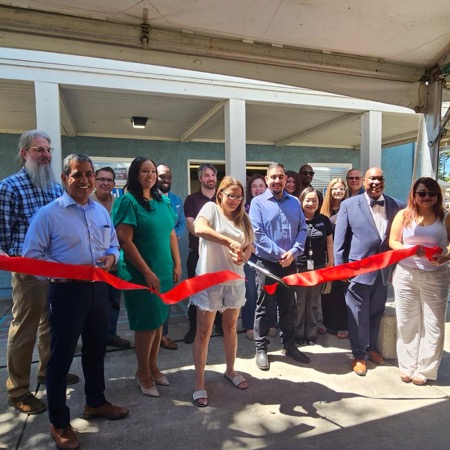
California community leaders, activists, and a coalition of partners gathered earlier this month to celebrate the launch of a new broadband infrastructure project at Sequoia Courts and Sequoia Courts Terrace in Fresno, bringing free high-speed Internet access to more than 350 residents.

The plan to bring broadband access to residents at no cost was made possible through a partnership with Fresno Housing, Fresno Coalition for Digital Inclusion (FCDI), United Way Fresno & Madera Counties, and Central Valley Community Foundation (CVCF). The Fresno Housing Authority will own and maintain the finished network.

The expansion, which leverages a hybrid fiber-wireless approach, was directly funded by California’s ambitious Broadband For All initiative, a $6 billion effort aimed at dramatically boosting broadband competition and access across the Golden State. Much of that effort was funded, in part, by the 2021 American Rescue Plan Act (ARPA).

Image
A group of community leaders and housing resident cut red ribbon in front of building

The Fresno grant was for $471,000, with $1,000 or less per unit cost to build, according to details on the project included in a California Public Utilities Commission (CPUC) filing, which notes that the enterprise-grade wireless mesh network used in the project was more costly, but provided “flexibility and scalability for future expansion.”

FCC’s Carr Eyes Dubious ‘Reforms’ To E-Rate, Broadband Mapping

Trump Federal Communication Commission Chairman Brendan Carr has announced vague potential changes to the FCC’s E-Rate program that could harm program funding, effectiveness, and the overarching goal of bringing affordable Internet access to long-neglected schools and rural communities trapped on the wrong side of the digital divide.

The reforms come as Carr also looks to make changes to the FCC’s broadband mapping efforts, something consumer groups say could harm the government’s ability to measure which communities need improved, affordable access, or suffer from a pronounced lack of broadband competition.

In an announcement to the FCC website, Carr stated the 30-year-old bipartisan E-Rate program, which costs $3 billion annually, was in dire need of reforms. The program is primarily funded by a small surcharge affixed to phone lines. With the steady erosion of copper-based phone lines, debates have arisen about how to best sustain the program.

But instead of focusing on issues like subsidy fraud by large telecoms, Carr’s announcement oddly focuses heavily on concerns about student “screen time” and what content students are allowed to view. It’s a problematic foray for an FCC boss recently under fire for unconstitutional censorship efforts targeting comedians and journalists.

How NextLight Became the #1 Internet Service Provider in the Country - Episode 12 of Unbuffered

Unbuffered Logo - Two text bubbles

In this episode of Unbuffered, Chris is joined by Valerie Dodd and Scott Rochat for a conversation about the history, growth, and continued success of Longmont's NextLight fiber network.

They begin with some recent recognition for NextLight, including being named the number one Internet Service Provider in the country, the top municipal ISP, the most recommended provider, and the highest-value provider according to customer surveys. Valerie reflects on the network's continued growth and why community support has become one of its greatest strengths.

From there, the conversation turns to the history of the network, from Longmont's early investment in fiber infrastructure to the community campaigns that helped secure voter approval for city-owned broadband despite significant opposition spending. Scott shares stories from the effort to build the network and how public support continued to grow over time.

Chris, Valerie, and Scott also discuss lessons learned along the way, including managing rapid growth, maintaining customer trust, planning for success, and avoiding common mistakes. They reflect on what it takes to build and sustain a community-owned network and why success requires both local leadership and long-term commitment.

The episode also explores NextLight's commitment to affordability and accessibility. Valerie explains how Longmont developed discounted service offerings, expanded support during the pandemic, and continued providing low-cost Internet options even after federal subsidy programs ended.

The conversation closes with a look at the network's financial position, including subscriber growth, debt repayment, and what comes next for one of the country's most successful municipal broadband networks. 

This show is 39 minutes long and can be played on this page or via Apple Podcasts or the tool of your choice using this feed

You can also check out the video version via YouTube.

Transcript below.

We want your feedback and suggestions for the show-please e-mail us or leave a comment below.

Listen to other episodes (formerly Community Broadband Bits) or view all episodes in our index. See other podcasts from the Institute for Local Self-Reliance.

Thanks to Whitedrift for the song Operator, licensed Creative Commons Attribution (3.0).

A California Democrat Is Trying to Gut the State’s Broadband Watchdog

Today, the American Prospect published an analysis – “A California Democrat Is Trying to Gut the State’s Broadband Watchdog” – authored by our own Sean Gonsalves that examines a recently filed bill in California which aims to “strip telecommunications oversight authority away from the California Public Utilities Commission (CPUC) and shift it to a more easily lobbied state legislature and a hypothetical state broadband office that doesn’t yet exist.”

The piece details how the CPUC has become a national model for broadband consumer protection, extracting landmark affordability commitments from the proposed Charter-Cox merger, launching a state-funded broadband subsidy program, and administering the only public loan fund in the nation dedicated exclusively to community-owned Internet networks.

Here's a few excerpts:

“Given what the CPUC has done over the past several years to ensure that every family in California can afford internet access, Boerner’s characterization of her poison pill is enough to make Orwell blush and MAGA operatives smile.”

“To understand what’s really at stake in Boerner’s proposal, it helps to understand what the CPUC has built, mostly behind the scenes, and what would be lost.”

“On telecom issues, the CPUC is not just a passive regulator. In the words of Ernesto Falcon, branch manager of the Communications and Broadband Policy division of the agency’s Public Advocates Office, the CPUC is something closer to ‘a public defender in the regulatory space.’”

“The office employs 22 public servants—attorneys, researchers, and policy specialists—whose sole job is to advocate for California consumers in a regulatory arena dominated by monopoly telecom companies with virtually unlimited resources to influence lawmakers and set the agenda.”

DigitalC at 10,000 Subscribers - Episode 11 of Unbuffered

Unbuffered Logo - Two text bubbles

In this episode of Unbuffered, Chris is joined again by Joshua Edmonds, CEO of DigitalC, for an ongoing conversation about one of the most ambitious efforts in the country to address the digital divide.

Josh explains how DigitalC evolved into a nonprofit Internet service provider serving Cleveland with next-generation fixed wireless technology. He shares how the organization built a citywide network, why it offers service starting at $18 per month, and what it means to be approaching 10,000 subscriber households serving more than 23,000 people.

Chris and Josh discuss the relationship between digital equity and everyday economics, including affordability, rising household costs, and why low-cost Internet service continues to resonate with residents. They also explore how DigitalC’s approach could influence the broader telecommunications industry, from pricing strategies to customer contracts.

The conversation also looks at the realities of operating a nonprofit ISP, including customer payments, subscriber growth, apartment building deployments, and the challenge of finding the right technology for different situations. Josh explains how DigitalC uses a mix of fixed wireless, existing infrastructure, and other solutions to reach both single-family homes and multi-dwelling units across the city.

Throughout the episode, Chris and Josh reflect on what it takes to build a sustainable model for connecting residents, why local solutions matter, and how communities can move beyond talking about the digital divide to actually closing it.

This show is 53 minutes long and can be played on this page or via Apple Podcasts or the tool of your choice using this feed

You can also check out the video version via YouTube.

Transcript below.

We want your feedback and suggestions for the show-please e-mail us or leave a comment below.

Listen to other episodes (formerly Community Broadband Bits) or view all episodes in our index. See other podcasts from the Institute for Local Self-Reliance.

Thanks to Whitedrift for the song Operator, licensed Creative Commons Attribution (3.0).

California Assembly Member Moves to Strip CPUC Broadband Oversight, Undermine Affordability Efforts

In the last few years, the California Public Utilities Commission (CPUC) has been more intensely focused on ensuring that broadband in California is affordable. 

So it’s curious to see the California State Assembly vote 67-1 on May 18 to strip telecom oversight authority away from the CPUC and shift it to a more easily lobbied state legislature – and an as-yet-undefined state broadband office.

The effort still has a long road before it’s formalized.

Assembly Constitutional Amendment 9, authored by Assemblymember Tasha Boerner, D-Encinitas, now moves on to the California Senate, where it needs to secure a two-thirds vote before appearing on a statewide ballot before California voters.

Image
CA Assembly member Tasha Boerner smiles at camera wearing a light blue sleeveless dress with ruffles

The proposal would remove the state constitutional requirement to define and regulate telecommunications as a public utility, something long supported by telecom giants. Boerner’s amendment (and companion bill AB 2289) gives lawmakers leeway to strip the CPUC of its telecom portfolio and hand it over to a newly created state broadband office by 2028.

Consumer Advocates Are 'Shocked' and Skeptical 

Boerner’s proposal is being sold to state lawmakers and the local press as a way to keep the CPUC focused on soaring electrical costs.

Vermont Closes In on Universal Broadband Access as Federal Dollars, Local Innovation, and Workforce Training Converge

In the marathon to bring universal high-speed Internet service to the most rural state in the nation, Vermont is heading into the last-mile stretch of the race with the finish line in sight.

In February, the Vermont Community Broadband Board (VCBB) announced that the National Telecommunications and Information Administration (NTIA) overseeing the federal Broadband Equity, Access, and Deployment (BEAD) program, had approved Vermont’s Final Proposal, unlocking $93 million of the state's nearly $229 million federal allocation.

After years of painstaking planning, public input, and navigating bureaucratic hurdles, it marked a pivotal moment – with the state's selected grant recipients cleared to begin deploying mostly fiber to the communities that have long been waiting for high-speed connectivity after decades of neglect from the Big Cable and Telecom providers.

“This is a major milestone for many of our rural towns and a once-in-a-generation opportunity to strengthen and revitalize communities,” Gov. Phil Scott said in a statement, crediting NTIA, Vermont's congressional delegation, and the VCBB for shepherding the state's plan.

Image
Vermont State House building on a sunny day after snowfall

U.S. Sen. Bernie Sanders, never one to mince words, spoke to both the significance and the frustration of the moment. “Affordable, high-speed [I]nternet is a vitally important resource in every corner of the country. It is foundational to modern life,” he said. 

Unbuffered Live! - Episode 6 of Unbuffered

Unbuffered Logo - Two text bubbles

In the first live episode of Unbuffered, Chris is joined by Heather Mills, Doug Dawson, and Drew Garner for a wide-ranging conversation about BEAD, permitting, mobile wireless, and the latest debates around broadband policy and infrastructure.

They begin with a discussion about Amazon’s Leo service, efforts to preempt local government “to encourage more investments in Internet access,” and the realities of mobile wireless performance after Chris spent weeks traveling around the country.

From there, the conversation turns to BEAD and where things currently stand. Drew explains that most states and territories have finally signed their award agreements and are getting closer to construction, while also warning that the process remains “interminable” because there are so many seeming final steps. Chris, Heather, Doug, and Drew discuss delays, permitting, workforce challenges, NTIA guidance, and concerns that states may face a very narrow list of eligible uses for remaining funds.

The group also talks about affordability, quality, and value in broadband infrastructure, including whether LEO satellite service is truly an acceptable alternative to fiber-based networks. Heather reflects on the risks of creating “a class system of who gets what,” while emphasizing that affordability programs and local capacity still matter for communities trying to get connected.

The episode closes with a conversation about mobile networks, fixed wireless capacity, and why networks may feel like they are “running hotter” than they used to.

This show is 64 minutes long and can be played on this page or via Apple Podcasts or the tool of your choice using this feed

You can also check out the video version via YouTube.

Transcript below.

We want your feedback and suggestions for the show-please e-mail us or leave a comment below.

Listen to other episodes (formerly Community Broadband Bits) or view all episodes in our index. See other podcasts from the Institute for Local Self-Reliance.

Thanks to Riverside for the music. The song is Caveman and is licensed under a Creative Commons Attribution (3.0) license