


Local government organizations are voicing their strong opposition to the American Broadband Deployment Act, an industry friendly proposal being cooked up in the House that would take public rights of way management and property decisions away from state, local, and tribal governments through federal preemption and industry-friendly defaults.
The American Broadband Deployment Act (HR 2289) saw initial approval by the US House Energy and Commerce Committee last January. It’s being presented by telecom companies as a way to dramatically streamline government broadband permitting and regulation.
With bill proponents insisting it will speed up the deployment of fast, affordable broadband access, the massive 100-page omnibus bill integrates more than 20 different permitting and preemption changes that would impact cellular tower siting, wireline broadband deployment, cable franchising, and federal review processes in ways favorable to industry.
But organizations representing local governments say the sales pitch for the bill is the latest in a long line of misleading gambits by industry, designed to eliminate oversight of heavily-taxpayer subsidized providers at the cost of state, local, and tribal autonomy and public safety.
The National Association of Counties (NACo), the U.S. Conference of Mayors (USCM), the National League of Cities, and the National Association of Telecommunications Officers and Advisors (NATOA) say the bill is just the latest blind deregulatory effort by a U.S. telecom industry keen on enjoying a massive infusion of taxpayer money, without any regulatory, consumer, or local safety oversight ensuring they’re meeting the public interest.
“H.R. 2289 is an unprecedented and dangerous usurpation of local governments’ authority to manage public rights-of-way and land use,” the organizations recently said in a letter sent to House leadership.
“The bill favors cable, wireless and telecommunications providers. In return for these favors, the bills impose no obligations on cable, wireless and telecommunications companies to provide broadband to ‘unserved’ and ‘underserved’ Americans through the use of our public roadways, owned by our citizens.”
A Familiar Song and Dance
U.S. telecom giants have a generational history of demanding less and less federal and state oversight in exchange for affordable next-generation broadband networks that always somehow wind up only half deployed. The claim that blind deregulation and the elimination of oversight is a panacea for U.S. connectivity woes is an all too familiar refrain.
While there certainly are bad regulations and obstinate and difficult local governments, state and local oversight has long been demonized as a bogeyman by industry to obfuscate a much larger problem with U.S. broadband: corruption-coddled telecom giants that have dismantled both oversight and most local competition, resulting in territorial telecom monopolies that often deliver patchy, expensive, slow broadband.

Much like the Republican-controlled House, the Trump FCC has also been busy working on efforts to “modernize” local permitting processes and preempt state regulations they say are “hindering network modernization.”
Such proposals, like this one put forth in March by the agency, propose a “more investment-friendly environment for broadband and wireless deployment,” according to industry-friendly coalitions like the U.S. Chamber of Commerce.
But more often than not, these are industry wishlists pushed exclusively by lobbyists, that ignore any need for local collaboration, downplay market failure, unfairly demonize local industry oversight, and undermine the public safety and infrastructure best interests of local communities.
The House’s American Broadband Deployment Act is no different, local governments say.
“Local governments’ broadband permitting and cable franchise functions facilitate safe, productive deployment in our public rights-of-way while protecting roads and residents from harm caused by poorly planned or executed construction,” the groups wrote. “The local permitting process is an essential tool for avoiding unnecessary repairs and cost overruns – whether from staffing overtime or reduced infrastructure lifespan caused by multiple intrusions into the right-of-way.”

Among many other changes, the new law would strip local authorities of authority over the siting and modification of small-cell wireless facilities, often managed by counties and municipalities within public rights-of-way.
The proposal also dramatically limits the time municipalities have to have their concerns heard, and offloads industry costs to taxpayers, the groups state.
“By imposing rigid federal ‘shot clocks’ and restricting local authorities’ ability to negotiate fair compensation for the use of public property, H.R. 2289 creates a framework that prioritizes communication companies’ shareholder value at the expense of the safety and financial interests of the communities and the taxpayers they serve,” the organizations said. “Furthermore, by limiting cost-recovery mechanisms for application reviews, the bill effectively forces local taxpayers to subsidize private providers' administrative expenses – a cost that falls entirely on the public.”
The changes come as local communities increasingly face the deployment of massive – and sometimes environmentally quite harmful – hyperscale data centers that tend to have a disproportionate impact on poor, marginalized, and minority communities. WIth the federal government abandoning any interest in equity (equal opportunity), local autonomy becomes more important than ever.
“As our nation faces unprecedented advances in both artificial intelligence technology and federal investments in broadband infrastructure, local governments seek to be constructive partners and rely on local zoning and permitting authority to make thoughtful decisions."
"Communities throughout the country are actively determining what AI infrastructure looks like in their communities. These zoning and permitting authorities enable cities, towns, and counties to make smarter decisions that create economic benefits for their communities and respect citizens’ concerns.”
There are certainly instances where a local municipality can be a bureaucratic nightmare through overly active regulations, but as the bill’s opponents state, federal mechanisms already exist to address this without harming local community rights and autonomy.
“In the rare instances where a local government truly obstructs deployment in the case of telecommunications infrastructure, the Federal Communications Commission (FCC) already possesses sufficient authority to intervene under Sections 253 and 332 of the Communications Act of 1996,” the coalition said.
H.R. 2289 has been reported out of the House Energy and Commerce Committee and currently awaits further action by the full House.
Header image of U.S. Conference of Mayors Summit press conference courtesy of U.S. Conference of Mayors Facebook page
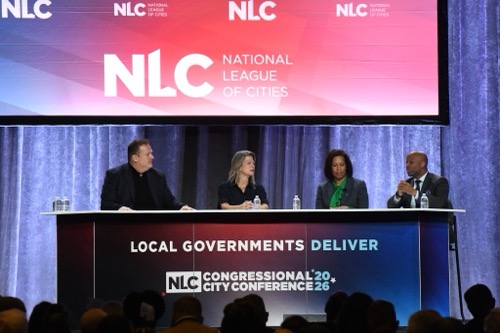
Inline image of the National League of Cities 2026 conference courtesy of National League of Cities Facebook page
Inline image of FCC Commissioner Brendan Carr courtesy of Broadband Breakfast
Inline image of public right of way clearing with underground fiber sign courtesy of Tri-State Forestry, CC BY-NC 4.0, Attribution-NonCommercial 4.0 International