
feature

Content tagged with "feature"

Related Topics
Displaying 1 - 10 of 221

DigitalC Beats 2025 Targets, Now Tests If ‘Cleveland Model’ Can Be Replicated

For years, Cleveland was labeled as one of the worst-connected cities in the nation despite the presence of AT&T and Charter Spectrum. But all of that is changing, thanks to an innovative nonprofit community network provider.

Even without getting a cent from the federal government’s flagship $42.5 billion dollar BEAD program, Cleveland is no longer just home to the Rock & Roll Hall of Fame. It’s now also the home of skyrocketing connectivity rates as DigitalC transforms the city’s digital landscape.

The data-backed progress was enough to convince the Cleveland City Council to recently sign off on a $4.35 million “performance payment” — part of an overall $20 million earmark from the city's coffers — to DigitalC after the nonprofit Internet provider blew past its 2025 goals for getting residents online and teaching them digital skills, a milestone city leaders are pointing to as proof that “The Cleveland Model” for closing the digital divide actually works.

Under its performance-based contract with the city, DigitalC was on the hook to add 4,700 new household Internet subscriptions and deliver digital skills training to 10,000 residents in 2025 or miss out on the multi-million dollar infusion of city cash.

RiverStreet Networks Loses Virginia Contracts After Numerous Delays

RiverStreet Networks has been removed from multiple broadband deployment projects by the Virginia Broadband Office after years of delays, leaving the state scrambling to find a replacement suitor for projects intended to bring affordable Internet access to more than 30,000 rural customers across The Old Dominion state.

The company was stripped of its state contracts after it repeatedly failed to meet deadlines and struggled to find additional funding needed to complete promised state deployments. Most of the state contracts heavily subsidized RiverStreet via the American Rescue Plan Act (ARPA).

But state officials say RiverStreet repeatedly failed to deliver promised connectivity to counties all across the state.

In Patrick, Henry, and Franklin counties, for example, RiverStreet was selected in 2022 and 2023 by the West Piedmont Planning District to bring fiber Internet access to 14,547 households. But according to local news outlet Cardinal News, the ISP had delivered just 40 total connections across all three counties.

“Well, it’s certainly been frustrating, and I have dedicated a tremendous amount of my time to this project,” Henry County Administrator Dale Wagoner told the outlet. “I’ve served as lead [on the project] since day one and the first grant application. It’s most frustrating for our residents who we’ve been promising broadband to for many years now.”

Massachusetts' Residential Retrofit Program Hits Its Stride

Late last month, officials from the Massachusetts Broadband Institute (MBI) and Community Broadband Networks America (CBN America) —  an independently-owned fiber Internet service provider — gathered with dozens of residents at two Southbridge Housing Authority properties to celebrate the expansion of the state's Residential Retrofit Program

The event marked the latest milestone for a program that, more than two years after its launch, has grown from a $22 million pilot project into a $74 million initiative to rewire some of the Commonwealth's oldest affordable housing stock in order to allow residents living there faster and more reliable access to the Internet.

For the roughly 150 residents at the two Southbridge properties — many of them elderly, on fixed incomes, or living with disabilities — the occasion really hit home. 

Diane Servant, board chair of the Southbridge Housing Authority and a resident herself, told the crowd gathered for the celebration what the upgraded wiring will mean for broadband-hungry residents.

“It's going to save you money, and that's always a plus for all of us on very fixed incomes,” Servant said. “Some of the perks are you will be able to do telehealth, talk with your children, talk with your grandchildren. It's just going to be fabulous.”

Image
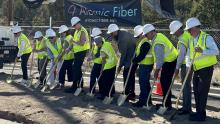
MBI and CBN officials cut blue tape at ceremony

CBN America is handling the fiber build-out at the Southbridge properties, part of a broader push by the provider into southern Worcester County. In total, CBN was awarded $5.7 million in grant program funds to upgrade wiring in buildings across six different communities in the region, bringing all-fiber connections to 1,820 units, MBI officials tell ILSR.

‘Normalcy, Never Again:’ Building for Digital Equity Asks What the ‘Dream’ for Digital Equity Looks Like Now

Sixty-three years ago this August, Dr. Martin Luther King Jr. stood on the steps of the Lincoln Memorial and delivered one of the most memorable speeches in American history. 

At the heart of King’s “dream” speech — "that one day this nation will rise up and live out the true meaning of its creed" – was a vision for a society built, not on making peace with inequality, but on its structural dismantling, where equity is not just aspirational, but foundational.

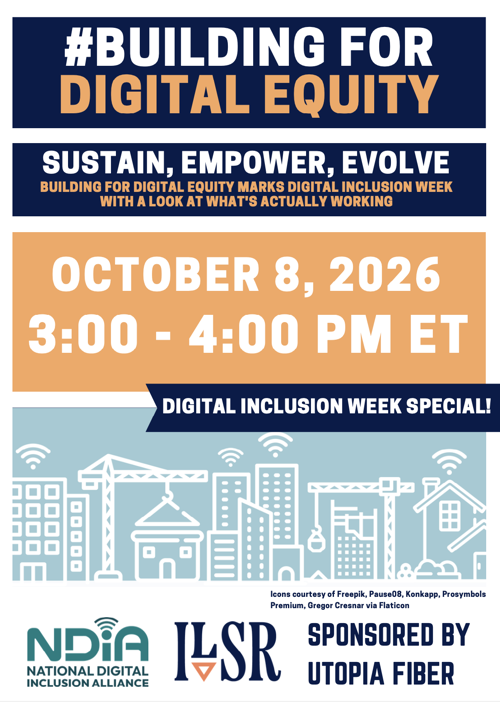
On Wednesday, August 19 at 3pm ET, just eight days before the anniversary of King’s speech, the on-going webinar series hosted by the Community Broadband Networks Initiative at the Institute for Local Self-Reliance (ILSR) and the National Digital Inclusion Alliance (NDIA) returns to pose a pointed question to the digital inclusion community: what is our dream for digital equity — and what kind of ecosystems do we need to, at last, build a “Beloved (connected) Community?”

Registration is now open here.

Image
B4DE flyer

The live-streamed webinar — "Normalcy, Never Again" — takes its name from the spirit of King's August 28, 1963 address and will serve as a rallying point to reaffirm that the digital equity movement will not accept business as usual or be managed into irrelevance, even if the face of a federal government actively dismantling the programs and protections that were supposed to close the digital divide.

It will bring together a roster of voices from the front lines of the digital equity fight — including advocates, educators, librarians, healthcare providers, and community broadband builders doing the unglamorous, essential work of getting people connected. 

Broadband Communities Names Its 2026 Provider of the Year Shortlist — and It's Not the Usual Suspects

As states across the nation are poised to begin awarding BEAD grants as part of the single-largest federal investment in U.S. history to build new high-speed Internet networks, a sizable share of the funding is going to the big cable and telecom giants, with hundreds of millions in subsidies slated for Starlink and Amazon Leo.

Yet, eight community and independently-owned networks are in the running for this year’s Broadband Provider of the Year Award – a reminder that bigger does not always mean better and BEAD isn’t the only way to solve the digital divide in local communities.

“From municipal pioneers to digital equity champions and rapidly scaling fiber builders, the 2026 shortlist for the Broadband Communities Broadband Provider of the Year represents the best in high-speed connectivity, customer-first service, and network innovation,” Broadband Communities, one of the nation’s leading digital and broadband technology publications, announced in the run-up to its Broadband Communities Summit 2026.

Image
Broadband Communities Summit 2026 logo

The winners will be revealed live during a special awards ceremony at the end of Day 1 at this year’s summit, which will be held on August 26 at the George R. Brown Convention Center in Houston, Texas.

And Nominees Are…

The shortlist of standouts competing for top honors this year are the following:

IN OUR VIEW: Statement on Federal Court Decision to Reinstate Digital Equity Act Grant Funding

Yesterday a federal district court judge ruled that Digital Equity Act programs should resume, although without any of the Act’s original race-based factors, which the judge deemed to be unconstitutional.

In response to the ruling in the on-going lawsuit filed by the National Digital Inclusion Alliance (NDIA), Christopher Mitchell, Director of the Community Broadband Networks initiative at the Institute for Local Self-Reliance (ILSR), made the following statement:

“Yesterday’s ruling on the Digital Equity Competitive Grant Program is, on balance, a victory. The National Digital Inclusion Alliance deserves enormous credit for fighting to get to this point. The court affirmed what should have been obvious all along: the Trump administration had no legitimate basis to hold this program hostage. The only real question now is how quickly NTIA moves to actually implement it.”

“The removal of racial and ethnic minorities as a designated ‘covered population’ are  a loss because the Trump Administration continues to find ways to undermine populations that have been historically disadvantaged.  But I don’t think it will significantly change who the program actually serves or what work gets done on the ground. The Digital Equity Act’s continued focus on low-income communities, older adults and veterans means that the people who most need to be prioritized will still be prioritized. Due to historic discrimination, many racial minorities will remain the focus of the program due to their disproportionately low income.”

“Digital equity work does not cost the federal government money – our taxpayer dollars are used inefficiently when millions of people cannot access telehealth and similar services. Additionally, the benefits of federal investments into new Internet networks are greatly enhanced when more people are able to take advantage of modern technology.” 

AT&T vs California: The Life-and-Death Battle Over Landline Service

California residents are engaged in a protracted, ugly battle with telecom giant AT&T over their ability to receive life-saving communications during an emergency. 

The battle comes as the telecom monopoly attempts to eliminate most meaningful oversight of the company’s communications networks, actively putting human lives – and state rights – at risk.

At the heart of the standoff is California’s Carrier Of Last Resort (COLR) obligations, which mandate that state residents maintain reliable access to voice calls, 911, toll free calls, deaf and disabled assistance services, customer service support, protection from unwanted charges, operator services, directory help, and flexible billing options.

AT&T lobbyists have worked tirelessly to eliminate such requirements in 20 of its 21 state service territories, falsely claiming the regulations stifled the company’s ability to install next-generation fiber access. In reality, AT&T has long been criticized for cheaping out on fiber investments, and is primarily interested in eliminating any dwindling oversight.

As COLR obligations are eliminated, customers are frequently shoveled from traditional copper-based landlines – which operate even during power outages – to frequently less reliable and significantly more expensive wireless alternatives. In many cases that results in California elderly residents losing access to essential lifesaving services entirely, particularly in areas where cellular connectivity is spotty or unavailable.

California Greenlights Another $18.2 Million For Affordable Broadband

California and the California Public Utilities Commission (CPUC) continue to heavily invest in state efforts to expand affordable Internet access, and bolster digital equity, inclusion, and education programs to ensure freshly-connected communities are able to make the most of it.

According to a new announcement by the CPUC, the agency has freshly approved $14.7 million in California Advanced Services Fund (CASF) Broadband Infrastructure Grant Account funding for four fiber-optic broadband projects in rural Northern California.

The agency says it approved another $3.4 million in CASF Rural and Urban Regional Broadband Consortia grants supporting broadband planning and coordination efforts across 16 counties, and nearly $200,000 in Digital Divide Grant Program funding to expand access to technology, devices, and digital literacy training in underserved communities.

The state’s latest $18.2 million in digital literacy and access grants are one small part of California’s landmark $6 billion Broadband for All Initiative, which prioritized closing the digital divide in all of California’s 58 counties, and recently culminated in the launch of the state’s new $3.2 billion Middle-Mile Broadband Initiative (MMBI).

The CPUC states that its $14.7 million in CASF broadband infrastructure grants will be doled out to Plumas-Sierra Telecommunications – a wholly owned subsidiary of Plumas-Sierra Rural Electric Cooperative (PSREC) for four projects around the Golden State. Plumas-Sierra Telecommunications will own the finished networks across all four projects:

Rural Cooperatives Frustrated With NTIA BEAD Changes

Rural cooperatives have been the backbone of modern efforts to bring affordable next-generation fiber to long-neglected rural U.S. communities. 

So it’s important to listen to them when they warn that Trump administration NTIA changes to U.S. telecom subsidy programs are going to have a profoundly-negative impact on efforts to expand fast, affordable Internet access.

Earlier this month rural electric and broadband cooperatives gathered in Washington, DC, for the 5th annual Broadband Leadership Summit

The topic du jour was broadly unpopular changes made by the NTIA to the Broadband, Equity, Deployment, and Access program (BEAD) created by the 2021 infrastructure bill.

As ILSR has repeatedly explored, NTIA BEAD changes reduced oversight of deployment, lowered quality standards, stripped away requirements that the resulting taxpayer Internet access be affordable and equitably deployed, and redirected billions of dollars away from affordable fiber to the low-Earth orbit space ambitions of billionaires Jeff Bezos and Elon Musk.

That’s not sitting well with the cooperatives doing the heavy and costly lifting to bring affordable access into long-neglected rural communities.

Beyond the Fiber: Vermont's Community Network Model Aims to Improve Lives One Hub at a Time

The ​​soundproofed privacy pod tucked inside the first floor of the Rural Edge affordable housing development may be one of the most consequential pieces of infrastructure built in Vermont since the state’s Communications Union Districts (CUDs) first began deploying fiber networks.

With a population of just over 500 Vermonters living in the small town of Groton — where the nearest hospital is a 30-minute drive away and not every conversation can or should be overheard at home — the fiber-connected privacy pods are small enough to fit just two people, but private enough for life-enhancing online conversations to be had.

“Groton is where the largest percent of folks are without high speed Internet access. It’s highly unserved, except for downtown,” explained Christa Shute, Executive Director of NEK Broadband, which recently combined with the CVFiber CUD to form a 72-town telecommunication utility district now providing fiber Internet service across some of the most rural parts of the most rural state in the U.S.

Thanks to the commitment of Groton volunteers and town leaders and their intimate knowledge of their community – backed with the resources of the Vermont Community Broadband Board (VCCB) — “we knew what addresses didn’t have service,” Shute tells ILSR, fresh off the weekend’s grand opening celebration of the Groton Connectivity Hub, which also featured a live fiber splicing demo, online safety presentations, and drop-in tech help for the public.