
Vermont

Content tagged with "Vermont"

Displaying 21 - 30 of 150

Shot Clock Winding Down on ARPA Funds For Broadband Projects

Communities looking to leverage American Rescue Plan Act (ARPA) funding for broadband or other local infrastructure need to act soon or risk losing access to a once-in-a-generation funding resource.

Most ARPA recipients seem well aware of the deadline, but data suggests more than a few communities could drop the ball.

As part of the 2021 American Rescue Plan Act (ARPA), $25 billion was specifically earmarked for broadband expansion.

But the law also created the State and Local Fiscal Recovery Funds (SLFRF) program, which doled out $350 billion for states, municipalities, and tribal governments to offset pandemic losses or flexibly invest in local infrastructure.

Vermont CUD Northwest Fiberworx Nabs $20 Million ARPA Infusion

The popular Vermont Communications Union District (CUD) Northwest Fiberworx (NWFX) has received a $20.2 million infusion in state American Rescue Plan Act dollars to extend affordable fiber broadband into long-underserved regions of the Green Mountain State.

The St. Albans-based CUD is a nonprofit special purpose municipality with 22 member towns. Its latest build will connect 3,800 unserved and underserved households in Franklin and Grand Isle counties in the Northwest part of the state.

Great Works Internet Vermont (GWI VT) will design the network and manage the operations, though Fiberworx will own the finished build.

Image
Northwest Fiberworx CUD road with utility poles

“We have a unique model, that of which we will build, own and maintain a fiber-to-the-premise open-access network,” Northwest Fiberworx Network Operations Manager, Mary Kay Raymond said in a statement.

The new $20.2 million grant awarded late last month by the Vermont Community Broadband Board (VCCB), was made possible by 2021 federal COVID relief funding courtesy of the American Rescue Plan Act.

“Northwest Fiberworx and their partner Great Works Internet Vermont have found a way to bring service where others would not,” VCBB Deputy Director Rob Fish said of the award.

“They’re building a sustainable network to serve Vermonters for decades to come.”

$25 Million Lamoille County, Vermont Fiber Build Gets Underway

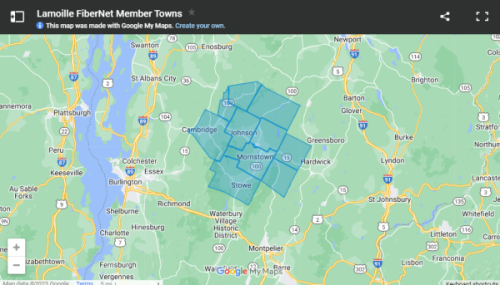
Last October, Vermont CUD (Communications Utility District) Lamoille FiberNet greenlit a $25 million public partnership with Consolidated Communications. The goal: to finally bring affordable fiber broadband access to 4,170 locals in Lamoille County. Eight months later and locals say network construction is finally getting underway.

According to the Lamoille County News And Citizen, Consolidated trucks have started to appear in towns like Stowe, Johnson, Eden, Cambridge, Belvidere and Waterville as Phase 1 of the network build gets underway.

Consolidated crews plan to deploy more than 400 miles of fiber this summer, providing locals with speeds up to 10 gigabits per second (Gbps).

Image
Lamoille CUD map

“It’s been a Herculean effort for more than three years, so we’re all very excited to see the trucks rolling this summer,” Lamoille FiberNet Executive Director Lisa Birmingham told the outlet.

Vermont's Community-Driven Broadband for All - Episode 606 of the Community Broadband Bits Podcast

In this episode of the podcast, Chris and Ry engage in an insightful discussion with Ellie de Villiers, Executive Director of Maple Broadband in Vermont. They explore the unique Communications Union District (CUD) model that Vermont has adopted to bridge the broadband infrastructure gap, especially in underserved areas.

Ellie shares her personal connection to Vermont and describes the local lifestyle before diving into the history and structure of Maple Broadband. The conversation highlights the strategic partnership between Maple Broadband and Waitsfield and Champlain Valley Telecom (WCVT), detailing how this collaboration aims to enhance broadband access in Addison County.

The episode also delves into the impact of the COVID-19 pandemic on broadband needs, the challenges of building infrastructure in rural areas, and the importance of community involvement. Ellie explains the phases of construction, the funding mechanisms, and the hurdles they faced, such as make-ready work and pole attachment issues.

The discussion wraps up with a look at future plans, including potential uses of BEAD funding and the ongoing evolution of Maple Broadband's strategy to provide high-quality, affordable internet to its community.

This show is 42 minutes long and can be played on this page or via Apple Podcasts or the tool of your choice using this feed.

Transcript below.

We want your feedback and suggestions for the show-please e-mail us or leave a comment below.

Listen to other episodes or view all episodes in our index. See other podcasts from the Institute for Local Self-Reliance.

Thanks to Arne Huseby for the music. The song is Warm Duck Shuffle and is licensed under a Creative Commons Attribution (3.0) license

Vermont CUD Maple Broadband Moving Quickly To Expand Access

Vermont’s Communications Union Districts (CUDs), which were the subject of a recently released ILSR report, continue to make steady inroads in delivering high-quality broadband access to long-neglected rural Vermont residents.

That includes locally owned not-for-profit municipal operation Maple Broadband, which has completed the first phase of its broadband network and is busy on an expansion.

Maple Broadband is technically an extension of the Addison County Communications Union District (ACCUD), a coalition of 20 different member towns working collaboratively to bring gigabit-capable fiber to residents long left unserved or underserved by regional telecom giants.

In September of 2021 Maple Broadband announced a public private partnership with Vermont-based Waitsfield and Champlain Valley Telecom (WCVT), to build and operate a district-wide fiber network. The $30 million network is, in part, propped up by ARPA funds and a $9.1 million grant from the Vermont Community Broadband Board (VCBB).

Image
Maple Broadband logo

Three years later and the CUD says it has completed the first phase of its network; laying 143.5 miles of fiber and passing 1,647 homes and businesses in portions of the Vermont towns of Cornwall, Orwell, Shoreham, Whiting, Salisbury, and Middlebury.

Neighborly Networks: Vermont's Approach to Community Broadband

Image
Neighborly Networks report

In partnership with the Benton Institute for Broadband and Society, today ILSR releases a new report examining how the state of Vermont is supercharging its telecommunications infrastructure efforts to reach the unconnected by puttings its weight behind community broadband-driven efforts.

The report - Neighborly Networks: Vermont's Approach to Community Broadband [pdf] - traces the emergence of a unique public-public partnership arrangement that first appeared in the Green Mountain State in 2008. The Communications Union Districts (CUD) model first emerged more than a decade and a half ago among a coalition of towns in the eastern part of the state long-ignored by for-profit Internet Service Providers. There, a collection of community broadband champions came together to prove that the solution to the broken marketplace lay internal to east-central Vermont. ECFiber, a publicly owned, nonprofit ISP was borne of that effort, and began bringing affordable, fast, reliable service to households in the region.

Image
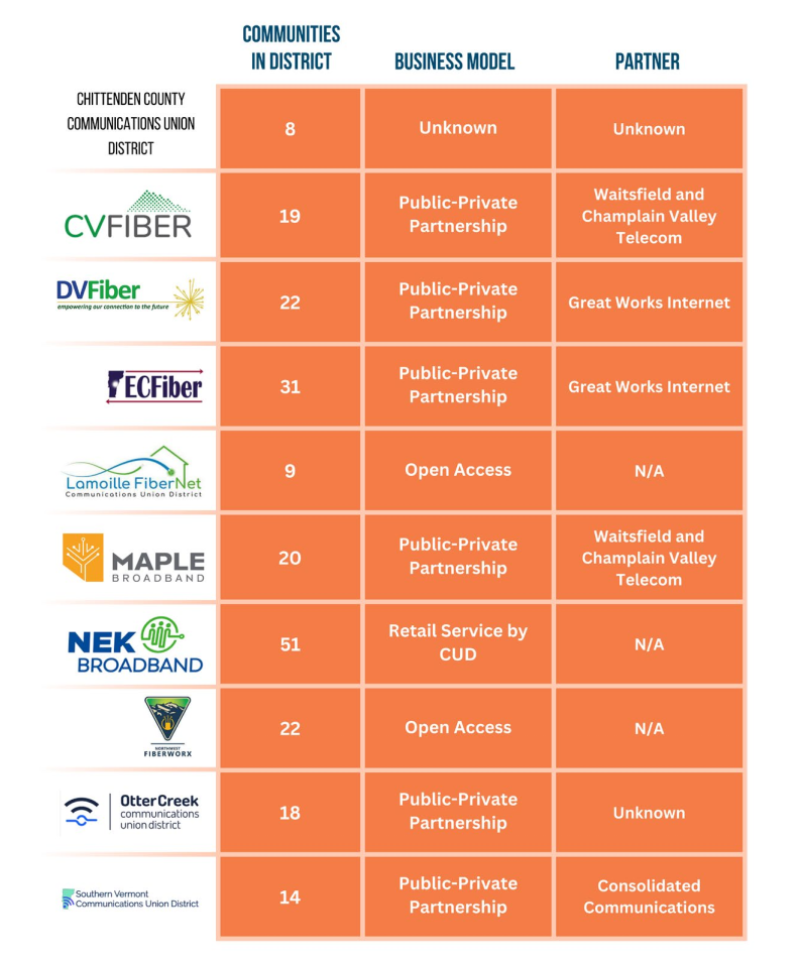
CUD models

Ten years later, when the state began formulating a plan for the future of Internet access, the progress made by and lessons learned from ECFiber drove a landmark shift in public policy in the state. Volunteers emerged, towns voted, and CUDs were placed at the center of Vermont’s effort to bridge the infrastructure gap in the state. Today, there are ten CUDs covering 216 towns across the state, and Vermont’s leaders have put the lion’s share of public funds behind the communications union district model.

New Report: Neighborly Networks - Vermont's Approach to Community Broadband

In partnership with the Benton Institute for Broadband and Society, today ILSR releases a new report examining how the state of Vermont is supercharging its telecommunications infrastructure efforts to reach the unconnected by puttings its weight behind community broadband-driven efforts.

The report - Neighborly Networks: Vermont's Approach to Community Broadband [pdf] - traces the emergence of a unique public-public partnership arrangement that first appeared in the Green Mountain State in 2008. The Communications Union Districts (CUD) model first emerged more than a decade and a half ago among a coalition of towns in the eastern part of the state long-ignored by for-profit Internet Service Providers. There, a collection of community broadband champions came together to prove that the solution to the broken marketplace lay internal to east-central Vermont. ECFiber, a publicly owned, nonprofit ISP was borne of that effort, and began bringing affordable, fast, reliable service to households in the region.

Image
CUD models

Ten years later, when the state began formulating a plan for the future of Internet access, the progress made by and lessons learned from ECFiber drove a landmark shift in public policy in the state. Volunteers emerged, towns voted, and CUDs were placed at the center of Vermont’s effort to bridge the infrastructure gap in the state. Today, there are ten CUDs covering 216 towns across the state, and Vermont’s leaders have put the lion’s share of public funds behind the communications union district model.

Tracing the history of this effort from 2008 to today, this report breaks down the conditions that led to this sea change, where the CUDs are at today, and how we might learn from the Vermont case to improve Internet access elsewhere across the country.

New Resource Alert: Rising Tide of Municipal Broadband Networks Fact Sheet

As the municipal broadband movement continues to gain momentum, we created a new fact sheet to highlight the dramatic surge in the number of communities building publicly-owned, locally controlled high-speed Internet infrastructure over the last three years.

In January, we announced our updated tally of municipal broadband networks across the U.S., which showed that between January 2021 and January 2024 at least 47 new municipal networks had been lit up for service.

Our census of new municipal broadband networks comes while dozens of other projects are still in the planning or pre-construction phase, which includes the possibility of building 40 new municipal networks in California alone.

The new fact sheet not only contains pertinent numbers to illustrate the rising tide of municipal broadband networks, it also includes snapshots of four recently launched networks now providing service to communities hungry for high-quality Internet connectivity and competitive choice.

You can find the new Rising Tide of Municipal Broadband fact sheet here.

Image
New Muni Fact Sheet screenshot

Community Broadband Resource Pairing

New Documentary Showcases Vermont's Unique Community Broadband Approach

A new documentary, produced by the Vermont production company Well Told Films and the Vermont Community Broadband Board (VCBB), tells the uplifting story of how community-minded Vermonters came together to solve a common challenge: the lack of high-speed Internet connectivity across the Green Mountain State.

Connected: Vermont’s Grassroots Effort for Rural Broadband” recently premiered at the Capitol Theater in Montpelier, giving viewers a front-row seat at how hundreds of volunteers (and later state leaders) rallied around the emergence of Communications Union Districts (CUDs) as the state's primary vehicle to bring high-quality Internet service to every resident and business in one of the most rural states in the nation.

The 35-minute film brings to life the story of how a community-based solution to solving the digital divide in Vermont came to be, while showcasing all of the progress that's been made since ECFiber, the state's first CUD, was established in 2007.

It begins with the celebration of ECFiber completing its fiber-to-the-home (FTTH) network last year, an event at which U.S. Sen. Peter Welch succinctly summarized why the community broadband movement in Vermont was, and is, necessary:

"All this started with what at the time was really a radical idea – that if we in rural Vermont were going to depend on the big telecommunication companies to wire our homes to get us Internet, we'd be waiting until our grandchildren had grandchildren."

ECFiber S&P Bond Rating Shines Light on How Municipal Broadband Builds Can Save On Borrowing Costs

Municipal finance is not for the weary.

But for the wise – at least according to the number-crunchers enmeshed in that world – one particular sliver of municipal finance (issuing bonds) has long been a viable way for local communities to finance the construction of municipal broadband networks. And as one Communication Union District in Vermont has discovered, bonding is better – when it’s rated.

Shining a light on bond-backed municipal broadband projects is the recent announcement that ECFiber, Vermont's first Communications Union District (CUD), obtained a BB rating from Standard & Poor Global, the nation’s preeminent credit rating agency. The rating will allow ECFiber to pay lower borrowing costs to complete a network expansion project.

Image

“This is a historic moment,” Stan Williams, ECFiber’s municipal finance advisor said in a prepared statement. “For the first time, a CUD will be issuing a rated bond, which means that many more investors will be competing to buy those bonds, lowering the interest rate. ECFiber has been managed for its entire existence to reach this goal. It’s hard to overstate the importance of this achievement.”

East Central Vermont Telecommunications District governing board chairman F. X. Flinn added that the new bond rating "was made possible by over 16 years of grass-roots persistence, driven by a conviction that working together, our region could overcome the failure of the marketplace to offer decent broadband to all our homes and businesses."