
preemption

Content tagged with "preemption"

Related Topics
Displaying 11 - 20 of 406

Arkansas Electric Cooperatives Pass 1 Million Broadband Connection Milestone

The Electric Cooperatives of Arkansas say they recently finished delivering fiber broadband capability to more than one million Arkansans as part of a $4.66 billion expansion.

More than 40,000 miles of fiber have been installed by 17 cooperative broadband providers, including 15 local broadband providers, one wholesale broadband provider, and one middle-mile fiber company.

In a prepared statement, Arkansas cooperatives indicate they have $2.2 billion in additional projects lined up connecting an additional 13,000 residents in the “Natural State.” Once completed, Arkansas cooperatives will have deployed 53,000 miles of fiber and connected 1.2 million state residents to fiber.

Informed by their efforts at rural electrification nearly a century earlier, U.S. electrical cooperatives have increasingly been pushing into fiber broadband deployment. Initially as a way to better monitor and manage complex modern electrical grids, then ultimately as a way to extend access to predominately rural customers trapped on the wrong side of the digital divide.

Image
Arkansas family happy with elec coop broadband

Nearly 80 percent of the state cooperatives’ investment in fiber infrastructure has been self-funded without grant subsidies, the coalition notes. Many of the markets they’ve targeted have long been neglected by regional cable and phone giants that believe the investment into rural counties isn’t worth the time and resources, or won’t be profitable enough, quickly enough for Wall Street.  

The State of State Preemption: Stalled – But Moving In More Competitive Direction

As the federal government makes unprecedented investments to expand high-speed access to the Internet, unbeknownst to most outside the broadband industry is that nearly a third of the states in the U.S. have preemption laws in place that either prevent or restrict local municipalities from building and operating publicly-owned, locally-controlled networks.

Currently, there are 16 states across the U.S. (listed below) with these monopoly-protecting, anti-competition preemption laws in place.

These states maintain these laws, despite the fact that wherever municipal broadband networks or other forms of community-owned networks operate, the service they deliver residents and businesses almost always offers faster connection speeds, more reliable service, and lower prices.

In numerous cases, municipal broadband networks are able to provide low-cost or free service to low-income households even in the absence of the now expired federal Affordable Connectivity Program (ACP). And for several years in a row now, municipal networks consistently rank higher in terms of consumer satisfaction and performance in comparison to the big monopoly Internet service providers, as PCMag and Consumer Reports have documented time and time again.

Nevertheless, these preemption laws remain in 16 states, enacted at the behest of Big Cable and Telecom lobbyists, many of whom have ghost written the statutes, in an effort to protect ISP monopolies from competition.

The Infrastructure Law Was Supposed to Move the Preemption Needle But …

Revisiting the Fight for Community Broadband and Public Networks - Episode 620 of the Community Broadband Bits Podcast

In this special episode of the podcast, Chris is joined by Gigi Sohn, Executive Director of the American Association for Public Broadband (AAPB). Originally aired last summer, they discuss the crucial role of state and local governments in broadband policy, efforts to grow community broadband networks across the U.S., and the ongoing challenges these networks face from incumbents and dark money groups.

Gigi also shares insights into her work with Benton, where she helps build coalitions in Missouri, Arizona, and Pennsylvania to ensure effective use of broadband funding. Additionally, the conversation highlights AAPB’s mission to double the number of municipal broadband networks in five years and the importance of defending these networks from attacks like those in Bountiful, Utah.

This show is 47 minutes long and can be played on this page or via Apple Podcasts or the tool of your choice using this feed.

Transcript below.

We want your feedback and suggestions for the show-please e-mail us or leave a comment below.

Listen to other episodes or view all episodes in our index. See other podcasts from the Institute for Local Self-Reliance.

Thanks to Arne Huseby for the music. The song is Warm Duck Shuffle and is licensed under a Creative Commons Attribution (3.0) license

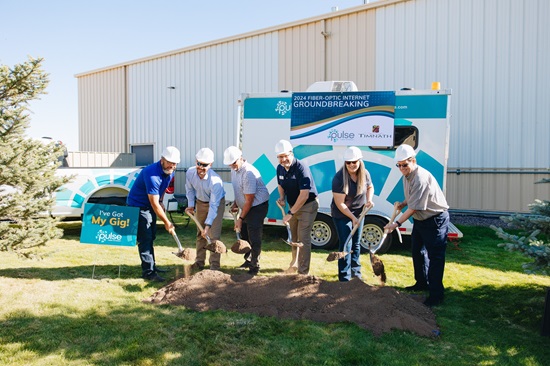
Timnath, Colorado Breaks Ground On New $20 Million Fiber Build

Timnath, Colorado officials have broken ground on a new $20 million fiber network that should dramatically expand affordable fiber access to the town of 7,100 residents.

Working in partnership with the city of Loveland’s Pulse Fiber, the project has been several years in the making, and – as with most of the successful municipal operations in Colorado – was fueled by ongoing public frustration with the speed, availability, and cost of monopoly-dominated regional broadband access.

“This project is about more than just Internet access,” Timnath Town Manager Aaron Adams said in a statement.

“It’s an investment in our future, ensuring that we have the infrastructure in place to support economic growth, attract new residents and businesses, and improve quality of life for everyone in Timnath.”

Last year the two cities signed an Inter-Governmental Agreement (IGA) greenlighting the plan to bring ubiquitous, affordable high-speed Internet access to Timnath. Under the arrangement, Tinmath is slated to receive 25 percent of the network’s gross income. That should equate to a 2 to 6 percent return on capital investment over 20 to 30 years, with the network fully paid off in 26 years.

Image
Timnath CO fiber network groundbreaking

Timnath’s project was heavily funded by the town’s capital improvement funds, which were in turn bolstered by broadband grants received via the 2021 American Rescue Plan Act (ARPA).

Fort Collins Municipal Network Celebrates 20,000 Subscriber Milestone

Fort Collins, Colorado has repeatedly won awards for being a trailblazer in the municipal fiber space, and local subscribers continue to take notice. The city-owned and operated Connexion network operation just announced it has passed the 20,000 subscriber mark, after nabbing a significant new wave of state and federal funding for expansion earlier this year.

Fort Collins began thinking about a citywide fiber deployment as early as 2012. By 2015, locals had voted to exempt the city from a counterproductive state law restricting communities from building their own broadband networks.

Image
Fort Collins 20K subscriber celebration flyer

Construction of the municipal network began in 2018. Subscribers began to connect to the network in 2019, and by 2023 fiber service was available to every last home and business in the city of 169,000.

Thanks to local leaders, city residents now have access to some of the fastest, most affordable broadband available anywhere, including symmetrical 1 gigabit per second (Gbps) service for $70 a month; symmetrical 2 Gbps service for $100 a month; and symmetrical 10 Gbps service for $200 a month. Connexion service comes with no usage caps or long-term contracts.

As part of its celebration of reaching 20,000 subscribers, Connexion officials say they will give away a year of free Internet access to 20 subscribers chosen at random. 

To mark the occasion, Chad Crager, Executive Director of Fort Collins Connexion, said:

Ting Brings Competition, Fiber Service and Microtrenching to Centennial, Colorado

The City of Centennial, Colorado is making steady inroads bringing affordable fiber Internet service to the city of 106,000, leveraging its city-owned fiber backbone and a partnership with the Charlottesville, VA.-based fiber provider Ting.

Just south of Denver – in a city known for its high-tech industry, craft breweries, and family-friendly neighborhoods – voter-approved efforts to get out from under the thumb of regional monopolies has driven a surge of competition, most recently exemplified by Ting’s continued delivery of affordable gigabit fiber.

Ting Public Affairs manager Deb Walker told ISLR that while the company couldn’t break out specific details on the number of passed fiber locations in the Centennial market, they’re making inroads on fiber deployments across Colorado.

“Now that Ting has city-wide networks built or under construction in three markets in the Denver region (Centennial, Greenwood Village and Thornton), and they share certain operational resources, we report progress on those markets together in our quarterly Ting Build Scorecard,” Walker said.

Image
Streets at SouthGlenn in Centennial Co

“At the end of the first quarter of 2024, we had almost 31,000 serviceable addresses in the region, mostly in Centennial as we’re just starting the other two markets,” she added.

In 2021 Ting also unveiled the construction of a new 16,000 square foot office complex and data center, Walker said. Ting is also collaborating with Colorado Springs Utilities, which is building a fiber network throughout the city and connecting local homes and businesses.

Federal Municipal Network Support Declining, Warns Experts

*In partnership with Broadband Breakfast, we occasionally republish each other's content. The following story by Broadband Breakfast Reporter Taormina Falsitta was originally published here.

Experts expressed concern that federal support for municipal broadband is limited, prompting uncertainty about future funding and operational sustainability at a Fiber for Breakfast event Wednesday.

Tyler Cooper, editor-in-chief of Broadband Now, a website that provides resources for internet providers, said that Broadband, Equity, Access, and Deployment (BEAD) grants are less promising for municipal broadband deployments despite initial promises.

Image
Broadbandnow logo

"We want to make sure BEAD funding areas have a vibrant competitive marketplace for decades to come," said Cooper. “It is here that I think municipal providers stand to make the most impact over time.”

“Municipal providers have been a lifeline to residents in these areas. They spur competition and innovation, they build future-proof technologies, primarily fiber, and they're more in tune in general with the needs of their communities than other providers.”

However, Cooper expressed concern that BEAD rules and requirements may not favor municipal networks, potentially favoring larger ISPs. BEAD has “become a much less promising vehicle for deploying municipal broadband nationwide.”

[See our recent story here on how local officials are seeing this play out in Massachusetts]  

Houston, Missouri’s Municipal Fiber Network Revs Up City’s Economic Development Engine With Big City Connectivity

In the Show Me State – cradled in the center of the Ozarks – Houston, Missouri is the biggest small city in Texas County.

And what local officials have shown its 2,100 or so residents over the last four years is that it can build its own modern telecommunication infrastructure to help spark economic development and offer big city Internet connectivity at affordable rates.

It began with a citizen survey in 2019, asking residents if they would be interested in a municipal broadband service, given the inadequate offerings of the big incumbent providers. Since then – not only has the city built an 18-mile fiber ring for an institutional network (I-net) to connect the city’s facilities – it has built a fiber-to-the-home (FTTH) network that now covers 95 percent of the 3.6 square-mile county seat.

Image
Houston MO fiber cabinet

“The project started in 2020 and we went live in the spring of 2021,” Randon Brown, Technology Director for the City of Houston Fiber Department, tells ILSR. “Construction of the project has taken approximately four years. (Today) 95 percent of the town (network) is operational and can be serviced.”

The city has spent $3 million of its own money to fund construction of the aerial fiber network, Brown said.

The network passes 1,200 premises with 272 subscribers now getting service from Houston Fiber, “which encompasses a mixture of residential and business customers” – though that number will soon rise to 364 (30 percent take rate) in the near future as more residents and businesses are in the pipeline waiting to be connected, he added.

Minnesota Strikes Down Preemption Laws Blocking Municipal Broadband

Community broadband advocates have scored a major victory in Minnesota as state lawmakers there have repealed the state’s preemption laws that prevented cities and towns in the Land of 10,000 Lakes from providing municipal broadband services.

The new legislation, signed into law yesterday by Gov. Tim Walz, took aim at two statutes that sought to protect large monopoly telecommunications providers from competition.

New Law Unwinds Antiquated Statutes

One antiquated law that had been on the books for over a century (Minn. Stat. Ann. § 237.19) allowed municipalities in Minnesota to buy or construct “telephone exchanges” only if they secured a supermajority vote in a local referendum election. Though intended to regulate telephone service, the way the law had been interpreted after the invention of the Internet was to lump broadband in with telephone service thereby imposing that super-majority threshold to the building of broadband networks.

Image
Minnesota state seal

Another law (Minn. Stat. Ann. § 429.021(19)) gave municipalities the express authority to “improve, construct, extend, and maintain facilities for Internet access” but only if a private provider was not offering service in that municipality.

But this week, with a single omnibus bill (SF 4097), those old preemption laws were repealed by state legislators and signed into law by the Gov. Walz yesterday, officially paving the way for any municipality in the state to have the option of building networks to offer municipal broadband service or partner for the same.

Untangling BEAD, Minnesota Repeals Preemption Law, and Open Access is Hard | Episode 95 of the Connect This! Show

Connect This! Show

Join us Friday, May 24th at 2pm ET for the latest episode of the Connect This! Show. Co-hosts Christopher Mitchell and Travis Carter will be joined by regular guests Kim McKinley (UTOPIA Fiber) and Doug Dawson (CCG Consulting) along with special guests Alexis Schrubbe (University of Chicago) and Brian Snider. They'll talk about how the devil's in the details with the BEAD program, movement in California surrounding digital discrimination, and Minnesota repealing its state preemption law.

Email us at [email protected] with feedback and ideas for the show.

Subscribe to the show using this feed or find it on the Connect This! page, and watch on LinkedIn, on YouTube Live, on Facebook live, or below.

Remote video URL