
Portlanders Launch Grassroots Campaign for Municipal Broadband in Oregon

Interest in broadband as a utility continues to rise across the country and in places where elected officials need a show of support, grassroots groups are stepping up. Recently in Portland, Oregon, a group of locals launched Municipal Broadband PDX, an effort to grow an already increasing momentum in the Rose City.
No Stranger to Fiber
The idea of better connectivity and local control over infrastructure is something that Portland has wrestled with for several years. With Comcast and CenturyLink controlling much of the market in the city of about 647,000 people, citizens have always struggled to get fast, affordable, reliable connectivity. The city failed at its attempt to provide free citywide Wi-Fi and the estimated price tag on a feasibility study more than ten years ago scared off the community. At one point, the city seemed about to get Google Fiber, but the plan never came to fruition.
Portland’s Integrated Regional Network Enterprise (IRNE) serves public entities with fiber connectivity and its leadership has been part of discussions on how to bring better access to businesses and residents. Back in 2012, we spoke with Mary Beth Henry with the Director of the Portland Office for Community Technology about early discussions. That was episode 7 of the Community Broadband Bits podcast.
Moving Forward


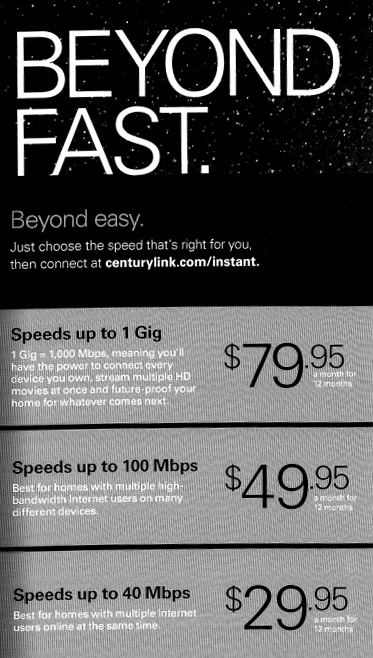 The promotional sheet claims CenturyLink will offer speeds "up to" 1 Gig for $79.95/month for 12 months. 100 Mbps runs $49.95 and 40 Mbps is $29.95 - each for 12 months. No mention of upload speeds but CenturyLink has demonstrated a real aversion to symmetry so users can expect far slower upstream than what modern municipal networks and Google fiber deliver.
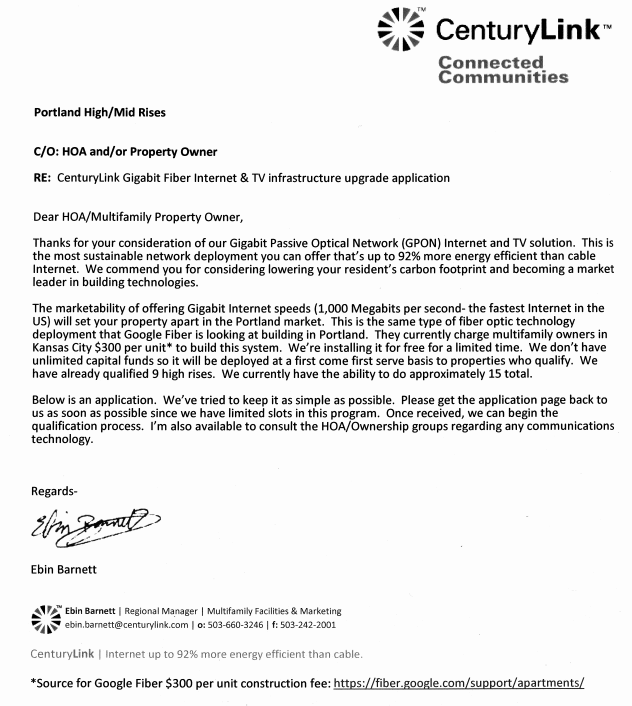
The standard operating procedure in apartment buildings will be for CenturyLink to try to lock up the internal wiring to buildings and deny it to competitors. FCC rules make exclusive agreements with landlords unenforceable, but there are a host of tricks that incumbents use to prevent any competition and landlords getting a kickback often have little reason to encourage competition.
The CenturyLink copy notes that its fiber optic GPON option is "up to" more than 92 percent energy efficient than cable modem Internet access. I have to wonder how it compares to DSL energy efficiency and whether that number holds up better than the "up to" 12 Mbps claims they make on DSL circuits that seldom peak at 5 Mbps.
At any rate, it is more than we can expect in the many communities CenturyLink is serving where there the local government have done nothing to spur competition by investing in publicly owned assets that could form a municipal network or be used to entice independent service providers to enter the market. In particular, I would be curious where else CenturyLink is rolling out fiber to buildings without any upfront charges.
The promotional sheet claims CenturyLink will offer speeds "up to" 1 Gig for $79.95/month for 12 months. 100 Mbps runs $49.95 and 40 Mbps is $29.95 - each for 12 months. No mention of upload speeds but CenturyLink has demonstrated a real aversion to symmetry so users can expect far slower upstream than what modern municipal networks and Google fiber deliver.
The standard operating procedure in apartment buildings will be for CenturyLink to try to lock up the internal wiring to buildings and deny it to competitors. FCC rules make exclusive agreements with landlords unenforceable, but there are a host of tricks that incumbents use to prevent any competition and landlords getting a kickback often have little reason to encourage competition.
The CenturyLink copy notes that its fiber optic GPON option is "up to" more than 92 percent energy efficient than cable modem Internet access. I have to wonder how it compares to DSL energy efficiency and whether that number holds up better than the "up to" 12 Mbps claims they make on DSL circuits that seldom peak at 5 Mbps.
At any rate, it is more than we can expect in the many communities CenturyLink is serving where there the local government have done nothing to spur competition by investing in publicly owned assets that could form a municipal network or be used to entice independent service providers to enter the market. In particular, I would be curious where else CenturyLink is rolling out fiber to buildings without any upfront charges.