
Timnath, Colorado Lights Up First Fiber Customer
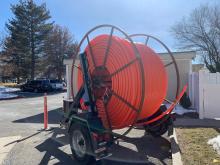
Last year, Timnath, Colorado broke ground on a new $20 million fiber network with the goal of dramatically expanding affordable fiber access to the town of 7,100 residents.
Some of the nation’s leading thinkers and doers in the community broadband sector will connect and collaborate in the nation’s capital for the inaugural Community First: The Future of Public Broadband Conference and Hill Day next week.
Slated for May 14 and 15, the two-day conference is being hosted by the American Association for Public Broadband (AAPB) and New America Open Technology Institute (OTI), in partnership with ILSR's Community Broadband Networks Initiative, the Benton Institute for Broadband & Society, and the Community Broadband Action Network.
The in-person gathering will bring together public broadband champions, community leaders, policymakers, and industry experts to focus on strategy and advocacy in the face of potentially dramatic changes to the $42.5 billion BEAD program – the single-largest federal investment to ensure every household in the nation has access to high speed Internet connectivity.
Registration and tickets are still available here.
With the rise of community-owned broadband networks and cooperatives now flourishing across the nation, organizers are hoping to create “an essential space to share best practices, discuss financing, shape public policy, and support the development and expansion of public broadband networks.”
Vermont’s Otter Creek Communications Utility District (CUD) says it has completed its ambitious fiber deployment, bringing affordable access to more than 6,000 homes and businesses in the Rutland County region of the Green Mountain State.
Otter Creek is another example of the way Vermont’s long under-served communities are bonding together via innovative new partnerships taking direct aim at the digital divide.
When last we had checked in on Otter Creek CUD, the CUD had just received a $9.9 million grant by the Vermont Community Broadband Board (VCBB). Otter Creek CUD then leveraged that grant funding to form a public-private partnership with Consolidated Communications.
Otter Creek CUD Chair Laura Black tells ILSR that the partnership involved 335 miles of new fiber passing *6,000 locations. Of the total target reach, 1290 locations had never had broadband access previously. Between the Otter Creek grant awards and contributions from private providers, more than $24 million has been invested in Rutland County to expand fiber access.
“We partnered with the existing ILEC business in most of our area, Consolidated Communications, to build and operate the fiber network with both their own contribution and grant funding we were able to secure,” Black said. “As well, a portion of our area was peeled off to allow the ILEC in three of the towns in our District to be served by the existing small ILEC business – Shoreham Telephone – under their own grant funding program (EACAM).”
Superior, Wisconsin officials say they’re getting very close to lighting up the first subscribers of a city-owned fiber network that will finally bring affordable, next-generation fiber access to the city’s long under-served community of 26,000.
“We have phase 1 in the ground and are working with Nokia right now for final configuration and testing,” Stephanie Becken, broadband manager for ConnectSuperior, tells ILSR.
“It's our plan to have our sign-up website ready in the next two weeks, as our two ISPs finalize their connections and offerings pages,” she says. “I'm hopeful we'll have drops and initial service started by mid-May, but we may be looking at June—there's always something!”
In 2020 the city passed a resolution declaring fiber essential infrastructure. In 2021, the city council voted overwhelmingly to move forward on a deployment master plan developed for the city by EntryPoint Networks.
In 2023 the Superior city council voted 8-1 to approve deployment in the project’s first pilot area: a swath of around 830 homes and businesses lodged between Tower Avenue, Belknap Street, and North 21st streets. But the phase 1 target area has expanded a little since as the city has moved forward on logistics and planning.
The Port of Whitman County in Washington state has received a new $2.9 million grant it says will help dramatically expand affordable fiber access to the heavily rural county of 48,000. The Port of Whitman’s broadband expansions have traditionally been open access, which allow multiple competitors to compete over shared, community owned infrastructure, driving down costs.
The latest funding, from the Washington State Department of Commerce’s Community Economic Revitalization Board (CERB) will support the construction of dark fiber to approximately 109 additional unserved and underserved locations in Whitman County.
According to the county announcement the project, supported by $622,441 in local matching funds, will construct last-mile fiber infrastructure along Sunshine Road east of Pullman, along Kitzmiller Road north of Pullman, and west of Tekoa. The build outside of Tekoa will bring fiber to the Port of Whitman County’s Tekoa industrial site, which the Port acquired in 2023.
“The Port is excited to partner with CERB on this broadband project,” said Kara Riebold, Port of Whitman County Executive Director.
“This continues our efforts to bridge the digital divide in rural Whitman County. We know that reliable broadband is no longer a luxury but a necessity for economic growth and are grateful for CERB’s continued investment in broadband across Washington State.”
In Washington State, several Public Utility Districts – including the Port Of Whitman County, the Port Of Coupeville, and the Port of Skagit in Skagit County – have leveraged millions in American Rescue Plan Act (ARPA) grants to deploy community-owned open access fiber, choosing Ziply as their operational partner.
Vermont’s Communications Union Districts (CUDs), which were the subject of a recently released ILSR report, continue to make steady inroads in delivering high-quality broadband access to long-neglected rural Vermont residents.
In 2021 the Vermont legislature passed Act 71, ensuring CUDs would play a key role in expanding fiber access in the Green Mountain state. In Vermont, municipally-led CUDs – municipal entities created by two or more towns with a goal of building communication infrastructure – can legally fund needed broadband expansions through debt, grants, and donations – but not taxes, though they themselves are tax-exempt nonprofits.
The CUD model allows municipalities to bond together to tackle broadband network deployments that might otherwise prove too costly or logistically difficult if attempted alone.
The results have been transformative for state residents long underserved or completely unserved by the state’s regional incumbent monopoly providers. Locals at times have likened the transformation to moving out of the “dark ages.”
Much of Vermont’s $150 million ARPA-based broadband package went toward assisting CUDs in a state where 85 percent of municipalities and 90 percent of all underserved locations fall under an existing CUD’s jurisdiction.
Comcast says it’s acquiring San Bruno, California’s CityNet, a municipally owned and operated broadband, video and voice network that currently serves over 5,400 residents and businesses.
San Bruno’s $8 million sale to Comcast was prompted by $21.5 million in debt and what the city says was surging operating costs. Unlike many municipal broadband providers, San Bruno also provided television services, which many smaller providers and communities are moving away from due to soaring programming costs and dwindling and unsustainable profit margins.
“Rates simply were not keeping pace with costs,” Bruno city manager Alex McIntyre wrote in a January report to the City Council. “CityNet has grown increasingly technologically obsolete over the past decade.”
Despite increasing service rates between 9 and 12 percent, the city says it saw operating losses of $794,852 in 2023 and $859,995 in 2022.
Originally founded in 1972 as San Bruno Cable TV, the pioneering cable broadband operator (with some scattered fiber development) struggled with modernizing its coaxial network to fiber, something city leaders refused to fund.
“A significant City-funded capital investment would be required to bring CityNet’s technology and operations up to current industry standard, as well as rate adjustments,” McIntyre wrote. “The Council declined to authorize this capital request in April 2023.”
UTOPIA Fiber is celebrating another banner year.
Created in 2009 by a coalition of Utah cities to cultivate a competitive market for fast affordable fiber Internet, the nation’s largest community-owned open access network recently announced it officially hit the 70,000 subscriber mark.
UTOPIA (Utah Telecommunication Open Infrastructure Agency) is now delivering fiber-to-the-home (FTTH) access in 21 Utah cities, partnering with 19 private-sector ISPs, while offering business-class service in 50 cities.
Over the past year – having deployed 1.9 million feet of fiber-optic cable, 1.3 million feet of underground conduit, 68,190 feet of aerial strand, and 8,660 handholes – UTOPIA’s growth in 2024 means fiber access is now available to 23,684 new homes and an additional 1,974 businesses in Utah, UTOPIA officials said.
This comes after having completed its West Haven City buildout and the nearly complete construction of Bountiful Fiber’s network, which is on track to be finished by July. Additionally, UTOPIA has also completed fiber installations in 22 homeowner associations (HOAs) and are gearing up to connect more in the coming months.
UTOPIA Fiber executive director Roger Timmerman pointed to the surging demand for affordable fiber connectivity as to what’s fueling the growth:
“Residents are the driving force behind these fiber projects because they need better Internet now, not years down the road.”
For Timmerman, the truth is in the ledger. UTOPIA added 11,256 new subscribers in 2024, which pushed its subscriber total to over 70,000 – half of whom joined the network in the past three to four years.
Leveraging years of regional fiber collaboration, Carson, California has broken ground on a municipal broadband pilot network city officials hope will someday be expanded to bring affordable fiber optic broadband to the entire city of 95,558, situated just 13 miles south of downtown Los Angeles.
Carson is looking to leverage $8 million in federal and state grant money to connect 1,000 unserved households and 372 businesses, with City Hall, the Civic Center and Cal State Dominguez Hills serving as anchor institutions for the new network. A new city announcement says construction has begun, with the pilot construction phase to be completed in 18 months.
“This visionary project is set to transform Carson into a cutting-edge digital hub, revolutionizing broadband access for residents, businesses, and city services,” the city said in a statement announcing the groundbreaking.
The new network deployment comes as the Los Angeles area prepares to host the 2026 FIFA World Cup, and is being built on the back of previous collaborative fiber deployments amid the state of California’s landmark effort to boost statewide broadband competition.
“This project represents a major milestone for Carson,” Carson Mayor Lula Davis-Holmes said of the new deployment. “By investing in our own fiber network, we are creating a foundation for enhanced connectivity, economic growth, and future smart city initiatives. This is just the beginning of a transformative journey for our community.”
The city of Willmar, Minnesota (est. pop. 21,000), has voted to move forward on plans for a city-owned open access fiber network. The $24.5 million investment, which saw finalized approval by the Willmar city council earlier this month with a 4-3 vote, aims to drive accountable, affordable, fiber access to long underserved parts of the city about 100 miles west of Minneapolis/St. Paul.
In its 4-3 vote in early March, the City Council opted to continue work on the Connect Wilmar Initiative, something it says is an answer to the ongoing failures by regional incumbent telecom monopolies to provide uniform, high quality, high speed, affordable Internet access.
“Local internet providers were not interested in improving Willmar's internet infrastructure,” the city says. “After soliciting proposals, the city chose to partner with Hometown Fiber, aligning with Willmar’s long-term vision to provide fast, reliable internet through an open-access fiber network.”
The decision to move forward on the network comes after several years of careful planning, starting with the creation of a city broadband committee in September of 2022, and a mapping of local broadband access (or lack thereof) completed in December of 2022.