
muni

Content tagged with "muni"

Displaying 601 - 610 of 977

Chattanooga's Fiber Network Praised for Great Customer Service

One of the main differentiator's of community owned networks compared to the big cable and telephone companies is customer service. Being rooted in the community, vested in its success, and employing local residents just means better, more prompt service. A prominent Chattanoogan recently explained

My last shout-out is to EPB Fiber Optics.  This is not a paid commercial, just an opportunity for me to brag on some people who know what they’re doing.  I am the first to go on social media and complain about whatever store or business is guilty of subpar service.  It’s human nature, and it often makes for a good story.  I started using EPB for my cable, internet and phone service about a month ago.  I have encountered three problems during that time, none of them major, but all beyond my level of expertise.  Each time, I called their help line.  Each time, I spoke to local people who did not put me on hold for extended periods, nor did they force me to learn a new language.  They always solved my problem within five minutes.  My blood pressure thanks you, EPB.  This is how it’s done.

We hear these stories frequently with community owned fiber networks. It is hard to do a national study that quantifies the benefits of better customer service, but if we could, we have no doubt the locally owned networks would bury the national cable and telephone companies.

Community Fiber Is Not Just About the Fiber

The focus on community networks tends to linger on the technology - FTTH is much faster and more reliable than cable or DSL services. But community fiber is only partially about the superior technology, as evidenced by a recent story over at Broadband Reports - "Verizon has been Quietly Increasing FiOS Fees." We don't see this behavior in Chattanooga, which has gone over four years without raising the fees for Internet access to telephone services. Community networks rarely increase their fees because the cost of delivering Internet and telephone services declines over time. Television prices go up, though less rapidly for community networks than big cable firms because the big firms demand a bigger margin. Further, we see that Verizon has been sneaking its price increases into things like the router rental fee, as Comcast and most providers have long done. At one point, renting the Comcast modem cost me $2, then $5, now $7, and in some places $9 I hear. Per month. I bought my own now - took less than a year to payback. But my bill has gone up even more since then, so I didn't gain much. Now Verizon is even charging for battery backup units:
In addition to price hikes, promotion cuts, the new gateway rental fee and the activation fee, Verizon also recently started charging users for the backup batteries in their ONT units, first charging users for backup battery replacement, then charging users to get any backup battery in the unit to begin with.
Anytime you hear someone arguing that munis should only be able to build their own networks where the private sector absolutely refuses, recall that community owned networks are not simply a consolation prize, they are often superior. Better customer service, lower rates over the long term, and more likely to invest in upgrades as needed - there is no good reason to condition this investment on the refusal of some other distant company to provide an inferior alternative.

Being a Gig City: Incubating Small Businesses

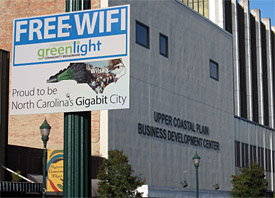
This is the first in a series of posts examining a premier Gigabit Community - Wilson, North Carolina. According to the U.S. Small Business Administration, 85% of all jobs originate from companies with fewer than 30 employees, and 87% of businesses which started through business incubators have succeeded after five years. So Wilson, North Carolina, focused its "Greenlight" gigabit beam on its local business incubator, the Upper Coastal Plan Business Development Center. "Greenlight is driven by three guiding principles," said Will Aycock, the network's General Manager. "Supporting the economic health of the community, improving the delivery of city services, and enhancing the quality of life for the citizens of Wilson." Providing access to symmetrical gigabit speeds has allowed the community's small business incubator to take its services to the next level, to give budding entrepreneurs access to the future today and in a uniquely affordable way. According to Greg Goddard, Executive Director of the Upper Coastal Plain Council of Government, access to gigabit speeds has meant "Taking our incubation to the next level." Historically their business incubator has attracted "low tech" entrepreneurs: consultants, counselors, state associations, childcare and healthcare providers, people who need work space after normal office hours, even Chic Fil-A administrators, for employee training. The incubator provides a full suite of services including a receptionist, copy and fax machines, phones, 24 hour secure entry, kitchen, meeting rooms, training classes, access to experts, parking, and now, symmetrical gigabit speeds, all for an affordable price. "An 8' by 8' cubicle with those full-suite services leases at $275/month," he said. The goal is to stimulate budding internet-age businesses. Free Wi-Fi in Wilson And it has, even for young entrepreneurs elsewhere in the state. For a tech entrepreneur like Dan Holt from Wake Forest, renting space at this Wilson-based incubator lets him be part of the future, and to experience the possible which is impossible at his home in Wake Forest only 30 miles away. Dan is a self-described techie for a local Raleigh defense subcontractor but he likes to be known as founder of the Wake Forest Fiber Optic Initiative.

Kansas Community Benefits from Community Owned Networks

Even though the Kansas cable lobby have temporarily retracted their competition-killing telecom bill, we still want to highlight the benefits of preserving full home rule, local authority by focusing on a number of communities, including Chanute, Ottawa, and Erie.

Chanute

We have reported on Chanute's municipal network for years. The community leveraged its electric utility assets and incrementally built an extensive publicly owned gigabit fiber network. Over several decades, the community expanded its network to serve schools, libraries, local government, and businesses. Chanute took advantage of every opportunity and created a valuable asset with no borrowing or bonding.

Several business, including Spirit AeroSystems, chose to locate in Chanute because of its incredible fiber network. Spirit brought approximately 150 new jobs. The network also retained jobs when incumbents refused to provide needed upgrades to local businesses. Rather than leave town, the businesses connected to the City's network and increased their productivity. 

Former City Manager J.D. Lester referred to municipal broadband as “the great equalizer for Rural America,” saying: “You don’t have to live in Kansas City to work there.” (See our case study Chanute's Gig: One Rural Kansas Community's Tradition of Innovation Led to A Gigabit and Ubiquitous Wireless Coverage [PDF])

Kids in Chanute have access to connectivity other schools can only dream about. The local community college has expanded its distance learning program with higher capacity broadband. Free Wi-Fi hotspots are all over town; money otherwise sent to distant providers stays in the community. Chanute has invested in a WiMAX wireless system that serves public safety all over the region, not only in town. Their other utilities use the network for automatic metering and SCADA applications, saving energy and allowing customers the chance to reduce utility bills.

UTOPIA Again Targeted by Bill in State Legislature

Kansas is not the only place where the cable and telecom lobbies are attacking publicly owned networks. Jesse Harris from FreeUtopia.org reports that State Rep. Curt Webb has introduced HB60, aimed at UTOPIA. From the story:

As the bill is currently written, UTOPIA wouldn’t just be prevented from building to people willing to pay for it. They could also be required to shut down any existing services and be prohibited from maintaining their backbone that links cities together. It would effectively be a death sentence on any network that isn’t entirely within member cities AND can connect to an exchange point to reach ISPs and the rest of the Internet.

FreeUtopia also reports that the bill does not affect cable, DSL, wireless, or any other technology. Harris writes:

Naturally, I had to follow the money and it explains a lot. Rep. Webb has taken contributions from CenturyLink and the Utah Rural Telecom Association. 

As an observation, I take issue with the state's fiscal note on HB60. It reports that enactment of the bill "likely will not result in direct, measurable costs for local governments." The fiscal note also concludes that "enactment of this bill likely will not result in direct, measurable expenditures by Utah residents or businesses."  

If this bill ends UTOPIA in certain areas, affected government, residential, and business customers will lose the competitive rates they now enjoy - direct and measurable! See Pete Ashdown's comment on Jesse's story - he runs XMission, a beloved local ISP that uses UTOPIA to connect to some subscribers.

This bill is another example of how cable and telephone company lobbyists are not just trying to shut down municipal networks, but any possible public private partnerships. This is emphatically not about tax dollars, as Jesse rightly notes:

A Roadmap for the FCC To Ensure Local Authority to Build Networks - Community Broadband Podcast #84

When the DC Circuit Court handed down a decision ruling against the FCC's Open Internet (network neutrality) rules, it also clarified that the FCC has the power to overrule state laws that limit local authority to build community networks. Harold Feld, Senior Vice President for Public Knowledge, joins us for Community Broadband Bits Episode #84 to explain the decision. Harold exlains what Section 706 authority is and how all the DC Circuit judges on the case felt that the FCC, at a minimum, has the authority to strike down laws that delay or prohibit the expansion of broadband infrastrcturue. We then discuss how the FCC can go about striking down such laws to reestablish local authority - a community in a state like North Carolina could file a petition with the FCC for action or the FCC could decide to take action itself. Either way, it will have to build a record that laws revoking local authority to build networks are harmful to expanding this essential infrastructure. Finally, some of this power filters down to state public utility commissions, but just how much is unclear at present. Read the transcript from our discussion here. We want your feedback and suggestions for the show - please e-mail us or leave a comment below. Also, feel free to suggest other guests, topics, or questions you want us to address. This show is 15 minutes long and can be played below on this page or via iTunes or via the tool of your choice using this feed. Listen to previous episodes here. You can can download this Mp3 file directly from here. Find more episodes in our podcast index. Thanks to Fit and the Conniptions for the music, licensed using Creative Commons.

OnLight Aurora Partners with the City for Better Connectivity in Illinois

Nine years ago, Aurora officials decided it was time to reduce telecommunications costs and upgrade to a faster, more reliable network. The local government built a fiber network to service municipal government, but developed long-term ideas for the network to benefit the entire community.

Nonprofit OnLight Aurora now uses the City's fiber optic network to provide high-speed connectivity to educational institutions, businesses, healthcare facilities, social service entities, and major non-profits. The organization leases fibers from the City's fiber optic network and provides Internet access at affordable rates.

Aurora is the second most populous city in Illinois. The municipal government spans 52 buildings over 46 square miles. Before the city's fiber network, connections were a patchwork of varying speeds and capabilities. Employees in a building with a slow connection would need to travel to City Hall to access a high-speed connections to use the city's bandwidth intensive applications. The network was old, unreliable, and expensive. The Director of Onlight Aurora recently spoke with Drew Clark from Broadband Breakfast :

"In 2005-2006, we came to the conclusion that we were paying $500,000 a year [to telecommunications providers] for leased line expenses,” said Peter Lynch, Director and President of Onlight Aurora.

The 60-mile network, constructed from 2008 - 2011, cost approximately $7 million to deploy. At the beginning of the process, payback was estimated at 10 years. While the short-term goal was to cut municipal connectivity costs, community leaders intended to expand its use in other ways. The City now saves approximately $485,000 each year from having eliminated leased lines. From a Cisco case study on Aurora [PDF]:

Baltimore Mayor: You Can't Grow Jobs with Slow Internet

Baltimore Mayor Stephanie Rawlings-Blake sees expanding Internet access as a justice issue and wants to make sure every Baltimore resident benefits from City assets, including fiber optic cables. To that end, the City is examining how it can use its conduit and fiber to improve Internet access. We have previously covered Baltimore and its consideration of public investments to expand Internet access after both FiOS and Google decided not to invest there. In the interview below, Mayor Rawlings-Blake expands on why this is important, saying "You can't grow jobs with slow Internet... people don't want to invest in communities where they feel like they are running through sludge, trying to catch up with other businesses," going on to say, "People want to be on the cutting edge."

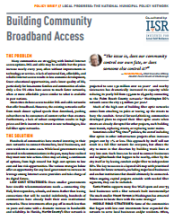
Policy Brief: Building Community Broadband Access

In partnership with the Center for Popular Democracy, we have created a new policy brief: Building Community Broadband Access. We offer examples of communities that have acted to improve access by using smart strategies that facilitate community owned networks.

This fact sheet provides information to legislators, advocates, or concerned citizens who want to educate others about the benefits of publicly owned networks. This is the latest in our growing collection of convenient, compact, and instructive fact sheets. 

The Center for Popular Democracy works with a long list of local, state, and national groups to exercise grass-roots democracy. 

Download the Policy Brief [PDF].

Sun Prairie Ponders Fiber Network Investment in Wisconsin

The Sun Prairie City Council met on January 14th to discuss a possible investment in a municipal fiber network. Thank you to local resident Jonathan Kleinow for alerting us to developments in the south central Wisconsin town.

The Star published an article about the meeting in which The Motive Group presented information to the Committee of the Whole. According to the story, the consulting firm has been working with Sun Prairie Utilities for a year to find ways to improve local connectivity and spur economic development with fiber. The community is considering the possibilities of a triple-play FTTH network for the areas 30,000 residents.

Sun Prairie Utilities solicited responses to a community survey. They received 700 responses with 88% in favor of a fiber investment. 

From the article:

The recommended plan put for[th] by The Motive Group has a total cost of near $27 million, with $21 million of that as year-one capital expenditures to serve roughly 13,550 homes and businesses in the city.

Budgeted in the initial year's expense total is $11 million for aerial and underground construction and equipment.

Once the fiber system is operational and available for customers, [The Motive Group's Beth] Ringley said projections show $9.97 million in annual operating revenue by year 20 of the system to go along with expenses of $1.26 million.

By year 20, total assets are projected to be at $27.16 million, with total cash at $12.56 million.

Councilman Jon Freund commented that he was opposed to the idea at first but that he now believes Sun Prairie Utilities and the City could partner to distinguish the community. From the article:

“Technology has become a greater and greater need for both businesses and residents,” Freund continued. “This is an opportunity for us to basically differentiate Sun Prairie from all the other communities in Dane County.”

...

He added that fiber installation would “put Sun Prairie on the leading edge” for economic development and local and long-distance education opportunities.