
Fast, affordable Internet access for all.
minnesota
Content tagged with "minnesota"
A Closer Look at FiberNet Monticello
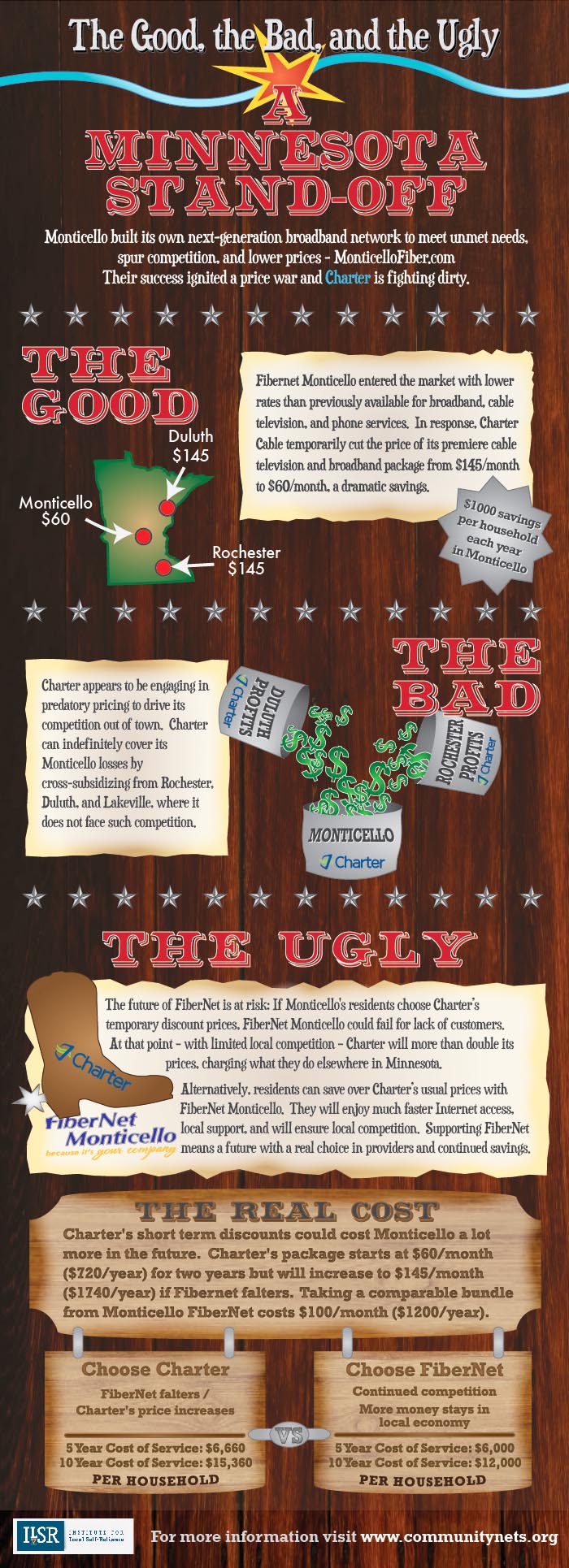
City administrator Jeff O'Neill said that the city has no intention of abandoning FiberNet's 1,700 customers, including about 130 businesses. "This system isn't going anywhere," he said. "We're not going out of business." Despite the problems, he said the city has one of the fastest Internet systems in the country that has driven down prices and improved services by providing competition.The article also notes that prior to the City-owned network, the telephone company (TDS) provided very poor DSL service that was harming area businesses with slow and very unreliabile phone and broadband services. Without FiberNet Monticello, we don't know how many businesses would have been forced to relocate to be competitive in the digital economy. We decided to dig a little deeper to get a sense of what Monticello has received for its investment and difficulty. We previously examined the prices charged by Charter cable in town and found that households taking that deal were saving $1000/year.
We also noted that Charter was almost certainly engaging in predatory pricing. After talking with other networks, we would guess that Charter is losing between $30 and $50 (conservatively) per subscriber per month.State by State Campaign to Gut Consumer Telecom Protections
AT&T and Verizon, the dominant telephone companies, want to end their 99-year-old universal service obligation known as "provider of last resort." They say universal landline service is a costly and unfair anachronism that is no longer justified because of a competitive market for voice services. The new rules AT&T and Verizon drafted would enhance profits by letting them serve only the customers they want. Their focus, and that of smaller phone companies that have the same universal service obligation, is on well-populated areas where people can afford profitable packages that combine telephone, Internet and cable television.What happens when the states hand over authority to these companies? David has an answer:
AT&T and Verizon also want to end state authority to resolve customer complaints, saying the market will punish bad behavior. Tell that to Stefanie Brand. Brand is New Jersey's ratepayer advocate whose experience trying to get another kind of service - FiOS - demonstrates what happens when market forces are left to punish behavior, she said. Residents of her apartment building wanted to get wired for the fiber optic service (FiOS) in 2008. Residents said, "We want to see your plans before you start drilling holes, and Verizon said, 'We will drill where we want or else, so we're walking,' and they did," Brand told me. Verizon confirmed that because of the disagreement Brand's building is not wired. And there's nothing Brand can do about it. Verizon reminded me the state Board of Public Utilities no longer has authority to resolve complaints over FiOS.Better broadband is not just about technology.
Southwest Minnesota Broadband Services' Construction Moves Forward
Good news for folks in Jackson, Wilder, and Bingham Lake in Southwest Minnesota! Your local broadband options are about to get much better. Southwest Minnesota Broadband Services (SMBS) just announced that construction is advancing on the new network. The 125-mile fiber ring is expected to be completed by September, 2012. If you live in their service area, give them a call.
Here are contact details from the announcement:
Wilder - A sales event has been held. Please call our Lakefield office at 507-662-7000 if you still need to sign up for services.
Bingham Lake - A sales event will be held on April 10th from 12 PM to 8 PM at the town hall/community center. If you are unable to attend, please contact our Lakefield office at 507-662-7000.
Jackson - Our first three construction phases have been identified. We intend to have phases 1-3 completed by June, 2012. Our web-site, mysmbs.com will be updated as construction dates are set for phases 4-9. The entire City of Jackson will be completed by fall, 2012. Southwest Minnesota Broadband informational material will be delivered to homes according to construction phasing in the coming months.
SMBS is a consortium of 8 communities: Bingham Lake, Brewster, Heron Lake, Jackson, Lakefield, Okabena, Round Lake and Wilder. Stimulus funding of $12.8 million dollars is allowing the communities to offer ftth service in this rural area, building on the network first established in Windom by the local public power utility.
SMBS recognizes the need for a community owned network in a place where the private sector does not want to invest. On their FAQ page:
What is SMBS? Southwest Minnesota Broadband Services is consortium of cities that realize today’s incumbent service providers will not be able to provide the next-generation of broadband services that will keep this area competitive with the global marketplace. SMBS will own and operate the network, employees will be your friends and neighbors and dollars will stay in your communities.
Digital Divide Event in St Paul on April 18
As the Internet and other information technologies have transformed our lives, we now benefit from greater connectivity to educational, employment and social opportunities in the Twin Cities. Yet low income communities, communities of color, and immigrant communities are often left behind. This exclusion deepens the divide between the haves and the have nots and reinforces the inequities in our region. Join us for our next Organizer Roundtable where will we take a look at organizations who are working to bridge the digital divide. Come and learn the strategies that they are using to provide access to underserved communities in our region.The event is at 12:30 on April 18 (Wednesday) at the Merriam Park Library.
New Minnesota Networks Face Tough Challenges
Bill Tapper, who owns a cabinet company with clients around the world, recalls a time just a few years ago when the Internet was so slow it hurt business. "The service we had in Monticello was horrible," he said. "My employees would sometimes take the data home where they had a better Internet connection than we did and do their uploads at night." Tapper said he lost out on business, but at the time the established Internet service providers like phone and cable TV companies told Tapper and other frustrated business owners in town that the city was wired sufficiently.
After the community voted in favor of a publicly owned fiber-optic network, the incumbent provider, TDS, filed a lawsuit. The lawsuit strategically succeeded in stalling the development of the new network but did not destroy the project. Even though the incumbent provider describes pre-network status as "just fine before the city got involved," TDS took advantage of the delay they caused to began building their own fiber network. Currently, subscribers in Monticello are benefitting from their high-speed fiber in ways beyond expanded and improved access.
Charter Fights Dirty to Kill Competition in Monticello
Download a higher resolution PDF here.
Charter has taken a package for which it charges $145/month in Rochester, Duluth, Lakeville, and nearby Buffalo (MN) and is offering it for $60/month - price guaranteed for 2 years. A Monticello resident supplied us with this flyer, which this person had received multiple times at their home over the course of a month. (See below for the full flyer).
This is either predatory pricing or the cable industry is out of control with its rate increases. If that package costs Charter more than $60/month to supply, then it is engaging in predatory pricing to drive competitors out of the market. Consider that Charter may be taking a loss of $20/month ($240/year) from each household that takes this offer.Minnesota Legislation Would Revoke Local Authority over Broadband
In Minnesota, Rural Fiber to the Farm Project Expands
Soeffker, who farms with her husband in rural Sibley County, said the dish receiver they must use works fine in good weather but balks during heavy rain and snowstorms. Meantime, her husband struggles with a lagging Internet speed of .6 megabits a second that falls short of meeting his business needs when he’s selling commodities.The committee organizing the network set a goal for demonstrating the interest of something like 50% of the population in the target area. There has been some confusion as to exactly how many they should have before committing to the project but with just two mass mailings, they have received nearly 3,000 positive responses (of the over 8000 households that could be served). This is a very strong response. To keep the public informed, they have had numerous public meetings in each of the communities that will be involved. To be as open as possible, they would often have three meetings in a town per day -- a morning, afternoon, and evening meeting to accomodate everyone's schedule. As this project moves forward, no one can claim the group has been anything but open with the plan. On January 19, they had a major meeting with over 100 people attending, including many elected officials from the towns. For over two and a half hours, they had five presentations and numerous questions.
Rural Community Broadband Network in Minnesota Garners More Coverage
Schensted and his wife are the first in their southwest Minnesota community to connect to a new high-speed Internet service. He said the new service is everything it was advertised to be. "We're getting anywhere from 50 megabits downloading and about 20 to 30 uploading," Schensted said. "It's just really incredibly fast."Stimulus dollars spent on expanding publicly owned networks gets the most bang for the taxpayer's buck and should have been a much larger focus for the broadband stimulus. The people and businesses served by this network have faster connections at lower prices than we can get in the metro area of Minneapolis/St Paul.
Schensted's house is connected to the nearly $13 million Southwest Minnesota Broadband Service project that will serve eight communities: Bingham Lake, Brewster, Heron Lake, Jackson, Lakefield, Okabena, Round Lake and Wilder. Internet equipment Schensted said he has never had that kind of Internet speed, even when he lived in the Twin Cities. "This is perhaps overkill for even my home," he said. "I'm not complaining about it, but it's a wonderful overkill. My wife and I can both be using a computer, we can be streaming something on the television, all at the same time which is something we wouldn't have dreamed of before."Smart public investments can connect everyone in this state, at a fraction of the price that it would cost to subsidize the big private companies to do it. They are too inefficient and require too large a margin of profit, in addition to a host of other problems.