
infrastructure

Content tagged with "infrastructure"

Related Topics
Displaying 111 - 120 of 145

Virginia's Roanoke Valley Opens Fiber Access - Community Broadband Bits Podcast 221

Having few options for high-quality telecommunications service, Virginia's Roanoke Valley formed a broadband authority and is building an open access fiber-optic network with different options for ISPs to plug-in. In addition to being our guest on Community Broadband Bits episode 221, Frank Smith is the Roanoke Valley Broadband Authority CEO and President. We discuss their various options for ISPs to use their infrastructure and the various services their network is providing, including access to conduit and dark fiber leases. We also discuss why they formed a state authority to build their carrier-grade network. Though they have had some pushback from incumbents - something Frank seems unphased by in calling the Authority "the new kid on the block" - they have built local support by building relationships with local organizations like Blue Ridge PBS. Read all of our Roanoke Valley Broadband Authority coverage here.

This show is 29 minutes long and can be played on this page or via Apple Podcasts or the tool of your choice using this feed

Transcript below. 

We want your feedback and suggestions for the show-please e-mail us or leave a comment below.

Listen to other episodes here or view all episodes in our index. See other podcasts from the Institute for Local Self-Reliance here.

Thanks to mojo monkeys for the music, licensed using Creative Commons. The song is "Bodacious."

AT&T Gets Snagged In Giant Loophole Attempting To Avoid Merger Responsibility

They're at it again. Recently, they have been called out for taking advantage of E-rate; now they are taking advantage of their own lack of infrastructure investment to worm their way out of obligations to serve low-income residents. Fortunately, a nonprofit group caught up with AT&T's shenanigans and held their feet to the fire.

"Nah, We Don't Have To Do That..."

As part of FCC-mandated conditions under which AT&T was allowed to acquire DirecTV in 2015, the telecommunications conglomerate created the "Access from AT&T" program, offering discount Internet access to low-income households. The program consists of tiered services - download speeds of 10 Megabits per second (Mbps) for $10 per month, 5 Mbps for $10 per month, and 3 Mbps for $5 per month.

The company is required to enroll households in the fastest speeds available, but a significant amount of low-income families don't qualify because the fastest speed AT&T offered to their home is 1.5 Mbps download. The problem, created by AT&T's own lack of infrastructure investment in certain neighborhoods, allowed AT&T to dodge their responsibility under the terms of the DirecTV acquisition by simply denying enrollment to households with speeds less than 3 Mbps. Trouble is, some one noticed.

NDIA In Cleveland, Detroit

The National Digital Inclusion Alliance (NDIA) realized the scope of the problem when they attempted to help families in low-income neighborhoods in Detroit and Cleveland sign up for Access from AT&T. In addition to discovering that residents could only obtain 1.5 Mbps download speeds, NDIA found that AT&T denied these households enrollment because their speeds were too slow. The only other option for ineligible households was AT&T’s normal rate for 1.5 Mbps service, which is six times the cost of the Access program.

Loopholes: All Lawyered Up And Nowhere To Go

Davis, CA, Issues RFP For Feasibility Study: Responses Due Oct. 31

The city of Davis, California, recently released a Request for Proposals (RFP) for a citywide fiber-optic feasibility study report. The community wants to consider the options for a Fiber-to-the-Home (FTTH) network. Responses are due October 31.

The scope of the work includes:

The study should provide an analysis of options for engineering, constructing, provisioning and operating a high speed citywide FTTP network. It should feature both physical and network transport layer components required to pass and potentially connect every home, business, apartment complex, and institutional building within the City of Davis. The analysis should also consider future use at strategic infill and edge points around the City in order to support network growth through the coming decades. 

Davis wants firms to consider public private partnerships, the city’s network as an open access infrastructure, and Davis is only an infrastructure provider.

In early 2015, a group of citizens formed DavisGIG to encourage community leaders to move forward by establishing a Broadband Advisory Task Force and the feasibility study. In March, Davis established a task force to examine the possibility of deploying a network to serve municipal facilities, community anchor institutions, businesses, and residents. Incumbents Comcast, AT&T, Omsoft, and non-profit Davis Community Network offer a wide range of services now and there is little consistency for the city’s 68,000 residents.

The University of California Davis (UCD) is a major employer, as is the State of California. According to the RFP, there is a growing entrepreneurial culture springing up in Davis due to the presence of UCD’s research environment. The community wants to feed that growth with a citywide, future-proof, FTTH network.

Important due dates:

  • Notice of Intent to Respond:  Thursday Sept. 22, 2016
  • RFP respondent questions due: Thursday Sept. 29, 2016
  • Answers to questions distributed: Friday Oct. 14, 2016
  • Proposals Due: Monday Oct. 31, 2016 at 3:00 p.m. PT

Send questions to Diane Parro, Chief Innovation Officer: clerkweb(at)cityofdavis.org.

Port of Lewiston Crossing Bridges: Network Forges Ahead

Port of Lewiston’s open access dark fiber network continues to move toward completion. Construction crews are burying fiber lines at multiple project sites around Lewiston. In the past few weeks, the network crossed to the north side of Clearwater River via the Memorial Bridge, where it will link to Whitman County’s fiber network. 

A recent article from the Port of Lewiston listed completed sections of the network, 

“So far, it reaches major employers such as St. Joseph Regional Medical Center, Lewis-Clark State College, Regence and the Vista Outdoor plant at 11th and Snake River avenues.”

The article also outlined the projects to be completed by September 1st,

“They will reach the industrial district by the Lewiston-Nez Perce County Regional Airport, Clearwater Paper, Schweitzer Engineering Laboratories and the Southway Bridge. At the bridge, the lines will connect with an Asotin County network built by the Port of Clarkston.”

Questions From The Past

Memorial Bridge is only the first of two bridge crossings necessary for the completion of the Lewiston-Whitman-Asotin fiber network. The Southway Bridge crosses the Snake River to Asotin County. Conduit access rights stalled construction progress across the river. We wrote about the negotiations in a story from earlier this summer.

Readers may recall that there was a question with Centurylink's right to have conduit on the bridge and whether or not they owned the conduit or where the provider's potential ownership rights ended. To iron out the details, the Port of Lewiston filed a Freedom of Information Act request with the U.S. Army Corps of Engineers, the bridge builders.

Dark Fiber Available In Lewiston But Rivers Slow Expansion

The Port of Lewiston’s dark fiber network is up and running and now has connected a commercial customer, reports 4-Traders, but achieving the maximum reach has hit some resistance.

Warehousing and distribution company Inland 465, is operating a 150,000 square-foot warehouse and obtaining Internet access from First Step Internet, which leases dark fiber from the Port of Lewiston’s network. Community leaders hope this is the first of many commercial customers.

Last summer the community announced that they intended to deploy an open access dark fiber network to spur economic development opportunities. The network plan called for a connection to nearby Port of Whitman’s fiber network, which has operated for more than a decade.

Bumps On Bridges

According to 4-Traders, the Port of Lewiston is encountering issues deploying over the optimal route for expanding to serve more commercial clients. The community is near the Clearwater and Snake Rivers and must cross bridges en route to connect with nearby networks in the ports of Whitman County and Clarkston. Both communities have their own fiber networks and would like to connect to Lewiston’s new infrastructure. The collaborations would allow a larger loop and better redundancy for all three networks.

The Port of Whitman has an agreement with Cable One to use the provider's hangers on the bridge across the Clearwater River. In exchange, Cable One is allowed to access certain Port of Whitman County conduit on a different bridge. The state of Idaho issued the permit to Cable One to allow them to install the hangers and now the Port of Whitman County is applying to the state to have those same permits issued in its name. Once the Port of Whitman County has the permits, the Port of Lewiston will be able to use the hangers to connect to the Port of Whitman County network.

CenturyLink's Conduit...Or Is It?

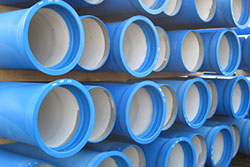
conduit-blue.jpg

Fairlawn Focuses on Citywide Gig Infrastructure - Community Broadband Bits Podcast 201

On the outskirts of Akron, just south of Cleveland, the community of Fairlawn is building a citywide wireless and fiber optic network using an interesting model. Most of the citywide municipal Internet networks in the U.S. have been built by communities with a municipal electric power company. Fairlawn has no such utility, not even a water utility. So they have partnered with another Ohio company, Extra Mile Fiber. This week, Deputy Director of Public Service Ernie Staten joins us for episode 201 of the Community Broadband Bits podcast to discuss their approach and goals. Fairlawn is building a carrier grade Wi-Fi and fiber-optic network, financed by municipal bonds. They will own the network and are focused first on generating benefits for the community and providing essential infrastructure rather than making sure every dollar of the network is repaid solely by revenues from network services. We also discuss how they structured the revenue-sharing arrangement with Extra Mile Fiber. 

This show is 21 minutes long and can be played on this page or via Apple Podcasts or the tool of your choice using this feed

Transcript below. 

We want your feedback and suggestions for the show-please e-mail us or leave a comment below.

Listen to other episodes here or view all episodes in our index. See other podcasts from the Institute for Local Self-Reliance here.

Thanks to Forget the Whale for the music, licensed using Creative Commons. The song is "I Know Where You've Been."

Local Media Covers The MN "Donut Hole" Phenomenon: Video, Editorial

As Minnesota's Legislature decides on funding for the state's Border-to-Border Broadband Development Grant Program, local media is calling on state leaders to prioritize local connectivity in the Capitol Chambers. This year, Governor Dayton's office is recommending allocating $100 million to the program.

Blended Is Better

In the past, the Border-to-Border Broadband Development Grant Program has granted funding to areas of only the greatest need, which has resulted in Internet infrastructure deployment in very rural areas. That's great for municipalities, businesses, and residents in those areas who certainly need and deserve better connectivity. Towns where there is some coverage, such as old DSL networks, have typically not qualified. As a result, rural areas of the state are developing "donut holes" of inadequate connectivity. In the long term, this could spell disaster for these towns because businesses have no reason to locate in places where they can't get the Internet access they need for operations. A blended approach will allow investment in both unserved areas and areas where some networks already exist so centers of economic activity can still compete with their neighbors.

Chris provides more information on the blended approach, and on one possible solution for rural communities, in this nicely produced video created by Capitol Almanac:

NYSBA Building (Economic) Bridges with Dark Fiber

The New York State Bridge Authority (NYSBA) expects to bring in over $900,000 over the course of the next ten years in revenue from dark fiber leases. The agreements, which allow private companies to access publicly owned dark fiber spanning the bridges, will also help maintain low tolls and allow regional telecom operators to expand their data transmission networks. The NYSBA announced on August 4 that it would be leasing dark fiber on two new bridges - the Bear Mountain and Rip Van Winkle bridges in upstate New York. These will be the third and fourth NYSBA bridges that generate revenue from fiber leasing.

The NYSBA dark fiber leasing program is now in its fifth year. Since the Authority does not receive any state or federal tax money for the operation and maintenance of its bridges, it has sought creative solutions to finance the upkeep of its infrastructure. It has now leased dark fiber on four of five intended bridges, with plans to lease more on a fifth - the Kingston­-Rhinecliff Bridge - in the near future.

In March, the Authority leased the Newburgh-Beacon Bridge to QCSTelecom, Inc. for $535,000. While such dark fiber leases are one-time fees, and usually last for at least ten years, the immediate benefit to the community takes the form of lower tolls for everyone who crosses the bridge. One editorial, posted in the Daily Mail, considered the locally-scaled benefits of the project:

Locally, we don’t have much to worry about from another toll hike in the immediate future. Although the lease won’t replace tolls as a principal source of revenue, it will help the bottom line and help keep tolls at current level. It’s clear that getting to the other side of the Hudson River can be costly over time and, as energy and transportation costs rise, we are not prepared for another toll hike. But with the success of the dark fiber leasing program, now in its fifth year, we can believe with some certainty that the drive to Columbia County won’t cost more.

Ammon, ID Experimenting with Open Access FTTH Network

We have covered the small Idaho city of Ammon before, but the people there always seem to be innovating. A few weeks ago, the city took first place with an ultra-high speed app in a National Institute of Justice competition. That utlra-high speed came from the city’s fiber network built for municipal buildings several years ago. The network has since expanded to connect the schools and some businesses.

Now, residents of Ammon might also get to experience high speed Internet. The city is conducting a survey, called Get Fiber Now, to determine interest in building a unique open access network. The first area with a 70% take rate will have 300 homes added to the network.

Ammon's technology director Bruce Patterson has a plan to make this unlike any other open access networks in the world. The fiber will be partitioned to have multiple services (such as telephone and television) on one strand. Our Christopher Mitchell has called the idea "open access on steroids” and the "best shot at demonstrating what can be done as far as innovation on an open network.” Patterson now has a pilot project of about seven homes connected to the experimental network with symmetrical speed of 1Gbps.

The city intends to have the plans for the open access FTTH network finalized for this next spring and is looking at a 20- to 30- year bond to cover the costs.

Local news coverage has the rest:

New Reference From U-W Extension A Library Must-Have

The University of Wisconsin-Extension recently released Broadband Policies and Regulations for Wisconsin Stakeholders, a good addition to your digital library, especially if you have in interest in Wisconsin and midwestern broadband issues.

The document provides case studies and an in-depth list of references addressing:

  • Public-private partnerships
  • Local ordinances
  • Technology councils
  • Community engagement
  • Local government telecommunications services
  • Unique efforts to increase adoption

While many examples hail from Wisconsin communities, the authors also provide information from other states and offers links to information such as local government broadband resolutions, tower agreements between municipalities and private internet service providers, successful applications for state and federal grant funds. 

The Broadband Policies and Regulations for Wisconsin Stakeholders is well organized and indexed. You can download the PDF, or access the online flip book for quick reference.