
FTTH

Content tagged with "FTTH"

Fiber to the Home
Displaying 301 - 310 of 1315

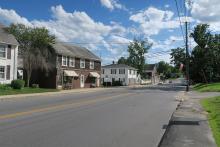
Yellow Springs’ Fiber-to-the-Home Project is No Joke

Named for its iron-rich natural springs, Yellow Springs is a hip and diverse village of approximately 3,600 Central Ohioans that most recently made headlines because of the controversy over comedian and actor Dave Chappelle’s opposition to a housing development proposal in the hometown of its most famous resident.

While the Village Council ultimately sided with Chappelle and other resident opponents in scaling back the planned development, in January the council gave their unanimous support for a different project that promises to connect village residents.

The vote gave the green light to move forward with a plan to bring municipal fiber-to-the-home (FTTH) service that will offer more affordable and reliable high-speed Internet connectivity (and competition) in a market already served by AT&T and Spectrum about 30 minutes east of Dayton.

Last fall, as Yellow Springs pursued state grant funding, Village Manager Josué Salmerón told WHIO-TV they were moving forward because “we felt we needed to do this from a business perspective and a human rights perspective. There’s a problem when our folks couldn’t do the essential things. They couldn’t go to work online. They couldn’t go to school online, and they couldn’t visit their doctors online. That’s a problem we were trying to solve. That’s why we went down this path.”

Thinking Big, Starting Small

The plan is to start with a small pilot project by connecting to the fiber backbone of the Miami Valley Educational Computer Association (MVECA), which has been expanding a 44-mile fiber ring in the region, having built one of the country’s first multi-jurisdictional networks, the GATEWay Public Fiber Network.

Field Reports: Municipal Broadband and Digital Equity in Baltimore

This week, we bring you a special field report from Maryland-based radio and podcast producer Matt Purdy. Through interviews with citizens, digital equity advocates, and the city's new Director of Broadband and Digital Equity, Purdy documents the connectivity struggles that have persisted in Baltimore's historically marginalized neighborhoods for decades.

Those challenges have only become more pronounced with the pandemic, prompting local officials to begin making moves in the direction of something we've not yet seen in a community the size of Baltimore: building a city-owned, open access fiber network.

This is a great story, so we won't give anything else a way. Listen below, or here.

Pierce Pepin Electric Co-op Brings Service Where Incumbent Providers Won’t

Pierce Pepin Electric Cooperative (PPEC), headquartered in Ellsworth, Wisconsin (pop. 3,300), announced in July of 2021 the start of a new phase of life, and the beginning of a fiber-to-the-home (FTTH) project that will connect its 6,800 members by 2025.

The $32 million-dollar project was begun at the end of last year. The move, powered by financial commitment from the cooperative but also state grants so far, will roughly double the cooperative’s physical plant assets, and ensure that member-owners will get fast, locally accountable broadband access for the lifetime of the infrastructure.

Bringing Service to Areas Ignored by Others

Incorporated in 1937, today PPEC serves the majority of Pierce County and parts of Buffalo, Pepin, and St. Croix counties just across the Minnesota-Wisconsin border, along the Mississippi River. 

It operates almost 1,350 miles of electric lines, about half of which are overhead and half underground, with 12 substations scattered throughout its territory. The cooperative serves an average of 5.7 households per mile. More than 90 percent of its member-owners live on residential properties or farms, though it has 600 commercial and industrial accounts and also powers more than three dozen public authority cites.

Image

The move towards broadband for PPEC, as with so many other electric cooperatives around the country, has been driven by dual forces: an internal push by member owners, and the lack of any evidence that outside providers will expand new infrastructure to the area anytime soon.

From KMALand:

Kandiyohi County, Minnesota Eyes Combination of Grants To Fuel Fiber Expansion

Like numerous U.S. counties, large segments of Kandiyohi County, Minnesota (pop. 44,000) lack access to affordable Internet service at modern speeds. So like many underserved communities, the county—situated about ninety miles west of Minneapolis—is looking to take advantage of a once-in-a-lifetime collision of funding opportunities to help finance a massive fiber broadband expansion across numerous county townships. 

A recent survey by the county unsurprisingly reveals that residents are greatly annoyed by the lack of affordable Internet access options, with 64 percent of locals saying they’re dissatisfied with the Internet service provided by regional monopolies.

Ten Projects on Tap

Hoping to address the shortcoming, Kandiyohi County and the City of Willmar Economic Development Commission have been working on ten different projects to shore up Internet access around the county. 

Some of the proposed projects involve partnerships with national monopoly providers like Charter Communications, but others will involve the county and a local cooperative doing the heavy lifting. The county had hoped to fund the projects with a combination of subscriber fees, American Rescue Plan funds, NTIA grants, and upcoming Minnesota state grants.

The first major project closest to being “shovel ready” is a $10 million fiber-to-the-home (FTTH) project in partnership with the Federated Telephone Cooperative of Morris. Federated is expected to finance twenty-five percent of the overall project, with new subscribers expected to pay about $1,250 per household to connect to the gigabit-capable network. 

A Wave (of Fiber) Crests Across Maryland’s Eastern Shore

The Dover Bridge is the span of infrastructure that crosses the Choptank River into Maryland’s Eastern Shore. But it’s the Choptank Electric Cooperative that’s building a bridge across the digital divide in the rural reaches of the region.

Building on the fiber backbone that connects the co-op's smart grid, the member-owned cooperative began construction of a fiber-to-the-home network (FTTH) last year that will reach all 54,000 of its members spread out across nine counties. Now subscribers are being lit up for service as the co-op continues to extend the network.

Thanks to the passage of the “Rural Broadband for the Eastern Shore Act” in May of 2020, it paved the way for the co-op to create a wholly-owned subsidiary known as Choptank Fiber. Moving quickly, in April of 2021, just two months after network construction began, Sherry Hollingsworth – whose grandfather was the first to get electricity through the co-op back in 1939 – became the first member to get service.

Image

At the ribbon-cutting ceremony outside her home in Denton, a town in Caroline County a little over an hour's drive from the nation's capital, Hollingsworth told The Star Democrat she was “honored” to be Choptank Fiber’s first subscriber because, like many households in and around the Eastern Shore, “we have struggled with our personal service and our business service for many, many years.”

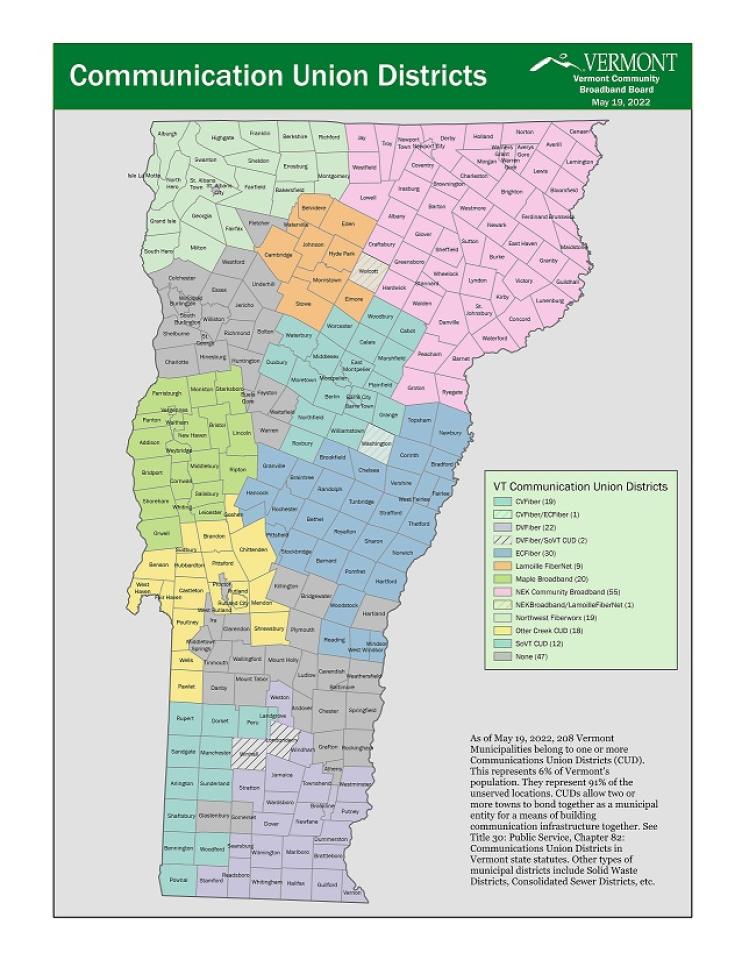
New Vermont Communications Union District Convenes to Connect the Rutland Region

With nearly 65,000 households unable to connect to the Internet at basic broadband speeds of 25/3 Megabits per second (Mbps), municipalities across the Green Mountain State have risen to the fore in formulating creative models for addressing the tens of thousands of homes without broadband access. Iterating on the EC Fiber (with roots back to the early 2000s), joint, municipally led projects have led to the creation of a total of nine Communications Union Districts (CUDs) at present, which places community-owned broadband at the forefront in Vermont.

What’s equally exciting is that the state has likewise stepped up, calling the CUDs the primary avenue by which it will solve the state’s connectivity crisis, and funneling at least $116 million in their direction in the next handful of years, with much of this spending dedicated to CUDs. To date, nearly 85 percent of Vermont’s municipalities and 90 percent of its underserved locations fall within a CUD. 

Waverly Muni Fiber Another Success Story for Iowa - Episode 493 of the Community Broadband Bits Podcast

This week on the podcast, Christopher is joined by Jeff Magsamen, Telecom Director at Waverly Utilities in Waverly, Iowa. During the conversation, the two discuss Waverly’s journey building a municipal network, how triple play take rates have changed in the last few years, and the benefits of partnering with neighboring municipal networks to reduce startup costs. Christopher and Jeff also take some time to highlight Waverly’s impressive take rate in the community, and what it takes to build a network people love.

This show is 20 minutes long and can be played on this page or via Apple Podcasts or the tool of your choice using this feed

Transcript below. 

We want your feedback and suggestions for the show-please e-mail us or leave a comment below.

Listen to other episodes here or view all episodes in our index. See other podcasts from the Institute for Local Self-Reliance here.

Thanks to Arne Huseby for the music. The song is Warm Duck Shuffle and is licensed under a Creative Commons Attribution (3.0) license.

BrightRidge Charges Ahead with Connecting Communities in Tennessee

<p>Located in the most northeastern part of Tennessee, BrightRidge has served as Johnson City’s public power utility for nearly 80 years. About a decade ago, BrightRidge stepped into the broadband space, and has since been taking serious strides to connect Johnson City residents and surrounding communities.&nbsp;</p><p><a href="https://muninetworks.org/content/brightridge-creating-10-gig-communitie… we left off with BrightRidge in 2019</a>, the utility was about to start into the first three phases of a fiber buildout to provide 3,847 homes and 373 businesses with broadband access. Since then, <a href="https://www.heraldandtribune.com/local-news/brightridge-continues-broad… and local funding</a> as well as utility investments have allowed BrightRidge to reach thousands of residents in the area.&nbsp;&nbsp;</p><p>Back in 2009 is when Johnson City, Tennessee began thinking about a possible fiber buildout. Since then, the city of 67,000 has considered a number of approaches, eventually landing on building out a hybrid (fiber and fixed wireless) network and serving as a publicly owned broadband utility to bring Internet access to residents. Known today as BrightRidge Broadband, the utility offers symmetric speeds of up to 10 Gigabits per second (for $149/month) in Johnson City and nearby communities.&nbsp;&nbsp;</p><p>Originally slated to be complete in 2026, demand and success in rolling out the infrastructure has led the utility to speed up its deployment plans.

Dickson, Tennessee Aims to Bring Community-Powered Fiber Across Seven Counties

Dickson, Tennessee (pop. 15,500) was the third municipal electric system to take power from the Tennessee Valley Authority after its creation in 1933, but the utility actually predates the regional electric generation system by almost 30 years. Today, it’s entering a new phase of life, parlaying its 117-year history of bringing affordable electric service into an $80 million fiber-to-the-home (FTTH) build that will see every household in its footprint (37,000 meters) get future-proof Internet access within the next four years.

A Cooperative in Municipal Clothing

Established in 1905, the very first Dickson Electric System (DES) customers received their power from a single 150-horsepower external combustion steam engine. DES upgraded its capacity in 1923, switching to two 150-horsepower oil-burning engines. A little more than a decade later, the TVA was established and DES took service, joining the maturing regional electric system and bringing its 650 customers and 50 miles of line into what would eventually be a group of more than 150 local power utilities almost a century later.

Image

Today, Dickson Electric territory covers almost 800 square miles across Dickson, Hickman, Cheatham, Williamson, Humphreys, Houston, and Montgomery Counties (with the bulk of its customers in the first three), across about 2,600 miles of distribution line to 37,000 locations.

Fort Collins' Connexion Continues to Expand and Adds Construction Projections for Residents

With a little less than a year left in its projected build schedule, Fort Collins (pop. 168,000) continues to make progress on its municipal fiber-to-the-home (FTTH) network, while also releasing new resources to help keep citizens informed and help households with affordability challenges stay online. 

When we last checked in on Fort Collins' Connexion a little more than a year ago, the network was nearing a milestone, having spent roughly 49 percent of its construction budget. Today, the network is well over the halfway point of its $142 million-dollar build. In fact, it expects to be done placing vaults and with boring work in July.

Along the way, local officials have taken steps to increase transparency and improve communication with local residents. Last summer, it released a construction map of the networks' anticipated 357 fiberhoods, delineating which areas were in design, under construction, or fully lit.

Image

In addition, at the end of November of 2020 the network released a Network Status tracker so that users could see in each of the four quadrants of the city if connections were down.