
fixed wireless

Content tagged with "fixed wireless"

Displaying 11 - 20 of 187

Syracuse, NY Community Broadband Network Steadily Expands

Syracuse, NY officials say the city’s community-owned broadband network Surge Link continues to dramatically expand two years after the network first launched, bringing affordable broadband access to the city of 145,000 – with a particular eye on helping the city’s disadvantaged.

A recent update from the city states that the network now serves more than 9,200 households in Syracuse, located in central upstate New York. The latest expansion brought the service into the city’s Valley, Skunk City, Washington Square, Northside, Prospect Hill and Hawley-Green neighborhoods in early July.

The Surge Link initiative is part of a broader $15 million investment into fixed-wireless access broadband infrastructure into a city traditionally left underserved by giant regional telecoms.

A lack of competition between dominant regional monopolies Charter (Spectrum) and Verizon has resulted in spotty access, high prices, and slow speeds.

Image
Syracuse Mayor Ben Walsh speaks at podium in front of community center at Surge Link launch party

The lion’s share of Surge Link’s latest expansion was made possible by a $10.8 million grant from the New York State ConnectALL initiative, a multi-layered billion-dollar project to dramatically boost high speed Internet access across the state leveraging a series of new grant programs, education initiatives, broadband mapping improvements, and digital equity proposals.

Pennywise, Pound Foolish: Inside the BEAD Program’s Latest Shakeup - Episode 651 of the Community Broadband Bits Podcast

In this Monday edition of the podcast, Chris sits down again with Evan Feinman, former BEAD Director at NTIA, to unpack the fallout from the Trump administration’s sweeping changes to the BEAD program.

Feinman calls out the decision to prioritize short-term cost savings over long-term infrastructure, arguing that these policy shifts will slow progress, drive up monthly bills, and ultimately leave rural communities behind.

From satellite subsidies to the sidelining of fiber, they explore why the new guidance undermines state-level planning, threatens broadband quality, and may betray the very voters it claims to help.

This show is 40 minutes long and can be played on this page or via Apple Podcasts or the tool of your choice using this feed.

Transcript below.

We want your feedback and suggestions for the show-please e-mail us or leave a comment below.

Listen to other episodes or view all episodes in our index. See other podcasts from the Institute for Local Self-Reliance.

Thanks to Arne Huseby for the music. The song is Warm Duck Shuffle and is licensed under a Creative Commons Attribution (3.0) license

BEAD Overhauled | Connect This! Show

Connect This! Show

Catch an emergency episode of the Connect This! Show, with host Christopher Mitchell (ILSR) joined by Lori Adams (Nokia), Heather Mills (Tilson), and Blair Levin (Brookings) to talk about the raft of fundamental changes to the Broadband Equity, Access, and Deployment Act (BEAD) announced by NTIA last Friday. States are required to rebuild and resubmit their proposals to the federal agency on a 90-day sprint after making core changes just as money for construction was about to go out the door.

Join us live on June 9th at 4pm ET, or listen afterwards wherever you get your podcasts.

Email us at [email protected] with feedback and ideas for the show.

Subscribe to the show using this feed or find it on the Connect This! page, and watch on LinkedIn, on YouTube Live, on Facebook live, or below.

Jemez Pueblo Tribe Seeks ‘Light,’ Fiber Knowledge To Advance Digital Sovereignty

For Angela Diahkah, what started as a self-described “side hustle” is now her full-time job.

Diahkah – or “Ange,” as she sometimes goes by – is five years into serving as Network Operations Supervisor and Digital Navigator Program Manager for JNET, the Tribally-owned broadband provider for the Pueblo of Jemez.

Just 50 miles northwest of Albuquerque, Angela leads the charge in building a new fiber network, the gold-standard of Internet connectivity, that once complete will serve her community (one of the 19 Pueblos in New Mexico).

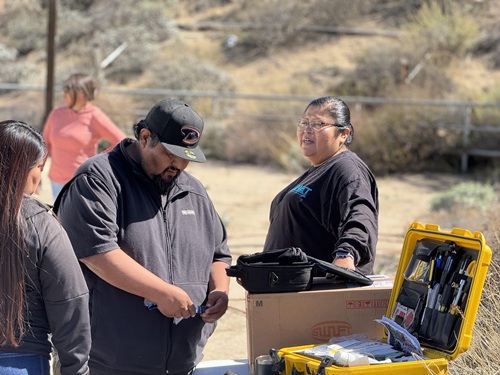
Last week, she was at the 17th Tribal Broadband Bootcamp (TBB) in Aguana, California in the hills above Temecula Valley, along with a half dozen JNET technicians-in-training and JNET Director Kevin Shendo. The 30 or so other TBB participants – representing broadband leaders from several other federally-recognized Tribes – were also there for the three-day immersive learning experience focused on building and operating Tribal Internet networks.

Held in different tribal regions several times a year since the initiative began in 2021, this most recent bootcamp was back at TBB co-founder Matthew Rantanen’s “RantanenTown Ranch.”

Image
Angela looks at her crew explore fiber splicing equipment on a table outdoors on RantenenTown Ranch in the desert-like foothills of Anguana, Califonia

“We're basically trying to find a light in a dark tunnel and just work with what’s best for us,” Angela told ILSR in describing why she and her JNET crew had come, just as they are in the early stages building out their own fiber-to-the-home network.

“We want to expose them to the network,” literally and figuratively, she said.

New Policy Brief: Dollars and Sense In Debate Over BEAD Fiber Rules

The $42.5 billion federal Broadband Equity, Access, and Deployment (BEAD) grant program is facing what appears to be a significant overhaul as the new administration aims to alter, among other things, one of program’s key tenets: a preference for building fiber networks.

Meanwhile, a new ILSR policy brief – “BEAD Should Continue to Prioritize Fiber Internet Network Investments” – makes the case for why “these changes would repeat past policy mistakes and waste billions of dollars while delivering subpar Internet access to rural families at much higher prices.”

The brief then describes why fiber networks should continue to be prioritized:

“In designing BEAD, Congress recognized that it was foolish to spend thousands of dollars per home every 5-10 years to deliver obsolete connections and chose instead to build fiber optic networks that will last generations – ultimately both saving taxpayer dollars and delivering an equitable Internet access option to millions of rural homes.”

And while the policy brief points to important long-term consequences that should be considered to ensure rule changes don’t squander a “generational investment” by building “something more temporary and inferior to the services found on every street in urban and suburban areas,” the brief does not argue that other technologies should not be a part of the mix.

“To be clear, BEAD’s priority for fiber does not bar the use of other technologies when appropriate. In cases where the cost of fiber is simply too great, other technologies are on the table – likely wireless options of both terrestrial and low-earth orbit,” the brief says.

Frontiers in Fiber Optic Sensing | Episode 107 of the Connect This! Show

Connect This! Show

Catch the latest episode of the Connect This! Show, with co-hosts Christopher Mitchell (ILSR) and Travis Carter (USI Fiber) joined by regular guests Kim McKinley (TAK Broadband) and Doug Dawson (CCG Consulting) along with special guest Paul Dickinson (Dura-line, Fiber Optic Sensing Association, and Aii) to talk about the future of fiber optic sensing to do everything from avoid fiber cuts from construction equipment to monitor traffic to detect pipeline leakages. They also hit a grab-bag of other topics, including:

Join us live on February 7th at 2pm ET, or listen afterwards wherever you get your podcasts.

Email us at [email protected] with feedback and ideas for the show.

Subscribe to the show using this feed or find it on the Connect This! page, and watch on LinkedIn, on YouTube Live, on Facebook live, or below.


This show was more technical than is usual, even for Connect This!. See transcript below. Some additional resources mentioned in the episode include:

Smarter Infrastructure through Distributed Fiber Optic Sensing with Paul Dickinson

Fiber Broadband Association Awards Concepts that Advance Subscriber Experience at Fiber Connect 2024

G.652.D vs G.657.A1 vs G.657.A2 Fiber Optic Cabling: What’s the Difference?

A New Class of Sensing Products for DAS – AcoustiSens® Wideband Vibration Sensor Fibers and Cables

AcoustiSens® Wideband Vibration Sensor Fiber

The Alliance for Innovation and Infrastructure

Common Ground Alliance

Fiber Deployment Cost Annual Report, 2024

Meet the crypto officers: How the internet is controlled by 14 people with seven secret keys

2025 Predictions with Blair Levin - Episode 631 of the Community Broadband Bits Podcast

In this episode of the podcast, Chris speaks again with Blair Levin, former Director of the National Broadband Plan and current Equity Analyst at New Street Research. Together, they dive into the major issues shaping the year ahead for broadband and telecommunications.  

Levin shares insights on the evolving landscape of network ownership, media regulations, and market dynamics, while addressing pressing topics like the expiration of the Affordable Connectivity Program and its impact on affordability. The discussion also touches on the BEAD program, fixed and wireless broadband competition, and the influence of geopolitical and economic policies on deployment efforts.  

Levin critiques the Federal Communications Commission's priorities under Brendan Carr's leadership, predicts significant shifts in media ownership and content distribution, and examines the role of satellite Internet and emerging technologies. This forward-looking conversation also highlights the importance of reliable data and competitive intensity in shaping the broadband future.  

Tune in for an engaging discussion filled with expert predictions, political analysis, and reflections on the broader implications of broadband policy decisions.

This show is 45 minutes long and can be played on this page or via Apple Podcasts or the tool of your choice using this feed.

Transcript below.

We want your feedback and suggestions for the show-please e-mail us or leave a comment below.

Listen to other episodes or view all episodes in our index. See other podcasts from the Institute for Local Self-Reliance.

Thanks to Arne Huseby for the music. The song is Warm Duck Shuffle and is licensed under a Creative Commons Attribution (3.0) license

North Dakota Nearing 100 Percent Fiber Connectivity

With the incoming Trump administration and the ascendance of GOP leaders taking aim at key aspects of broadband expansion initiatives embedded in the Bipartisan Infrastructure Law, industry insiders expect the $42.5 billion Broadband Equity, Access, and Deployment (BEAD) program to likely get a major facelift in the coming months.

GOP Senate leaders have signaled they will push for BEAD to be scaled back or reconfigured.

One way they may do that is to remove the law’s preference for funding fiber network deployments and create a path for subsidizing Musk’s satellite Internet company, arguing that Starlink would be a more cost-effective solution to bring broadband to rural America.

Late last week, in fact, NTIA released its “Final Guidance for BEAD Funding of Alternative Broadband Technology.” And while the updated guidelines still considers fiber deployments as “priority broadband projects,” the agency administering the BEAD program now explicitly says that states can award “LEO Capacity Subgrants.”

New York Announces Another $140 Million in Municipal Broadband Grants

New York’s Municipal Infrastructure Program (MIP) continues to provide grant funds to build municipal broadband networks across the state, as state broadband officials recently announced the program’s largest round of funding to date.

As we reported in June, the MIP program – specifically designed to fund municipally-owned networks as part of the Empire State’s $1 billion ConnectALL initiative – awarded $70 million to a half dozen projects earlier this summer.

Then, earlier this month, another $140 million in grant awards were announced for an additional six projects, promising to deliver “more than 1,200 miles of publicly-owned fiber optic infrastructure and wireless hubs, connecting (passing) over 60,000 homes and businesses with affordable, symmetric service – offering equal download and upload speeds at rates below regional averages.”

Image
NY ConnectALL logo

The funding will be used to expand broadband infrastructure (and seed competition) in the Central New York, Finger Lakes, Mohawk Valley, North Country, Mid-Hudson and Western New York regions.

In a prepared press statement, New York Gov. Kathy Hochul characterized the grants as “a transformative step forward in our mission to connect every New Yorker to affordable, high-speed Internet.”