
federal

Content tagged with "federal"

Related Topics
Displaying 101 - 110 of 216

Municipal Networks As Local Action From Cambridge To You

Depending on where you live, there may be more opportunities these days to participate in marches, demonstrations, or community political meetings. Regardless of whether your beliefs lean red or blue, you may be like many other Americans and wonder what the future holds for federal telecommunications policy. Saul Tannenbaum from Cambridge recently wrote a piece that stressed the importance of local decision making authority and how municipal networks can rise above reversals anticipated by the new administration’s FCC.

Tannenbaum looks at four policies that are likely to be or have been adjusted from current practice to a new approach under the Trump administration:


  • Digital Inclusion
  • Network Neutrality
  • Corporate Consolidation
  • Privacy

Cambridge has considered developing in its own municipal network for a while and Tannenbaum connects the dots between the investment and local control over these issues. While he describes the situation in his own community, it can apply to many other places on the map; he reminds us that decisions about connectivity can and should be local.

While telecommunication policy is thought of as national, in reality, it’s a matter of whose cables and services reach which home. That decision can be a very local one. A free, fair, open, and affordable Internet for Cambridge is within grasp. All Cambridge needs to do is build one.

By building its own network, Cambridge can ensure that its infrastructure reflects its values and the needs of its residents, not the values and needs of Comcast and Verizon.

Check out the full article, Municipal Broadband Is Municipal Resistance, on Medium.

Motherboard Vice Quotes Christopher Mitchell on Protecting Net Neutrality

Motherboard Vice - January 17, 2017

Local Activism Is the Best Way to Preserve Net Neutrality

Written by Jason Koebler

Before President-elect Donald Trump takes office this week, take a moment to remember the height of the net neutrality battles of 2014 and 2015. Remember the letter writing campaigns, the comments filed to the Federal Communications Commission (some of them handwritten), remember John Oliver’s rant. Remember that the people fought, and the people won, and for a brief moment, big telecom monopolies had at least some limits placed on them by the federal government.

Remember it now, because very likely, the anti-regulation commissioners of the FCC, reporting to an anti-regulation president, are about to undo the rules millions of Americans fought so hard for. Under Trump, big telecom and its sympathizers will call the shots.

...

“Because we have net neutrality now, those seeds are out there,” Christopher Mitchell, director of the Community Broadband Networks Initiative, told me. “Our biggest enemy is ignorance, so when things go badly and cable bills go up under Trump, and we have to pay more to access certain sites, people will say ‘Wait a minute, this is a violation of net neutrality.’ We’re in such a better position to fight now.”

...

Federal Lifeline Modernization Order: NCC Webinar Hashes Out The Details

Internet access for low-income households is becoming more affordable, thanks to an FCC modernization order that brings the Lifeline program into the 21st Century. 

Next Century Cities recently offered a webinar for people who want to learn more about changes to the Lifeline program; our own Christopher Mitchell moderated the event. Jaymie Gustafson, Director of Stakeholder Engagement for the Lifeline, and attorney Olivia Wein from the National Consumer Law Center shared their knowledge about the order, discussed how local governments can utilize the program in public housing, and suggested ways local governments can help make the program a success.

The program, which initially provided a $9.25 subsidy to eliminate or lower the cost of telephone services to low-income households, now allows recipients to use the funds to purchase broadband services. Gustafson noted one of the driving factors behind the modernization order:

“We know it’s so important in terms of helping children do their homework, in terms of people being able to search for and keep their jobs, in terms of accessing services, just in terms of interacting with society around you. Right now, broadband is not a luxury. It’s a necessity.”

About The Program

The Universal Services Administrative Company (USAC) governs the Lifeline program, which originated in 1985 and receives funding from the Universal Services Fund. The fund, established in 1935, supports other programs that invest in telecommunications infrastructure in addition to low-income access. Instead of receiving a voucher to purchase services from a carrier or an Internet Service Provider (ISP), the provider receives the subsidy directly from USAC; after the discount is applied to Lifeline participants' bill, the participant pays the remainder to the provider.

logo-USAC.png

Chairman Tom Wheeler To Depart Jan. 20, 2017

Chairman Tom Wheeler will be stepping down as FCC Chairman as of January 20, 2017; the day President Obama leaves office. The decision is not surprising, as FCC chairmen typically leave their position when a new administration takes the helm, but Wheeler had not yet made it official. His departure emphasizes the apprehensive uncertainty that has troubled advocates of municipal networks, local telecommunications authority, and network neutrality, as well as a long list of other public policy concerns that affect our future through technology.

In a statement released on December 15, Chairman Wheeler wrote:

“Serving as FCC Chairman during this period of historic technological change has been the greatest honor of my professional life. I am deeply grateful to the President for giving me this opportunity. I am especially thankful to the talented Commission staff for their service and sacrifice during my tenure. Their achievements have contributed to a thriving communications sector, where robust investment and world-leading innovation continue to drive our economy and meaningful improvements in the lives of the American people. It has been a privilege to work with my fellow Commissioners to help protect consumers, strengthen public safety and cybersecurity, and ensure fast, fair and open networks for all Americans.”

He Proved Himself

When Tom Wheeler was appointed as 31st Chairman of the FCC in November 2013, we had our concerns. He was following Julius Genachowski, one of the worst FCC Chairs in modern history, who had been appointed in Obama's first term. He had run both cable and wireless industry trade groups, but was strongly defended by Susan Crawford and Gigi Sohn when public interest groups opposed him. He strongly surpassed our hopes for what the FCC could achieve.

Federal Reserve Report Highlights High-Quality Connectivity

The Federal Reserve is responsible for setting interest rates and executing monetary policy in the United States, but many people don’t realize that the agency also has a hand in community development. This summer, the Federal Reserve Bank of Dallas released a report, Closing the Digital Divide: A Framework for Meeting CRA Obligations, which includes information for banks about funding digital inclusion programs and community networks.

The report, published in July, states:

“Access to broadband has become essential to make progress in all areas of community development—education and workforce development, health, housing, small-business development and access to financial services.”

Closing the Digital Divide is important not only because it provides substantial information for banks, but also because it indicates federal support exists for community-based infrastructure improvements. The report discusses improving Internet access for low and moderate-income individuals and neighborhoods.

Using The Community Reinvestment Act To Improve Infrastructure

From the 1930 until the late 1970s, many banks denied lending to individuals and organizations based on their location. The practice is called “redlining” after the red ink that outlined low-income neighborhoods on a map, and was made illegal when Congress passed the Community Reinvestment Act (CRA) in 1977. Under the CRA, banks must to use the same evaluation criteria for all loan applicants regardless of the neighborhood they live in, which expands lending to include low and moderate-income (LMI) individuals. The Federal Reserve assesses banks’ performance under CRA guidelines, which bring about $100 million in capital to low and moderate income areas per year through various projects. Improving Internet access is an increasingly large portion of these initiatives.

In The Weeds

Jamming At DAPL Protest? Ask The FCC To Investigate

According to a 2014 Enforcement Advisory, cell phone and Wi-Fi jamming by state and local law enforcement is illegal by federal law. And yet, persistent allegations of jamming are coming from Water Protectors at the Standing Rock protests in North Dakota. Any jamming by law enforcement to monitor protestor cell phone communications is a serious breach of their Fourth Amendment rights as it amounts to unreasonable search and seizure. First Amendment rights of freedom of speech are also compromised when the method of transmitting reports is purposely blocked.

In order to pressure the FCC to determine whether jamming is happening in North Dakota, MoveOn.org has posted an online petition. From the petition:

Proving or disproving allegations about jamming is very difficult for anyone except the Federal Communications Commission [FCC]. Only the FCC can work with wireless providers, protesters, and local law enforcement to find out definitively what’s going on. The FCC is the only expert agency with authority to require law enforcement to disclose their use of any wireless devices and the only agency with the expertise to assess what is actually happening. If the FCC investigates and finds that there is no illegal jamming happening, then it can settle this concern. If the FCC discovers that there is illegal jamming happening, it has an obligation to expose the jamming and use its power under federal law to order local law enforcement to stop interfering with First Amendment rights of freedom of speech and freedom of the press.

As Harold Feld writes in his recent blog article, that the presence of IMSI catchers or Stingrays, leaves signs that the Water Protectors are experiencing at Standing Rock - sudden loss of a strong signal at inopportune times, cell phone batteries depleting quickly and inexplicably. Cell phones not only allow them to communicate with each other, but allow them to document law enforcement reaction:

Trust In Government: Strongest Close To Home

We have recently covered state laws preempting local control, especially in North Carolina and Tennessee. State governments are supposed to be “laboratories of democracy” and municipalities are sub-parts of the state. Preemption is ostensibly to prevent problems, but instead these state laws limit local governments’ solutions for ensuring better connectivity.

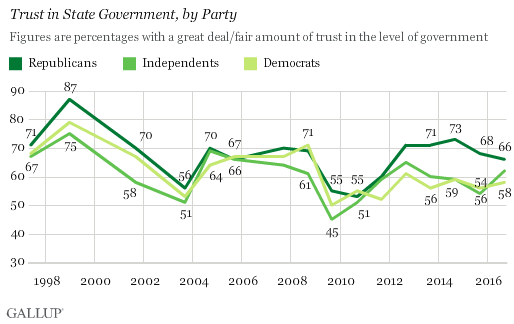
At the same time, people trust their local government more than their state government to handle problems. That’s the latest finding from Gallup’s most recent Governance Poll, and that makes sense for all of us following community networks.

It's no surprise that trust starts with local community leaders. We have spoken to a number of public officials that acknowledge that when you know your elected official - perhaps live down the street from them or run into them at the grocery store - it's much easier to know that they share your hopes for the community.

Polls, Trends, and Republicans

Gallup’s September 7th-11th Governance Poll found that 71 percent trust their local government to handle problems, but only 62 percent say the same about their state government. This continues a fifteen-year trend of people putting their faith in local government more than in state government.

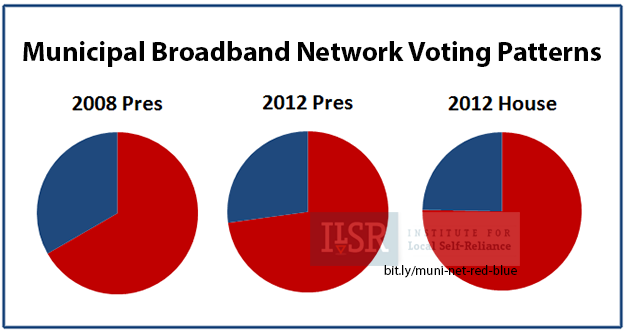
Seventy-five percent of Republicans stated that they have a "great deal/fair amount" of trust in local government. (Compare to only 71 percent of Independents and 66 percent of Democrats.)  This corresponds with what we found in January 2015 while analyzing our data. Most citywide, residential, municipal networks are built in conservative cities. They trust local governments to solve connectivity problems when the big providers can't or won't deliver.

Municipal network voting patterns

Image of the graph on trust in local and state governments from Gallup

Local Authority "A-Number One" Priority For Congress, Says Wheeler

“A-number one importance.”

On September 15th, the Senate Commerce, Science and Transportation Committee gathered to discuss FCC oversight and telecommunications issues. Among those issues, the Committee discussed municipal networks.

Senator Cory Booker (D - NJ) asked FCC Chairman Tom Wheeler to provide his thoughts on how important it is that Congress takes action. The matter he put before Wheeler was the prospect that Congress act to allow local communities to have local authority on issues relating to Internet infrastructure and advanced telecommunications capabilities. How important is it?

Wheeler’s answer: “A-number one importance.”

Wilson, Pinetops, And A Harmful State Law

Booker, who introduced a bill in 2015 to restore local authority, brought up the subject of Wilson, North Carolina, and nearby Pinetops. When the FCC rolled back restrictive state laws in 2015, Wilson’s electric utility finally had the legal authority to help their neighbors so began offering high-quality Internet access through it’s municipal Internet service, Greenlight. Earlier this summer, the Court of Appeals found in favor of the state, which challenged the FCC decision. As a result, Wilson must cut off service to Pinetops or risk losing the legal ability to serve anyone. The FCC has announced that it will not pursue further review of the decision and will focus its resources on other areas. 

Booker described the situation in Pinetops as “disturbing,” but went on to praise Wilson for investing to solve the need in the region and pointing out how local businesses, including those in Pinetops, came to depend on those investments. He went on to say he was “disappointed, if not angered” by the Court of Appeal’s decision.  

Watch a clip of the hearing:

In The Hopper: Community Broadband Bill of 2016 From Rep. Eshoo

In order to allow local governments to help communities get the connectivity they need to compete, Rep. Anna G. Eshoo (Dem.-CA) introduced the Community Broadband Act of 2016 on September 13. The bill is designed to preserve local authority for municipalities, tribal, and local governments that wish to serve community anchor institutions, businesses, and residents with advanced telecommunications capability.

From Rep. Eshoo’s official statement:

“I’m disappointed that a recent court ruling blocked the FCC’s efforts to allow local communities to decide for themselves how best to ensure that their residents have broadband access. This legislation clears the way for local communities to make their own decisions instead of powerful special interests in state capitals.”

“Rather than restricting local communities in need of broadband, we should be empowering them to make the decisions they determine are in the best interests of their constituents. Too many Americans still lack access to quality, affordable broadband and community broadband projects are an important way to bring this critical service to more citizens.”

Rep. Eshoo introduced “dig once” legislation last fall and has long advocated for federal legislation to support Internet network deployment and increase universal access. This legislation would pair with Senator Cory Booker's 2015 Community Broadband Act.

When Christopher spoke with Sam Gustin for Motherboard about the bill, he said:

[He’s]“excited to see Rep. Eshoo's bill that would restore local authority to communities. Local governments need to be empowered to decide how to improve internet access rather than leaving their businesses and residents at the mercy of a few big monopolies.”

The Coalition for Local Internet Choice also responded positively:

CLIC applauds Congresswoman Eshoo for her efforts to protect local Internet choice and the options of all local communities to deploy critical broadband infrastructure.

Feds Are Fed Up With AT&T's Lame Excuse For Abusing E-rate

In late July, the FCC released a Notice of Apparent Liability (NAL) in which it found the telecommunications giant AT&T Southeast liable for a $106,425 forfeiture. The agency also ordered the company to return $63,760 of E-rate funds it described as “improperly disbursed.” AT&T overcharged two school districts in Florida and, in a response released last week, are trying to justify their pilfer by blaming the E-rate rules and the schools themselves, much as a criminal blames victims for being such easy targets.

Funded By Phone Users

E-rate funds are collected as a surcharge on telephone bills; the funds go to schools to help pay for telecommunications costs at schools, including telephone, Internet access, and infrastructure costs like fiber network construction. The amount a school district receives depends on the number of students in the district that qualify for free and reduced lunches; schools with higher numbers of low-income students are reimbursed at a higher rate. Given that many of our schools are funded through property tax rolls, this means that schools in poorer neighborhoods that are more likely to need help with their budgets receive the higher reimbursement rates.

According to the program rules, phone companies and Internet Service Providers (ISPs) that participate are required to offer the “lowest corresponding price” to schools. Providers aren’t permitted to charge rates that exceed the “lowest corresponding price” or bid higher than that price on contracts to serve similarly situated entities if those entities are eligible to receive E-rate funds. School districts do not carry the burden of getting the lowest corresponding price - telephone and Internet access providers are responsible to ensure that they offer the lowest price in exchange for the opportunity to participate in the program. Between July 2012 and June 2015 alone, AT&T received $1.23 billion in E-rate funding nationwide.

Filching In Florida