

FCC

Content tagged with "FCC"

Displaying 71 - 80 of 657

Mecklenburg Electric Cooperative Seeks Relief From Ongoing CAF II Mess

EMPOWER Broadband, a subsidiary of Mecklenburg Electric Cooperative (MEC), is asking the Federal Communications Commission (FCC) to waive financing requirements attached to the provider’s takeover of thousands of subsidized broadband locations from RiverStreet Networks. It’s a move the cooperative says will save it millions of dollars in errant additional penalties.

It’s also highly representative of the ongoing challenges facing a program that has long been criticized for dysfunction and mismanagement.

The FCC program not only fell short of fulfilling its original promise, it now risks boxing numerous communities out from what could be a generational funding opportunity made possible by the 2021 infrastructure bill.  

During the 2018 Connect America Fund (CAF) Phase II auction, RiverStreet was awarded $32.1 million in financing to provide high-speed Internet to 13,518 locations in Virginia. RiverStreet is looking to divest 3,757 locations across three counties, poised to receive $8.1 million in annual CAF II broadband deployment support.

Image
MEC Empower Broadband logo

According to a May RiverStreet filing with the FCC spotted by Broadband Breakfast, the divestment is necessary because the company “encountered certain obstacles that have prevented it from meeting its CAF II buildout milestones in the assigned CBGs.”

What Happens Now That the Fifth Circuit Has Ruled the Universal Service Fund is Unconstitutional?

On July 24, 2024, the Fifth Circuit Court of Appeals ruled 9-7 that the Universal Service Fund is unconstitutional. 

The decision throws a whole raft of federal broadband programs - including those which help schools pay for connectivity, those which help homes pay for home Internet access, and more - into a state of uncertainty. 

All signs point to a stop at the Supreme Court for final ruling on the future of the program. On the most recent episode of the Connect This! Show, hosts Christopher Mitchell (ILSR) and Travis Carter (USI Fiber) were joined by regular guests Doug Dawson (CCG Consulting) and Kim McKinley (UTOPIA Fiber) as well as special guest Casey Lide (Keller and Heckman Law Firm) to talk about the decision. They discuss the impact of the decision in the long-term, including how the USF fits into the jigsaw puzzle of federal broadband funding programs and what we can expect to see if the decision is upheld. 

Watch the segment below.

Email us at [email protected] with feedback and ideas for the show.

Subscribe to the show using this feed or find it on the Connect This! page, and watch on LinkedIn, on YouTube Live, on Facebook live, or below.

Remote video URL

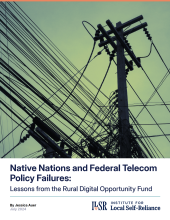
Native Nations and Federal Telecom Policy Failures: Lessons from the Rural Digital Opportunity Fund

Image
Native Nations report

A new report published today by the Institute for Local Self-Reliance (ILSR) reveals how the sovereignty of Tribal Nations and their own efforts to solve connectivity challenges on Tribal lands can be undermined by the poor design and maze of bureaucracy associated with some federal broadband programs. 

The report – Native Nations and Federal Telecom Policy Failures: Lessons from the Rural Digital Opportunity Fund [pdf] –shows how even as the National Telecommunications and Information Administration (NTIA) takes over administration of the largest federal funding programs and re-situates Tribal closer to where they belong, the Federal Communications Commission (FCC) continues its long-standing practice of scant engagement and infrequent consultation, complicating the terrain and stymieing Tribal efforts to close the digital divide in Indian Country.

Completed in December 2020, the Rural Digital Opportunity Fund auction underscores the pernicious consequences of federal policy. While the report begins with a real-life example of how Tribal nations now working to build their own broadband networks can be blindsided by bureaucratic neglect and non-Tribal ISPs, it goes on to detail why the FCC’s approach to broadband funding has fostered tension between providers and Tribal ISPs, and why RDOF has earned a particularly bad reputation among many Tribes.

The report also examines how RDOF impacts the roll-out of the federal government’s major broadband infrastructure funding program known as BEAD (Broadband Equity, Access, and Deployment), which is being administered by the National Telecommunications and Information Administration (NTIA).

Read Native Nations and Federal Telecom Policy Failures: Lessons from the Rural Digital Opportunity Fund [pdf].

New Report: Native Nations and Federal Telecom Policy Failures: Lessons from the Rural Digital Opportunity Fund

A new report published today by the Institute for Local Self-Reliance (ILSR) reveals how the sovereignty of Tribal Nations and their own efforts to solve connectivity challenges on Tribal lands can be undermined by the poor design and maze of bureaucracy associated with some federal broadband programs.

The report – Native Nations and Federal Telecom Policy Failures: Lessons from the Rural Digital Opportunity Fund [pdf] – begins with a startling example of how one Tribe learned about the plans of a major fiber Internet provider to serve “a handful of locations in the heart of the Tribal Reservation.”

Authored by Dr. Jessica Auer, Tribal Broadband Policy Analyst with ILSR’s Community Broadband Networks initiative, the report captures the pernicious consequences of a program that was supposed to help bring high-speed Internet service to rural communities who lacked access:

A non-Tribal telecommunications company had received federal funding to build broadband infrastructure on Tribal lands without consent, had appeared to shirk required federal Tribal engagement requirements, had ignored the Tribe’s attempt to raise concerns about it, and now seemed to be expecting to dictate what would happen next.

While the report begins with a real-life example of how Tribal nations now working to build their own broadband networks can be blindsided by bureaucratic neglect and non-Tribal ISPs, it goes on to detail why the FCC’s approach to broadband funding has fostered tension between providers and Tribal ISPs, and why RDOF has earned a particularly bad reputation among many Tribes.

“Some recent federal broadband programs do actually require ISPs to secure Tribal consent prior to receiving funds,” Auer says. “But, the FCC still has not adopted this approach. The problems outlined in this report reinforce the need for such a requirement.”

FCC Rejects Broader Relief For Growing List Of RDOF Defaulters

The Federal Communications Commission (FCC) says it won’t be providing broader relief for broadband operators that have defaulted on grant awards via the agency’s messy and controversial Rural Digital Opportunity Fund (RDOF) broadband subsidy program.

According to an FCC public notice, the FCC stated it found "no demonstrated need for broad relief" from provider penalties connected to either the RDOF or Connect America Fund II (CAF II) programs. It also shot down calls for a broader amnesty program for defaulters.

“Given the flexibility available under the existing default processes…we decline to provide a blanket amnesty,” the agency’s Wireline Competition Bureau said.

In a letter to the agency last February, a broad coalition of providers and consumer organizations suggested that either reduced penalties – or some sort of amnesty program – might speed up defaults, freeing areas for upcoming broadband infrastructure bill (Broadband Equity Access And Deployment, or BEAD) subsidies.

Image
FCC front entrance

The group was quick to point out that areas where RDOF and CAF II money has been committed are considered “served” for purposes of BEAD deployments, potentially boxing out many desperate U.S. communities from billions in potential funding.

“Many of the RDOF and CAF II awardees who cannot or will not deploy their networks are located in states with the greatest connectivity needs, like Missouri and Mississippi,” the authors wrote. “The Commission should not permit these unserved rural communities to face this type of double whammy and be left behind once again.”

But in its statement, the FCC insisted that changes to its approach aren’t necessary because, it claims, its existing processes are working.

CBRS Spectrum: A Potential Boon To Community Broadband

Recent federal government efforts to expand use of public Citizens Broadband Radio Service (CBRS) spectrum could be of significant help to municipalities and local communities looking to bridge the digital divide with the increasingly popular wireless technology.

CBRS spectrum refers to 150 MHz of spectrum in the 3.5 GHz band. In 2015, the FCC adopted rules for shared commercial use of the band, creating a three-tiered structure to avoid interference with military radar during collaborative use of the spectrum.

For municipalities, the spectrum has already proven to be a valuable way to deploy wireless access to the public. In Syracuse, New York, the city last fall launched a new public wireless network on the back of CRBS. In Longmont, Colorado, the St. Vrain Valley School District used CBRS to build a private LTE network connecting 4,000 students in partnership with NextLight, which operates Longmont's city-owned municipal fiber network.

Not all community deployments of CRBS have delivered satisfactory results for municipalities, however. The STEM Alliance in Westchester County, New York retired their efforts to deploy a CBRS network in Yonkers after they struggled with urban capacity constraints and low usage.

Surf Internet Expands Fiber In Partnership With Newton County, Indiana

Surf Internet and Newton County, Indiana say they’re expanding a public private partnership (PPP) that will extend gigabit fiber access to 97 percent of the county – or roughly 3,839 Newton County households by the end of this year.

According to a joint announcement, Surf will contribute $6.6 million to the new endeavor, with the Newton County Economic Development Commission (EDC) contributing $4 million. The expansion should extend the gigabit network to Lake Township, Lake Village, Roselawn, Thayer and several additional rural areas.

Image
Newton County Indiana map

Surf Internet also provides access in Michigan and Illinois. The ISP’s service speeds and pricing can vary greatly by market, but range from symmetrical 50 Mbps (megabit per second) service for $35 a month, to symmetrical 1 Gbps (gigabit per second) service for anywhere from $70 to $80 per month, with no caps, hidden fees, or long-term contracts.

Surf Internet first came to Newton County in 2020, when it launched a $1.7 million project– funded by the FCC E-Rate program – that brought fiber connections to the North Newton School District. In 2023, Surf Internet expanded that fiber network to 382 Newton County homes as part of Indiana’s $81 million Next Level Connections (NLC) Broadband Grant Program.

Blueprints for BEAD: Use the FCC Map to Spot Trouble Areas for BEAD Challenges

Blueprints for BEAD is a series of short notes and analysis on nuances of BEAD that might otherwise get lost in the volume of material published on this federal funding program. Click the “Blueprints for BEAD” tag at the bottom of this story for other posts.

There are still almost two dozen states that have yet to go through the Broadband Equity, Access, and Deployment (BEAD) program challenge process, which will lock down those locations that will be eligible for federal broadband infrastructure funding. And one refrain we’ve heard over and over from those in states that have already completed theirs is that, despite NTIA’s best efforts, it's complicated and hard. 


States have been given significant leeway in setting the rules for developing a challenge process wherein unserved and underserved locations can be identified. Lacking clear direction from the NTIA for what may seem like insignificant details, the often-hastily developed rules have in many states resulted in opaque processes characterized by a lack of clear communication and outreach. The resulting state guidance on how to request a data license, navigate a challenge portal, and submit challenges has left many local governments, small ISPs, Tribes, and nonprofits feeling defeated about their ability to participate. Without the detailed counsel on strategies for identifying prospective challenges, the scale of impact that this group of eligible entities could have on BEAD outcomes has been significantly narrowed. 


This is particularly troubling because widening the circle of those who can effectively participate is important. Residents, local governments, and nonprofits often have the best sense of exactly where the connectivity gaps in their communities exist. They also know what form the digital divide takes - whether in reliability, or cost, or latency, or available speeds. But so far, the challenge process for BEAD has been dominated by the largest ISPs that have the staff and expertise to interact with large amounts of geographic data in a relatively short period of time.

New York State Is Trying To Make It Easier For Municipal Broadband To Succeed

In March, Charter Communications tried (and failed) to include a poison bill in New York State’s budget bill that would have hamstrung community broadband. In stark contrast, a New York legislator this month introduced new legislation he says would make it easier than ever for New York state municipal broadband projects to thrive.

State Senator Jeremy Cooney of Rochester has introduced the Broadband Deployment Assistance Act of 2024 (S9134), which would streamline the permitting process for municipal broadband projects by "amending the general municipal law, in relation to requiring substantially similar permits for broadband deployment to be processed together at the same time and on an expedited basis."

“With a quicker timeline and more efficient process for local governments, we can create affordable options for New Yorkers that empower them to take control of their digital destiny,” Cooney wrote in an editorial published at Syracuse.com.

Image
New York State Seal

Cooney says he was motivated by a lack of broadband competition in New York State. New York is dominated by Charter Communications, which was almost kicked out of the state in 2019 for poor service and  misleading regulators about broadband deployment conditions affixed to its 2016 purchase of Time Warner Cable.

Blueprints for BEAD: Stakeholders May Use Rebuttal Power to Prevent New Errors in BEAD Maps

Blueprints for BEAD is a series of short notes and analysis on nuances of BEAD that might otherwise get lost in the volume of material published on this federal funding program. Click the “Blueprints for BEAD” tag at the bottom of this story for other posts.
 

By mid June, we will have blown past the halfway mark in the BEAD challenge process - with more than thirty states having completed their “challenge windows” and another handful set to close imminently. But the “challenge window” is only part of the overall challenge process, and there are reasons for communities to stay engaged with the process even after that window closes. Communities - don’t sleep on the rebuttal window!

Where We Sit Today

Each state must conduct a challenge process prior to opening up BEAD grants to verify that the data on the National Broadband Map is accurate. That process will have three stages: the challenge window, the rebuttal window, and the determination window. During the challenge window, eligible challengers (local and Tribal governments, nonprofits, and ISPs) can present evidence that locations are incorrectly categorized as served, underserved, or served. According to the NTIA’s Challenge Process Policy Notice, those same eligible entities can participate in the rebuttal window, where they supply evidence refuting a challenge that was made by someone else. After both of these periods are over, the state weighs all of the evidence and makes a final determination (determination window). 

Why might this rebuttal period be important for communities? In short, not all challenges are created equally. While we might primarily think of challenges that make the map more accurate, some challenges could, in fact, make the map less accurate. Some ISPs might make questionable challenges about the level of service they can or will provide.