
New Year, Same Lame Cable and DSL Monopolies
As you read this, remember that the FCC's National Broadband Plan largely places the future of Internet access in the hands of these corporations.

As you read this, remember that the FCC's National Broadband Plan largely places the future of Internet access in the hands of these corporations.“Without the combination, we think the wireless industry will be further weakened by continued hypercompetitive activity, particularly regarding subscriber acquisition costs,” said Nomura Securities analyst Mike McCormack. That means customers can still get lower rates as the industry competes for their dollars. T-Mobile, for example, will continue to be a low-cost competitor, according to consumer advocacy group Consumers Union. A survey showed that data plans from T-Mobile were $15 to $50 less per month than those offered by AT&T.An excellent reminder that what is best for Wall Street is not what is best for the 99%. Big companies like AT&T find competing for customers a hassle that lowers their profits -- they consider a market with four sellers to be hypercompetitive. In wireline, they have acquiesced to the "competition" of two competitors -- cable and DSL. This is one reason communities build their own networks -- the private sector is not truly competitive when it comes to ISPs and most communities have no prospect real of improvement absent a public investment. But we should rejoice in this victory -- because we earned it. Without the hard work of many grassroots groups, it is hard to imagine the Department of Justice or FCC standing up to such a powerful corporation.
Dane Jasper, the CEO of Sonic.net, one of the few ISPs to survive the death of broadband competition over the past ten years, wrote about "America's Intentional Broadband Duopoly." It is a short history of how the FCC's flawed analysis (helped along by incredible amounts of lobbying dollars, no doubt).
He starts by asking when the last time anyone offered to sell you broadband over power lines (BPL). The FCC decided that cable and telephone companies shouldn't have to share their wires (which are a natural monopoly) with competitors (creating an actual marketplace for services) because BPL, satellite, and wireless would put so much competitive pressure on DSL and cable. FAIL.
Then, in the Brand X decision, they ruled that Cable would not be required to allow competitors to lease their lines either. The FCC did this by reclassifying broadband Internet access as an “information service”, rather than a “telecommunications service”. As a result, common carriage rules could be set aside, allowing for an incumbent Cable monopoly. This decision was challenged all the way to the supreme court, who ruled in 2005 that the FCC had the jurisdiction to make this decision. To close out Powell’s near-complete dismantling of competitive services in the U.S., the FCC took up the issue of ISPs resale of DSL using the incumbent’s equipment, also known as wholesale “bitstream” access. If Cable is an information service under Brand X, why shouldn’t Telco have the same “regulatory relief”? The result: the FCC granted forbearance (in other words, declined to enforce its rules) from the common carriage requirements for telco DSL services.For those who are thinking that wireless is finally competitive with cable and DSL, don't forget that while 4G appears much faster (because so few people are using it presently), it still comes with a 2GB monthly cap. So if you want to do something with your connection aside from watching one movie a month, 4G is not competitive with a landline connection.
The truth is that if we want to make sure small businesses can grow with the assistance of broadband, the Internet must remain open.
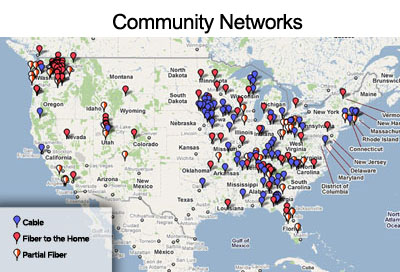
Members and allies of the Rural Broadband Policy Group hold “local ownership and investment in community” as a core principle in broadband deployment. We believe that local ownership of broadband infrastructure can address problems such as lack of service, limited provider choice, affordability, slow speeds, and also enforce strong consumer protections. Policies that encourage local ownership create opportunities and wealth in communities. For example, local broadband networks employ IT professionals who live and work in the local community. When communities own their communications infrastructure, not only do they boost their local economies and create jobs, but are also held accountable to ensure that broadband is accessible to every resident. Moreover, the 70-year history of rural electric and telephone cooperatives proves that locally owned networks are vital stewards of public subsidies. We are disappointed that the proposed USF/CAF reforms ignore the advantages of local ownership and prohibit community broadband networks, anchor institutions and Tribal governments from receiving USF/CAF support. The proposed reforms do not create avenues for local ownership in rural, Tribal, and low-income communities. This is a lamentable flaw in the proposal, and we respectfully request that the Commission include the following recommendations: Communities that self-provision should be eligible for funds. Currently, proposed USF reforms exclude community-based networks that have done the most to build out broadband infrastructure to provide essential services in underserved areas. These self-provisioning projects range from municipal networks to private sector nonprofit networks, and play a critical role in the future of their communities. Yet, they are not eligible for the proposed Connect America Fund. Self-provisioning communities have invested their social and financial capital in broadband infrastructure and services because incumbent carriers refused to make these investments.
Once upon a time, the old, old AT&T was the sole supplier of telephones and other equipment to consumers and businesses. The FCC, in a series of market-opening orders, culminating in the 1968 Carterfone ruling, finally freed the non-AT&T world to provide telephone equipment. Through the years, consumers and businesses had many more choices as new companies sprang up to provide home phones, business phones, and business switching equipment for voice and data. Anyone could buy a phone and plug it in. At one telephone equipment show in the mid-1980s, a small California computer company said it was going to enter the telephone business, but only put up an empty booth promising products later. (Whatever happened to those Apple guys and their phones, anyway?) ... One reason is that the FCC over the years succumbed to the Big Telecom campaign to put all the little guys out of business through subterranean means that the public would never see (like charges big phone companies levy to connect to their network). Another is that the FCC gave up the authority over Internet access (broadband), which leads to its current troubles in trying to justify legally how to get an open Internet and will likely lead to future controversies over how to support broadband deployment (universal service).Right now, it doesn't matter whether Democrats or Republicans appoint FCC Commissioners so long as 3 of the 5 commissioners are more concerned with what benefits a few massive companies rather than the vast majority of businesses and citizens.
I recently joined some other grassroots groups in talking to FCC Commissioner Copps about the ways the FCC could improve access to telecommunications for most Americans -- you know, the mission of the Federal Communications Commission. This was the day before FCC Chairman Genochowski announced the broad outline of Universal Service Reform.
Presently, it appears that the FCC will broadly adopt the industry's plan of taking more money from subscribers and spreading it among private companies and coops that are providing services in rural America. We have called up on the FCC to recognize the important role of community broadband networks and make them eligible recipients of USF funds but the FCC appears to be ready to double down on its past mistakes of relying on absentee-owners who have little incentive to actually provide reliable services at affordable prices. (Fred Pilot has also called upon the FCC to make this change.)
The result is that communities like rural Sibley County in Minnesota's farm country may build their own next-generation broadband network, only to find the federal government subsidizing a vastly inferior DSL network from a competitor. This is a fiscally irresponsible approach that prioritizes the profits of a few private companies over what is best for the vast majority of private companies and residents in communities that need networks that are actually accountable to them.
If you care about this issue, you should ask the Rural Broadband Policy Group or Media Actions Grassroots how you can help. They have been working to break through the beltway bias against solutions that encourage local self-reliance.
“Access to the internet is akin to a civil rights issue for the 21st century,” said David Cohen, Comcast’s executive vice president. “It’s that access that enables people in poorer areas to equalize access to a quality education, quality health care and vocational opportunities.”It was only after the federal government mandated a low-cost option for disadvantaged households that Comcast realized everyone could benefit from access to the Internet. Sadly for Comcast, it has done a poor job of reaching those disadvantaged communities, by its own admission:
"Quite frankly, people in lower-income communities, mostly people of color, have such limited access to broadband than people in wealthier communities."This is why so many communities are building their own next-generation networks - they know that these networks are essential for economic development and ensuring everyone has "access to a quality education, quality health care and vocational opportunities." And they know that neither Comcast nor the federal government are going to make the necessary investments. They need a solution for the next 20 years, not just the next 2.
Comcast has a de facto monopoly in many communities.
The genius behind the first wave of Wi-Fi innovation was unlicensed spectrum.