In Detroit, AT&T is facing a formal FCC complaint accusing the telecom giant of deploying discriminatory “digital redlining” tactics. This is the second such complaint filed against the telecommunications giant since the first of the year.
Demanding Equality in Connectivity
The complaint filed by civil rights attorney Daryl Parks says the FCC violated the Communications Act which forbids unjust and unreasonable discrimination. A month earlier, Parks filed a similar complaint on behalf of three Cleveland residents. In both instances, Parks and community members maintain that AT&T is withholding high-speed Internet from minority neighborhoods that have higher poverty rates.
These complaints fall under Title II of the Communications Act, which contains not only net neutrality rules but important consumer protections regarding discrimination. Title II SEC. 202. [47 U.S.C. 202] (a) clearly specifies:
It shall be unlawful for any common carrier to make any unjust or unreasonable discrimination in charges, practices, classifications, regulations, facilities, or services for or in connection with like communication service, directly or indirectly, by any means or device, or to make or give any undue or unreasonable preference or advantage to any particular person, class of persons, or locality, or to subject any particular person, class of persons, or locality to any undue or unreasonable prejudice or disadvantage.
Large, corporate providers like AT&T have to make shareholders happy, which is why they shy way from investing in regions where they don’t expect much profit. Routinely, those areas include sparsely populated rural communities and urban neighborhoods traditionally considered low-income. Often low-income neighborhoods also include a high percentage of people of color. Attorney Daryl Parks of ParksCrump, LLC, recently filed suit with the FCC on behalf of three residents in Cleveland who are victims of AT&T's "digital redlining."
The Data Tells The Story
In March, the National Digital Inclusion Alliance (NDIA) and Connect Your Community (CYC) released a report on digital redlining in low-income neighborhoods in Cleveland. “Digital redlining” refers to AT&T’s investments in infrastructure, which improve connectivity in areas where they serve, except for neighborhoods with high poverty rates. CYC and NDIA analyzed form 477 data submitted by the telecommunications company and noticed a pattern. The revelations in that report helped the plaintiffs understand their situation and choose to ask the FCC to look deeper into AT&T's questionable business practices.
The event that inspired the analysis was the AT&T DirecTV merger. As part of the merger, AT&T agreed to create a low-cost Internet access program for customers under a certain income level. The speed tier was only 3 Megabits per second (Mbps) download, but AT&T infrastructure investment in Cleveland lower income neighborhoods was so outdated, residents could not obtain those minimal speeds. As a result, they were deemed ineligible for the program.
The Case
The complainants are three African-American residents in Cleveland’s lower income neighborhoods who can’t take advantage of the affordable program mandated by the merger because they can only access speeds of up to 1.5 Mbps download or less. Without the infrastructure to connect at higher capacity, they’ve ended up paying higher rates for slower Internet access.
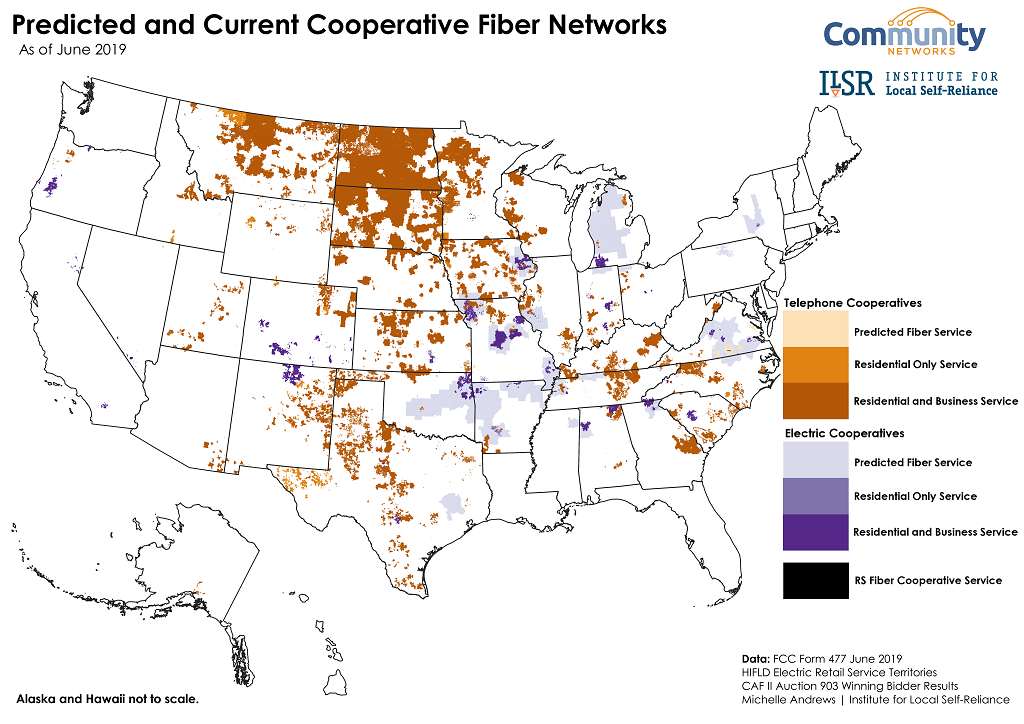
Cooperatives around the country have built on their long legacy of delivering essential infrastructure by starting to deliver next-generation Internet services. Here, we cover the basics of cooperatives in rural areas and then discuss the details of electric and telephone cooperatives that have already branched out into Internet service. Finally, we highlight the first fiber optic cooperative provider, and discuss how other communities have better Internet service through building their own networks.
Cooperatives are part of the fabric of rural America. The member owners control the cooperative: each person receiving service is a member of the cooperative and can directly vote in elections for the Board of Directors or even become a member of the Board.
Starting in the 1930s, the U.S. Department of Agriculture supported communities as they created more than 900 electric cooperatives across the country. In the 1950s, the federal government again supported communities building telephone networks, crisscrossing the country with telephone cooperatives to connect rural communities.
Each technology brought new markets, revitalized economies, and revolutionized industries. Cooperatives have a long history of building and maintaining essential infrastructure and providing excellent service in rural communities. Now they have the chance to do that again by building next-generation networks for Internet service.
Rural Public Policies
Rural areas face a number of challenges that urban and suburban communities do not. Low population density coupled with rough terrain can make building infrastructure challenging. Added to these factors, rural communities may not have access to the same financial resources as larger towns and cities do.
Image
Cooperatives, however, have made infrastructure projects work in rural communities for nearly a century. They have access to funding from their membership base, local banks, and often the federal government. Some state governments have expanded their broadband grant and loan programs to include electric cooperatives. Other states have clarified laws and policies to recognize that electric cooperatives can build fiber networks for Internet service using their current infrastructure. A few states have even removed legislative hurdles that stymied investments by electric cooperatives. Technically, the 1996 Telecommunications Act, Section 253, prohibits states from stopping any co-op from offering Internet service, but co-ops in many states are loathe to challenge state law in court.
North Carolina
In 2019, the state removed restrictions that prevented electric cooperatives from using USDA funding for non-electrical purposes, such as broadband networks. Our 2016 report, North Carolina Connectivity: the Good, the Bad, and the Ugly, highlighted how this roadblock kept the state’s electric co-ops from providing service to many rural communities.
Tennessee
During the 2017 legislative session, this state has clarified the language in its laws to allow electric cooperatives to build networks for Internet service.
Indiana
Cooperatives already have access to utility poles, easements, and Rights-of-Way in the communities that they serve. Indiana, however, needed to clarify that electric co-ops can use this access to provide Internet service, so it passed the FIBRE Act. Other states, including Georgia, Maryland, and Texas, have since followed suit.
Minnesota & Colorado
Minnesota and Colorado have made funding easier to access for cooperatives interested in providing Internet service. Both states have designed grant programs that promote local solutions to connectivity problems. In Minnesota, cooperatives provide most of the Fiber-to-the-Home Internet service thanks in no small part to that grant program.
Overbuild Or Underbuild?
In Community Broadband Bits Podcast Episode 91, Christopher Mitchell and Lisa Gonzalez discusses strategies for building Internet infrastructure in rural are. What do communities need to thrive?
More than 900 rural electric cooperatives provide electricity to about 12 percent of the U.S. population. Their service area, however, covers more than half of the total land, nearly 2 million square miles. About 90 rural electric co-ops have embarked on fiber optic projects to increase Internet access for their members.
Several of these electric cooperatives started by building fiber optic lines to substations and large demand centers to increase the reliability of the electric system through better monitoring. This could then form the backbone of a network for Internet service to businesses and residents.
Articles and Interviews
We have written many articles and collected several reports detailing how electric cooperatives have tried to increase Internet access in their communities. These stories show the many different ways electric cooperatives have structured partnerships and programs for their members.
Image
Several electric cooperatives provide Internet service themselves. Some started pilot projects, while others built out to their entire service area. The Fiber-to-the-Home project by Valley Electric Association boosted the local economy in Pahrump, Nevada. The co-op has already added 31 new jobs because of the fiber service.
Others partner with an existing telephone cooperative or telephone company. Ouachita Electric in Arkansas is one of the many cooperatives to have done this. By combining their resources and expertise, this partnership is able to extend electric and Internet service throughout much of southern Arkansas.
Many electric cooperatives work together, such as Sho-Me Power in Missouri and LS Networks in Oregon. These cooperatives have provided connectivity for local ISPs and businesses, and now are looking to connect residents.
In episode 229 of the Community Broadband Bits podcast, Jon Chambers, the former head of the FCC Office of Strategic Planning and Policy Analysis, describes how electric cooperatives have the potential to bring Internet access to unserved rural America.
Mel Coleman, president of NRECA and CEO of North Arkansas Electric Cooperative, joined the podcast in episode 243 to discuss how the electric co-op had improved Internet access for its members and what other cooperatives are doing.
This is a list of the rural electric cooperatives that have programs and projects to increase connectivity in their service areas. They do not all provide Fiber-to-the-Home. Some only offer fiber connections to businesses or provide wireless last mile connections while others focus on dark fiber and fiber transport services for other Internet Service Providers. (Total: 109) (Last updated: 12/2019)
Electric Cooperative
State
Project
Central Alabama Electric Cooperative
Alabama
FTTH (announced)
Joe Wheeler Electric Membership Corporation
Alabama
FTTH (announced)
North Alabama Electric Cooperative
Alabama
FTTH
Tombigbee Electric Cooperative (freedom FIBER)
Alabama
FTTH
Wiregrass Electric Cooperative
Alabama
Fiber backbone (under construction) — collaboration with cable company to connect members
Arkansas Valley Electric Cooperative (WAVE Rural Connect)
Arkansas
FTTH
Craighead Electric Cooperative Corporation (Empower)
Arkansas
FTTH
North Arkansas Electric Cooperative (NEXT)
Arkansas
FTTH
Ouachita Electric Cooperative (ARIS)
Arkansas
FTTH — collaboration with telephone company
Ozarks Electric Cooperative (OzarksGo)
Arkansas
FTTH
South Central Arkansas Electric Cooperative (South Central Connect)
Arkansas
FTTH
Anza Electric Cooperative (ConnectAnza)
California
FTTH
Plumas-Sierra Rural Electric Cooperative (Plumas-Sierra Telecommunications)
California
FTTH & wireless with fiber backbone
San Luis Valley Rural Electric Cooperative (Ciello)
Colorado
FTTH
Delta-Montrose Electric Association (Elevate Fiber)
Colorado
FTTH
Southeast Colorado Power Association (SECOM)
Colorado
FTTH
Yampa Valley Electric Association (Luminate Broadband)
Colorado
FTTH
Blue Ridge Mountain EMC
Georgia & North Carolina
FTTH
Habersham Electric Membership Corporation (Trailwave; North Georgia Network Cooperative)
Georgia
FTTH; FTTB and Schools
Jefferson Energy Cooperative
Georgia
FTTB — collaboration with Pineland Telephone Cooperative
Illinois Electric Cooperative
Illinois
FTTH
Jo-Carrol Energy (Sand Prairie)
Illinois
FTTH & wireless with fiber backbone
Jackson County Rural Electric Membership Corporation (Jackson Connect)
Indiana
FTTH
Johnson County Rural Electric Membership Corporation
Indiana
FTTH — collaboration with NineStar Connect
NineStar Connect (merger between Central Indiana Power and Hancock Telecom)
Indiana
FTTH
Orange County Rural Electric Membership Corporation
Indiana
FTTH
South Central Indiana Rural Electric Membership Corporation
Indiana
FTTH
Tipmont Rural Electric Membership Corporation (Wintek)
Indiana
FTTH
Allamakee-Clayton Electric Cooperative (AC Skyways)
Iowa
Wireless with fiber backbone
Maquoketa Valley Rural Electric Cooperative (MVLink)
Iowa
FTTH
Bulter Electric Cooperative (Velocity)
Kansas
FTTH
Warren Rural Electric Cooperative Corporation
Kentucky
FTTH pilot projects (announced) — collaborations with North Central Telephone Company and Franklin Electric Power Board
Great Lakes Energy (Truestream)
Michigan
FTTH
Midwest Energy Cooperative (Midwest Energy and Communications)
Michigan
FTTH
Tri-County Electric Cooperative (HomeWorks Connect)
Michigan
FTTH
Arrowhead Electric Cooperative (True North Broadband)
Minnesota
FTTH
Meeker Cooperative Light and Power Association (Vibrant Broadband)
Minnesota
Wireless with fiber backbone — collaboration with Mabel Cooperative Telephone Company and Spring Grove Communications
MiEnergy Electric Cooperative
Minnesota
FTTH & wireless with fiber backbone
Mille Lacs Energy Cooperative (XStream Internet)
Minnesota
FTTH — collaboration with telephone cooperative CTC
Roseau Electric Cooperative
Minnesota
FTTH (announced) — collaboration with local telephone company
Alcorn County Electric Power Association (ACE Fiber)
Mississippi
FTTH (announced)
Coast Electric Power Association (CoastConnect)
Mississippi
FTTH (announced)
Delta Electric Power Association
Mississippi
FTTH
Monroe County Electric Power Association (M-Pulse Fiber)
Mississippi
FTTH (announced)
Natchez Trace Electric Power Association (NT Spark)
Mississippi
FTTH
Northcentral Mississippi Electric Power Association (Northcentral Connect)
Mississippi
FTTH
Northeast Mississippi Electric Power Association (North East Fiber, LLC/NE SPARC)
Mississippi
FTTH
Pearl River Valley Electric Power Association (PearlComm Fiber)
Mississippi
FTTH (Announced)
Prentiss County Electric Power Association
Mississippi
FTTH (announced)
Singing River Electric Power Association (Singing River Connect)
Mississippi
FTTH (pilot)
Southern Pine Electric Power Association
Mississippi
FTTH
Tallahatchie Valley Electric Power Association (TVI-Fiber)
Mississippi
FTTH (announced)
Tippah Electric Power Association
Mississippi
FTTH (announced)
Tishomingo County Electric Power Association
Mississippi
FTTH
Tombigbee Electric Power Association
Mississippi
FTTH (announced)
Barry Electric Cooperative (goBEC)
Missouri
FTTH
Callaway Electric (Callabyte Technology)
Missouri
FTTH — collaboration with Kingdom Telephone Cooperative
Co-Mo Electric Cooperative (Co-Mo Connect)
Missouri
FTTH
Grundy Electric Cooperative (Mid-States Services)
Missouri
FTTH
Pemiscot Dunklin Electric Cooperative (Pemiscot Dunklin Fiber)
Missouri
FTTH
Ralls County Electric Cooperative (Ralls Technologies)
Missouri
FTTH
SEMO Electric Cooperative (GoSEMO Fiber)
Missouri
FTTH
United Electric Cooperative (United Fiber)
Missouri
FTTH
Crawford Electric Cooperative / Sho-Me Power Electric Cooperative (Sho-Me Technologies)
Missouri
FTTB & Transport Services
Gascoasage Electric Cooperative / Sho-Me Power Electric Cooperative (Sho-Me Technologies)
Missouri
FTTB & Transport Services
Howell-Oregon Electric Cooperative / Sho-Me Power Electric Cooperative (Sho-Me Technologies)
Missouri
FTTB & Transport Services
Intercounty Electric Cooperative Association / Sho-Me Power Electric Cooperative (Sho-Me Technologies)
Missouri
FTTB & Transport Services
Laclede Electric Cooperative / Sho-Me Power Electric Cooperative (Sho-Me Technologies)
Missouri
FTTB & Transport Services
Se-Ma-No Electric Cooperative / Sho-Me Power Electric Cooperative (Sho-Me Technologies)
Missouri
FTTB & Transport Services
Southwest Electric Cooperative / Sho-Me Power Electric Cooperative (Sho-Me Technologies)
Missouri
FTTB & Transport Services
Webster Electric Cooperative / Sho-Me Power Electric Cooperative (Sho-Me Technologies)
Missouri
FTTB & Transport Services
White River Valley Electric Cooperative / Sho-Me Power Electric Cooperative (Sho-Me Technologies)
Missouri
FTTB & Transport Services
Valley Electric Association (Valley Communications Association)
Nevada
FTTH
Continental Divide Electric Cooperative (Red Bolt Broadband)
New Mexico
FTTH
Kit Carson Electric Cooperative (Kit Carson Internet)
New Mexico
FTTH
Delaware County Electric Cooperative
New York
FTTH — collaboration with local telephone companies
Otsego Electric Cooperative (OEConnect)
New York
FTTH
French Broad Electric Membership Corporation
North Carolina
FTTH
Lumbee River Electric Membership Corporation (Bluewave Communications NC)
North Carolina
FTTH — collaboration with Horry Telephone Cooperative
Roanoke Electric Cooperative (Roanoke Connect)
North Carolina
FTTH
Consolidated Electric Cooperative
Ohio
FTTH
East Central Oklahoma Cooperative (ecoLINK)
Oklahoma
FTTH (under construction)
Lake Region Electric Cooperative (Lake Region Technology & Communications)
Oklahoma
FTTH
Northeast Oklahoma Electric Cooperative (Bolt Fiber Optic Services)
Oklahoma
FTTH
Oklahoma Electric Cooperative (OEC Fiber)
Oklahoma
FTTH
Consumers Power (Peak Internet)
Oregon
FTTP (open access network) — collaboration with Pioneer Consolidated and Stayton Cooperative Telephone Company
Central Electric Cooperative (LS Networks)
Oregon
FTTB, Schools, & Transport Services
Douglas Electric Cooperative (Douglas Fast Net; LS Networks)
Oregon
FTTH; FTTB, Schools, & Transport Services
Hood River Electric Cooperative (CACHE Communications; LS Networks)
Oregon
FTTH; FTTB, Schools, & Transport Services
Umatilla Electric Cooperative (LS Networks)
Oregon
FTTB, Schools, & Transport Services
West Oregon Electric Cooperative (LS Networks)
Oregon
FTTB, Schools, & Transport Services
Sullivan County Rural Electric Cooperative
Pennsylvania
FTTH (announced)
Tri-County Rural Electric Cooperative
Pennsylvania
FTTH (announced)
Mid-Carolina Electric Cooperative (Carolina Connect)
South Carolina
FTTH
Newberry Electric Cooperative (Carolina Connect)
South Carolina
FTTH — collaboration with Mid-Carolina Electric Cooperative
Appalachian Electric Cooperative
Tennessee
FTTH
Cumberland Electric Membership Cooperative (Cumberland Connect)
Tennessee
FTTH (announced)
Forked Deer Electric Cooperative (Forked Deer Connect)
Tennessee
FTTH
Gibson Electric Membership Corporation (Gibson Connect)
Tennessee
FTTH
Holston Electric Cooperative (Holston Connect)
Tennessee
FTTH
Meriwether Lewis Electric Cooperative (MLConnect)
Tennessee
FTTH
Sequachee Valley Electric Cooperative (SVEConnect)
Tennessee
FTTH
Tri-County Electric Cooperative
Tennessee
FTTH
Volunteer Electric Cooperative (Twin Lakes, powered by VEC)
Tennessee
FTTH — collaboratin with Twin Lakes Telephone Cooperative
Bandera Electric Cooperative (BEC Fiber)
Texas
FTTH
Grayson Collin Electric Cooperative (Grayson Collin Communications)
Texas
FTTH
Guadalupe Valley Electric Cooperative
Texas
FTTH
Jackson Electric Cooperative (MyJEC.net)
Texas
FTTH & wireless with fiber backbone
Taylor Electric Cooperative (Access Fiber)
Texas
FTTH
Victoria Electric Cooperative (Infinium)
Texas
FTTH & wireless with fiber backbone
BARC Electric Cooperative (BARC Connects)
Virginia
FTTH
Central Virginia Electric Cooperative (Firefly Broadband)
Virginia
FTTH
Craig-Botetourt Electric Cooperative
Virginia
FTTH (announced)
Mecklenburg Electric Cooperative (EMPOWER Broadband)
Virginia
FTTH
Prince George Electric Cooperative (Ruralband)
Virginia
FTTH
Columbia Rural Electric Association (Columbia iConnect)
Washington
FTTH Pilot Project
Orcas Power & Light Cooperative (Rock Island Communications)
Washington
FTTH
Chippewa Valley Electric Cooperative (Ntera)
Wisconsin
FTTH — collaboration with telephone cooperative Citizens Connected
Telephone Cooperatives
There are about 260 telephone cooperatives in the United States. Many provide Internet service as a natural extension of their existing infrastructure. Many started out by providing dial-up and DSL services, but only recently have begun to transition to Fiber-to-the-Home. Some have already transitioned to an all-fiber network, having upgraded everyone in their territory to fiber.
The Rural Broadband Association (NTCA) has a gigabit certification program in order to draw attention to how many small telephone companies cooperatives have built these next-generation networks.
Articles & Interviews
We have featured a number of these cooperatives on our website. Some cooperatives choose to work with local governments or electric cooperatives while others focus on providing service alone. Below is just a small selection of the many cooperatives that have built Fiber-to-the-Home networks.
Episode 188 of the Community Broadband Bits Podcast features Eric Cramer, the President and CEO of Wilkes Communications/RiverStreet Networks. He explained how the telephone cooperative has built a Fiber-to-the-Home network throughout several counties in northern North Carolina.
Cooperatives are not just telephone and electric. There is now a workable model for Internet cooperatives created from scratch. RS Fiber in Minnesota is the first cooperative formed for the express purpose of providing reliable, high-speed Internet service.
Yampa Valley Electric Association (Luminate Broadband)
Colorado
Electric
Yucca Telecommunications Systems
New Mexico
Telephone
Community Broadband Bits Podcast Episodes
Listen to our collection of Community Broadband Bits Podcasts to learn firsthand about how electric cooperatives have made the decision to provide Internet service.
What does it take for a telephone co-op in North Carolina to provide FTTH? President and CEO of Wilkes Communications and RiverStreet Networks explains
It’s getting easier to find high-speed internet service in rural Wisconsin, yet there are still places where a robust online connection is as elusive as the Hodag, a mythical creature that legend says prowls the Northwoods.
What’s more, critics of government grants aimed at boosting the service across the country say much of the money is being spent on internet speeds that are obsolete.
When the service providers focus on short-term profit, rather than building the best possible network, it’s not good for rural America, said Christopher Mitchell with the Institute for Local Self Reliance, a Minneapolis nonprofit that helps communities with internet access issues.
“I don’t blame the providers any more than I blame tigers when they maul humans. They are what they are. The problem is that government policy lets them do it,” Mitchell said.
Can’t get telephone or Internet service? Have you tried starting your own company? In 1998, John Reigle did just that with the support of the community and Michigan State University. Today, Allband Communications Cooperative provides not only telephone service, but also cutting-edge, high-quality Internet access and environmental research opportunities in rural Northeastern Michigan.
A Story Of Promise, Betrayal, And The Telephone Company
We connected with Allband representatives who shared details about Allband's interesting and dramatic history as told by Masha Zager back in 2005. They kindly provided updates and let us know what's in store for this by-the-bootstraps effort that started in the woods of Michigan.
When John Reigle moved out into the woods past the small town of Curran, Michigan, he didn't intend to start a brand-new venture. He simply wanted to build a home and work on his consulting business; he just needed telephone service.
The large incumbent telephone company GTE (which later became Verizon, which still later sold off this service area to Frontier) had assured Reigle that the lot where he planned to build his house would be easy to connect to their telephone network. They quoted him a price of about $34 and scheduled an install date. Trusting that the telephone company’s representatives knew the service area, Reigle moved forward with his plans to build.
After he finished constructing his house in 1998, Reigle contacted the telephone company to finalize his service connection. Despite the earlier assurance that his location would not prove a problem, Reigle found that he was miles away from the GTE network. This time, the company quoted $27,000 to run a copper telephone line from the highway to his new house.
His consulting firm could not operate without a telephone so he decided to bite the bullet and agree to the steep price. GTE rescinded its quote, however, and no matter how much Reigle offered, the company would not run telephone service to his new house.
Crowdsourced broadband mapping helps North Carolina clean its data
A new tool released by the state's technology agency is being used to refine coverage data reported by the FCC and open the way for new funding opportunities.
North Carolina's state technology agency launched a new tool for measuring broadband speeds across the state Wednesday as part of long-term infrastructure planning that could bring new connectivity to rural areas.
...
A fact sheet published by the Institute for Local Self-Reliance shows that North Carolina has a deeply stratified rural-urban divide when it comes to broadband. Christopher Mitchell, ILSR's director of community broadband networks, blames the state's regulations for the disparity.
"The state perversely discourages investment from local governments and cooperatives," Mitchell writes in a 2016 report summary.
A 1999 statute limits the ability of electric cooperatives access to capital for telecommunications, while a 2011 law limits the power of local governments build internet networks.
In an email to StateScoop, Mitchell said North Carolina is "far too focused on AT&T and Charter. It is a real shame."
Disputes over how to fund the state's rural broadband efforts have been an ongoing debate in recent years. A plan sketched by former Gov. Pat McCrory had theoretically positioned all residents in the state with connectivity by 2021. Mitchell argues that the state is ignoring some of its best options by depending on a private market that has thus far consistently failed to serve certain areas of the state.
This is the transcript for episode 254 of the Community Broadband Bits Podcast. Christopher Mitchell sits down with Joshua Breitbart, the Senior Advisor for Broadband to the Chief Technology Officer (CTO) of New York City. Listen to this episode here.
Joshua Breitbart: From New York City, I think that we are maybe the first city to begin to look at how we can take responsibility for the space of the Internet itself.
Lisa Gonzalez: This is episode 254 of the Community Broadband Bits podcast from the Institute for Local Self-Reliance. I'm Lisa Gonzalez. Finding ways for lower income individuals and families to obtain high quality Internet access is a problem in most urban areas. As Internet access becomes more central to our lives for everyday tasks, solving that problem becomes more immediate. In New York City the Queensbridge Connected project is aiming to solve that problem by working with a private sector partner and involving the community. This initiative will bring high-speed Wi-Fi to residents of Queensbridge Housing, which is part of the New York City Public Housing Authority. In this interview, Christopher talks with Joshua Breitbart who works for New York City. Joshua describes how the project has progressed, how they view the Queensbridge Connected project as a model of other parts of the city, and shares some of the lessons learned that have helped guide the project. Now here's Christopher and Joshua Breitbart talking about New York City's Queensbridge Connected initiative.
Christopher Mitchell: Welcome to another edition of the Community Broadband Bits podcast. I'm Chris Mitchell, still in my hotel room, talking with another person from the Broadband Community Summit down here in Dallas, 2017. Welcome to the show, Joshua Breitbart. Senior advisor for Broadband to the CTO of New York City.
You might not have made it to Mesa for the Digital Southwest Regional Broadband Summit, but you can now watch some of the speakers and panel conversations. Next Century Cities has posted video from panel conversations and the keynote address from Commissioner Mignon Clyburn.
In her address, Commissioner Clyburn said:
“Access to high-speed broadband is a necessity in today’s 21st century economy, providing a gateway to jobs, education, and healthcare. I am honored to join state and local leaders who are on the front lines of closing the digital and opportunities divide. Working together, we can achieve our shared goal of affordable broadband for all Americans.”
The Commissioner’s full remarks were about 18 minutes long:
Sharing Knowledge on Infrastructure
Christopher moderated Panel Two, focused on infrastructure needs, which included CISSP President and CTO of CityLink Telecommunications John Brown, Partner at Conexon Jonathan Chambers, Director of Technology at the Southern California Tribal Chairmen’s Association Matt Rantanen, Manager of Tribal Critical Infrastructure at Amerind Riskand Kimball Sekaquaptewa, and Vice President of Digital Innovation at Magellan Advisors Jory Wolf. If you listen to the Community Broadband Bits podcast, you’ll probably recognize most of these voices.
Net Inclusion 2017 from the National Digital Inclusion Alliance (NDIA) and hosted by the St. Paul Public Library is less than a month away. The event will be on May 16 - 17 in Minnesota and early bird registration prices are available to April 20th.
Participants will discuss current and potential local, state and federal policies and policy innovations that could increase digital equity, current and potential sources of financial and programmatic support of digital inclusion programs, and share digital inclusion best practices and new strategies from across the USA.
Maya Wiley, Senior Vice President for Social Justice and the Henry Cohen Professor of Urban Policy and Management at the New School will present the Keynote address. Read more about her work here.
The event will start on Tuesday, May 16th, with tours of local inclusion programs and lunch at the historic James J. Hill Center. Participants will then move to the St. Paul Central Library and City Hall for the Break-out Sessions. The Charles Benton Digital Equity Champion Award will be presented on Wednesday along with some other special discussions on local government investment and the digital divide.
Christopher will be speaking on Tuesday at the 2:45 p.m. “Statehouse strategies: State-level digital inclusion advocacy and programs” panel. Other familiar speakers include:
Chris Lewis, Public Knowlege
Joanne Hovis, CTC
Laura Breeden, NDIA
Nicol Turner-Lee, Brookings Institution
Bernadine Joselyn, Blandin Foundation
Matt Wood, FreePress
…and many others.
In addition to speakers from national organizations, the agenda includes quite a few participants from St. Paul and Minnesota groups working toward digital literacy and finding ways to bridge the digital divide.
A new report from the National Digital Inclusion Alliance and Connect Your Community concludes that the telecom giant AT&T has redlined low-income neighborhoods in Cleveland. The company has cherry-picked higher-income neighborhoods for new technology investments and skipped over neighborhoods with high-proverty rates.
AT&T’s Digital Redlining, uses publicly available data from the FCC and the American Community Survey to expose how AT&T has failed to invest in low-income communities in Cleveland.
See With Your Own Eyes
Read the report and explore the interactive maps on digitalinclusion.org. The National Digital Inclusion Alliance and Connect Your Community spent six months uncovering how AT&T has systematically passed over communities with high poverty rates. The five maps paint a stark picture of the digital divide.
The extent of AT&T’s failure only came to light after the AT&T and DirecTV merger. As part of the merger, AT&T had to create an affordable Internet access program for low-income residents. The lowest speed tier in the program was 3 Megabits per second (Mbps) download for $5, but many low-income communities in Cleveland were considered ineligible; infrastructure in their communities only allowed access to speeds that maxed out at about 1.5 Mbps download. (Read more in "AT&T Gets Snagged in Giant Loophole Attempting to Avoid Merger Responsibility")
Public Data Can Share Some Insights
The National Digital Inclusion Alliance and Connect Your Community noticed a pattern and began investigating. The FCC Form 477 data used in the report provides maximum speeds and technology by each census block, which typically overstates the quality of service actually available to households.