
American Rescue Plan

Content tagged with "American Rescue Plan"

Related Topics
Displaying 31 - 40 of 252

New Resource: Community Networks in California’s Federal Funding Account Broadband Grant Program

When California announced in 2021 that it would open a last-mile broadband grant program seeded with $2 billion, it was something of a watershed moment.

The Last-Mile Federal Funding Account (FFA) broadband program,* as it was called, instantly became one of the largest state-administered broadband grant programs ever. Along with other broadband programs overseen by the California Public Utilities Commission (CPUC), the FFA program sought to significantly close the digital divide by ensuring that at least 98 percent of households had broadband access.

Municipalities, cooperatives, Tribal entities and community-based nonprofit networks seized this opportunity to take charge of their digital futures, submitting nearly one hundred applications in more than 40 counties across the state.

As grant announcements began rolling out in June of 2024, the Institute for Local Self-Reliance (ILSR) began tracking where that money was going and, specifically, the kinds of applicants that were successful in the program. What emerged was indisputable: California’s Federal Funding Account broadband program was an unprecedented success for community networks.

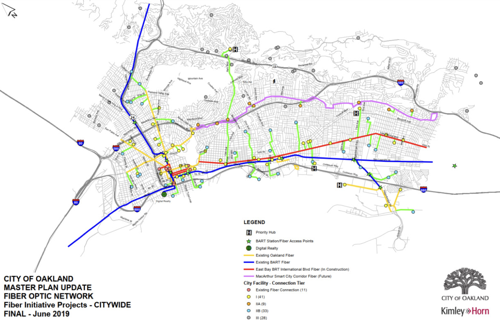
At communitynetworks.org, we have published numerous stories highlighting innovative and successful applications, including projects by Plumas-Sierra Telecommunications, the City of Huntington Park, the City of Oakland, Cold Springs Rancheria, and the City of Indio.

Today we are releasing a new two-part dashboard based on the CPUC’s data that helps visualize the success of community-based projects in this transformative state program. (The CPUC also has a very helpful interactive dashboard with more detail on each project, but it does not share our focus on community networks). Hover on each visualization within this dashboard for additional detail.

Baltimore Close To Issuing RFP For Major Fiber Expansion

Baltimore activists and leaders say the city is making steady progress in efforts to bridge the digital divide in the city of 565,000. The efforts have culminated in several grant-fueled initiatives to deliver fiber and wireless to city apartment complexes, a city middle-mile network, and a looming partnership with regional providers to further expand affordable access.

When we last checked in with Baltimore, the city had just doled out $2 million of its American Rescue Plan Act (ARPA) funding to bring fiber to 12 new city apartment buildings. The deployment is in partnership with Waves, a nonprofit formerly known as Project Waves.

Waves was first launched in 2018 in direct response to the Trump FCC’s repeal of net neutrality and the general failures of federal telecom policy to address digital inequity. Project Waves (profiled by ILSR in 2023) initially used Point-to-Multipoint wireless connectivity to deliver free wireless broadband service to about 300 multi-dwelling unit (MDU) residents.

Image
Project Waves sign

Now Baltimore Director of Broadband and Digital Equity Kenya Asli tells Government Technology the city is putting the finishing touches on a Request for Proposal (RFP) to strike a new public-private-partnership with an as-yet-unselected broadband provider. The deal should further expand fiber access to unserved and underserved parts of the city.

“Folks want more options, and so we are bringing in more options,” Asli said.

Vermont’s Otter Creek CUD Finishes Fiber Expansion, Focuses On Customer Service

Vermont’s Otter Creek Communications Utility District (CUD) says it has completed its ambitious fiber deployment, bringing affordable access to more than 6,000 homes and businesses in the Rutland County region of the Green Mountain State.

Otter Creek is another example of the way Vermont’s long under-served communities are bonding together via innovative new partnerships taking direct aim at the digital divide.

When last we had checked in on Otter Creek CUD, the CUD had just received a $9.9 million grant by the Vermont Community Broadband Board (VCBB). Otter Creek CUD then leveraged that grant funding to form a public-private partnership with Consolidated Communications.

Image
Otter Creek CUD logo

Otter Creek CUD Chair Laura Black tells ILSR that the partnership involved 335 miles of new fiber passing *6,000 locations. Of the total target reach, 1290 locations had never had broadband access previously. Between the Otter Creek grant awards and contributions from private providers, more than $24 million has been invested in Rutland County to expand fiber access.  

“We partnered with the existing ILEC business in most of our area, Consolidated Communications, to build and operate the fiber network with both their own contribution and grant funding we were able to secure,” Black said. “As well, a portion of our area was peeled off to allow the ILEC in three of the towns in our District to be served by the existing small ILEC business – Shoreham Telephone – under their own grant funding program (EACAM).”

Superior, Wisconsin Close To Launching City-Owned Open Access Fiber Network

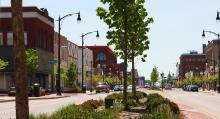
Superior, Wisconsin officials say they’re getting very close to lighting up the first subscribers of a city-owned fiber network that will finally bring affordable, next-generation fiber access to the city’s long under-served community of 26,000.

“We have phase 1 in the ground and are working with Nokia right now for final configuration and testing,” Stephanie Becken, broadband manager for ConnectSuperior, tells ILSR.

“It's our plan to have our sign-up website ready in the next two weeks, as our two ISPs finalize their connections and offerings pages,” she says. “I'm hopeful we'll have drops and initial service started by mid-May, but we may be looking at June—there's always something!”

Image
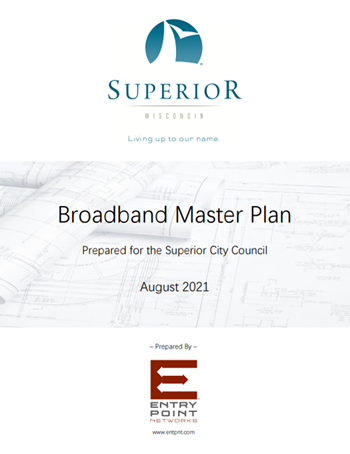
Superior Wisconsin master plan cover sheet

In 2020 the city passed a resolution declaring fiber essential infrastructure. In 2021, the city council voted overwhelmingly to move forward on a deployment master plan developed for the city by EntryPoint Networks.

In 2023 the Superior city council voted 8-1 to approve deployment in the project’s first pilot area: a swath of around 830 homes and businesses lodged between Tower Avenue, Belknap Street, and North 21st streets. But the phase 1 target area has expanded a little since as the city has moved forward on logistics and planning.

Port Of Whitman County, WA Gets $2.9 Million Grant To Expand Fiber

The Port of Whitman County in Washington state has received a new $2.9 million grant it says will help dramatically expand affordable fiber access to the heavily rural county of 48,000. The Port of Whitman’s broadband expansions have traditionally been open access, which allow multiple competitors to compete over shared, community owned infrastructure, driving down costs.

The latest funding, from the Washington State Department of Commerce’s Community Economic Revitalization Board (CERB) will support the construction of dark fiber to approximately 109 additional unserved and underserved locations in Whitman County.

According to the county announcement the project, supported by $622,441 in local matching funds, will construct last-mile fiber infrastructure along Sunshine Road east of Pullman, along Kitzmiller Road north of Pullman, and west of Tekoa. The build outside of Tekoa will bring fiber to the Port of Whitman County’s Tekoa industrial site, which the Port acquired in 2023.  

“The Port is excited to partner with CERB on this broadband project,” said Kara Riebold, Port of Whitman County Executive Director.

“This continues our efforts to bridge the digital divide in rural Whitman County. We know that reliable broadband is no longer a luxury but a necessity for economic growth and are grateful for CERB’s continued investment in broadband across Washington State.”

In Washington State, several Public Utility Districts – including the Port Of Whitman County, the Port Of Coupeville, and the Port of Skagit in Skagit County – have leveraged millions in American Rescue Plan Act (ARPA) grants to deploy community-owned open access fiber, choosing Ziply as their operational partner.

Chittenden County CUD Will Soon Emerge From The 'Dark Ages' with Fiber Expansion

Vermont’s Communications Union Districts (CUDs), which were the subject of a recently released ILSR report, continue to make steady inroads in delivering high-quality broadband access to long-neglected rural Vermont residents.

In 2021 the Vermont legislature passed Act 71, ensuring CUDs would play a key role in expanding fiber access in the Green Mountain state. In Vermont, municipally-led CUDs – municipal entities created by two or more towns with a goal of building communication infrastructure – can legally fund needed broadband expansions through debt, grants, and donations – but not taxes, though they themselves are tax-exempt nonprofits.

The CUD model allows municipalities to bond together to tackle broadband network deployments that might otherwise prove too costly or logistically difficult if attempted alone.

The results have been transformative for state residents long underserved or completely unserved by the state’s regional incumbent monopoly providers. Locals at times have likened the transformation to moving out of the “dark ages.”

Much of Vermont’s $150 million ARPA-based broadband package went toward assisting CUDs in a state where 85 percent of municipalities and 90 percent of all underserved locations fall under an existing CUD’s jurisdiction.

Consolidated Cooperative and Delaware County, Ohio Unveil $4.9 Million Fiber Expansion

The Delaware County, Ohio Board of Commissioners and Consolidated Cooperative have announced the start of a $4.9 million joint initiative to dramatically expand affordable fiber optic broadband access to large swaths of the heavily underserved county.

According to county officials, the expansion will be funded via American Rescue Plan Act (ARPA) funds, and the deployment will target more rural communities largely in the northwestern and north-central portions of Delaware County.

“We are very pleased to see this project taking tangible form now,” Delaware County Board Of Commissioners President Barb Lewis said of the project.

“So many more families, especially in the rural parts of the county, will finally be able to connect to high-speed Internet from their homes and farms, rather than having to travel someplace else to access it.”

Consolidated Cooperative provides electricity service to 15,900 electric members via 18,000 meters across eight counties in north central Ohio. The cooperative, which won the county contract during a competitive sealed bid process last year, says it has begun network construction and plans to begin offering service to impacted areas as early as this spring.

Consolidated offers four tiers of broadband service: symmetrical 300 megabit per second (Mbps) fiber for $80 a month, symmetrical 500 Mbps fiber for $100 a month, symmetrical 1 gigabit per second (Gbps) fiber for $120 a month, and a specialized symmetrical 1 Gbps “Gamer Gig” service (featuring reduced latency and “prioritized” routing) for $140 a month.

Oswego County, NY Nabs $26 million ConnectALL Grant To Expand Fiber Access

Oswego County, NY officials are celebrating the award of a new $26 million New York State grant aimed at dramatically expanding affordable fiber access to long-underserved rural communities in the northwestern part of the state, just north of Syracuse.

According to the announcement by New York State Governor Kathy Hochul, Oswego’s latest grant award will help fund the deployment of 345 miles of new fiber infrastructure to largely rural unserved regions, helping to bring affordable broadband access to nearly 11,000 homes, businesses and community institutions across 22 towns and villages.

Oswego County will own the finished open access network and lease the fiber to Internet Service Providers (SPs), including Empire Access, "on a non-discriminatory and non-exclusive basis."

Empire, a family-owned ISP and named the fastest ISP in the nation by PCMag in 2021, currently offers local residents symmetrical 500 Megabit per second (Mbps) service for $50 a month; symmetrical 1 gigabit per second (Gbps) service for $65 a month; and symmetrical 2 Gbps service for $100 a month.

ARPA Boosts Fiber Expansion To Underserved, Unincorporated San Diego County

California ISP Onward, which has increasingly partnered with California cities to expand affordable fiber access, is leveraging $4.7 million in American Rescue Plan Act (ARPA) broadband grants to further expand its footprint into long-unserved areas of San Diego County.

According to a recent announcement, San Diego county’s Broadband Committee has approved nearly $9 million in ARPA broadband grants to help expand fiber access to 1,000 residents in three unincorporated areas:

  • $4.7M awarded to Onward to deliver high-speed internet service to 281 households in Warner Springs.
  • $2.7M awarded to AT&T to deliver high-speed service to 101 households in San Dieguito.
  • $1.5M awarded to AT&T to deliver service to 53 households in Ramona.

The county says a Notice of Funding Availability was shared with all known Internet Service Providers in the County back in July of 2024. The County requested grant proposals through public outreach and engagement based on findings from its Comprehensive Broadband Plan.

Image
San Diego County map focus area

The effort is running parallel with the San Diego County Library Tech Connect Program that has provided 7,000 Google Chromebooks and MiFi hotspots with unlimited data plans to residents and students to the internet for free.

The Onward website states that the planned $4.7 million expansion into Warner Springs is still in the planning stage, but that once completed the fiber options will be between 10 to 100 times faster than existing offerings. Onward has also partnered with Rancho Cucamonga to dramatically boost access elsewhere in San Diego County.