
American Association for Public Broadband

Content tagged with "American Association for Public Broadband"

Related Topics
Displaying 21 - 30 of 36

Broadband by the People, For the People - Episode 607 of the Community Broadband Bits Podcast

In this episode of the podcast, Chris is joined by Gigi Sohn, Executive Director at the American Association for Public Broadband (AAPB), and Bill Coleman from the Benton Institute and Community Technology Advisors. The discussion centers on the importance of community-controlled broadband networks and the recent initiatives by AAPB to promote and defend these networks.

They discuss the challenges and benefits of building public broadband networks, the role of community support and leadership, and the varied models and paths communities can take to establish their own networks. 

The guests also highlight successful case studies, discuss the significance of public ownership in ensuring equitable access and local control, and emphasize the need for robust community engagement and education.

The episode also explores the increasing enthusiasm and commitment to public broadband initiatives and offers valuable advice on strategic planning and the leverage communities have in negotiating with incumbents.

Listeners will gain a deeper understanding of the strategic, financial, and social considerations involved in establishing community broadband networks and the transformative impact these networks can have on local communities.

You can find the "Own Your Internet: How to Build a Public Broadband Network" handbook here.

This show is 39 minutes long and can be played on this page or via Apple Podcasts or the tool of your choice using this feed.

Transcript below.

We want your feedback and suggestions for the show-please e-mail us or leave a comment below.

Listen to other episodes or view all episodes in our index. See other podcasts from the Institute for Local Self-Reliance.

Thanks to Arne Huseby for the music. The song is Warm Duck Shuffle and is licensed under a Creative Commons Attribution (3.0) license

Local Leaders Come Together in San Antonio to Nurture 'Ecosystem of Digital Opportunity'

Tomorrow, Gigi Sohn – one of the nation's premier broadband-for-all advocates and Executive Director of the American Association for Public Broadband (AAPB) – will join ILSR's Community Broadband Networks team and an emerging network of local digital inclusion champions in San Antonio to delve into what it takes to create an ecosystem for digital opportunity.

Hosted by the Digital Inclusion Alliance of San Antonio (DIASA) and the Texas Digital Equity Network (Texas DEN), the free event - "Eco-Bytes: Weaving the Digital Opportunity Web" - will be held on June 27, 2024 at the San Antonio Water System (SAWS) headquarters beginning at 8 am.

Image
Gigi Sohn AAPB

Similar to other ILSR Urban Digital Bootcamps in other cities across the nation, the agenda is packed with informative content designed to support community leaders working to close the digital divide in San Antonio.

The day will include interactive activities and opportunities for engaging conversations, as well as a fireside chat with Gigi and Institute for Local Self-Reliance (ILSR) Community Broadband Networks Initiative Director and event co-organizer Christopher Mitchell.

“I am thrilled to have the opportunity to visit San Antonio and the growing network of connectivity champions doing the important advocacy work for telecommunication policies and infrastructure investments that promote a healthy democracy and a just society," Sohn said.

“It’s vital that we foster community centric solutions that ensure everyone has access to the technologies necessary to fully participate in our society, our economy, our health care and education systems."

Event Highlights:

Event: How to Build a Public Broadband Network

Tune in June 11 for the third and final installment of a new webinar series aimed at local government leaders thinking about building publicly owned networks. Hosted by the American Association for Public Broadband (AAPB) and the Benton Institute for Broadband and Society - both veteran organizations in this space - the event aims to unpack key considerations in the building and operation of community-owned networks.

The first two webinars in the series took place in April and May, and featured conversations with industry experts on the factors that go into deciding whether to embark on a path to building publicly owned broadband and understanding the models available and when pursuing a partnership is the right path.

The webinar series as a whole follows the publication of a guide by AAPB and Benton published this spring called Own Your Internet: How to Build a Public Broadband Network [pdf]. It is packed with analysis, practical advice, and lessons learned on everything from feasibility studies to business models to financing to marketing, as well as case studies in Ohio, Texas, Utah, and more.

This third event - titled Implementation - Building and Operating the Network - rounds out the series with infrastructure builders and the General Manager of Waterloo, Iowa’s municipal network, which has been building since September 2022. See the full schedule below:

Webinar Three: Implementation - Building and Operating the Network

June 11th, 12 pm - 1pm ET

The last webinar will focus on the challenges of and strategies for building the physical infrastructure and launching services. Panelists will discuss how they manage complex operations while also adapting to changing conditions, all in view of a community invested in their broadband.

Bill will be joined by:

  • Suzanne Heritage, Underline
  • Sachin Gupta, Cetranet Fiber
  • Eric Lage, Waterloo Fiber
  • Jon Willow, Community Broadband Action Network

Register for the event, which runs from 12p to 1p ET on June 11th.

Minnesota Strikes Down Preemption Laws Blocking Municipal Broadband

Community broadband advocates have scored a major victory in Minnesota as state lawmakers there have repealed the state’s preemption laws that prevented cities and towns in the Land of 10,000 Lakes from providing municipal broadband services.

The new legislation, signed into law yesterday by Gov. Tim Walz, took aim at two statutes that sought to protect large monopoly telecommunications providers from competition.

New Law Unwinds Antiquated Statutes

One antiquated law that had been on the books for over a century (Minn. Stat. Ann. § 237.19) allowed municipalities in Minnesota to buy or construct “telephone exchanges” only if they secured a supermajority vote in a local referendum election. Though intended to regulate telephone service, the way the law had been interpreted after the invention of the Internet was to lump broadband in with telephone service thereby imposing that super-majority threshold to the building of broadband networks.

Image
Minnesota state seal

Another law (Minn. Stat. Ann. § 429.021(19)) gave municipalities the express authority to “improve, construct, extend, and maintain facilities for Internet access” but only if a private provider was not offering service in that municipality.

But this week, with a single omnibus bill (SF 4097), those old preemption laws were repealed by state legislators and signed into law by the Gov. Walz yesterday, officially paving the way for any municipality in the state to have the option of building networks to offer municipal broadband service or partner for the same.

Anti Muni Broadband Budget Amendment Gets Nixed in New York

Advocates for better Internet access are breathing a sigh of relief in New York as the State Assembly passed a budget bill yesterday that did not include an amendment that would have undermined the state’s municipal broadband grant program.

As we reported last month, buried in language near the bottom of the Assembly budget proposal was a Trojan horse legislative sources said was being pushed by lobbyists representing Charter Spectrum.

The amendment, which did not survive the budget reconciliation process, proposed to limit Municipal Infrastructure Program grants to projects that targeted “unserved and underserved locations only” – a restriction that would have made municipal broadband projects in the state less likely to become financially viable.

Image
New York State Capitol Empire State Plaza

Created as part of New York’s billion dollar ConnectALL Initiative, the MIP is specifically designed to support municipal broadband projects. Such projects are routinely targeted by lobbyists for the big monopoly providers intent on preventing any competition to their often spotty, high-cost service offerings.

New Resource Alert: Rising Tide of Municipal Broadband Networks Fact Sheet

As the municipal broadband movement continues to gain momentum, we created a new fact sheet to highlight the dramatic surge in the number of communities building publicly-owned, locally controlled high-speed Internet infrastructure over the last three years.

In January, we announced our updated tally of municipal broadband networks across the U.S., which showed that between January 2021 and January 2024 at least 47 new municipal networks had been lit up for service.

Our census of new municipal broadband networks comes while dozens of other projects are still in the planning or pre-construction phase, which includes the possibility of building 40 new municipal networks in California alone.

The new fact sheet not only contains pertinent numbers to illustrate the rising tide of municipal broadband networks, it also includes snapshots of four recently launched networks now providing service to communities hungry for high-quality Internet connectivity and competitive choice.

You can find the new Rising Tide of Municipal Broadband fact sheet here.

Image
New Muni Fact Sheet screenshot

Community Broadband Resource Pairing

Caution Ahead: RDOF and BEAD Collision Course

The Rural Digital Opportunity Fund (RDOF) was supposed to drive affordable fiber into vast swaths of long-underserved parts of rural America. And while the FCC administered program accomplished some of that goal, a multitude of problems have plagued the program since its inception, putting both current and future broadband funding opportunities at risk.

The $20.4 billion RDOF program was created in 2019 by the Trump FCC as a way to shore up affordable broadband access in traditionally unserved rural U.S. markets.

The money was to be doled out via reverse auction in several phases, with winners chosen based on having the maximum impact for minimum projected cost.

During phase one of the program, the FCC stated that 180 bidders won $9.2 billion over 10 years to provide broadband to 5.2 million locations across 49 states and the Commonwealth of the Northern Mariana Islands.

But, according to ILSR data, roughly 34 percent of census blocks that won RDOF funding–more than $3 billion in awards – are now in default. All told, 287,322 census blocks were defaulted on by more than 121 providers as of December 2023.

Image
RDOF top 10 screenshot

The defaults are only one part of a larger problem: namely that many communities bogged down in RDOF program dysfunction may risk losing out on the historic amount of federal funding to build modern broadband networks (BEAD) made possible by the 2021 bipartisan infrastructure law.

One Big Giant Mess

AAPB and Benton Publish New Handbook: ‘How To Build A Public Broadband Network’

More cities and towns across the U.S. are exploring municipal broadband as an increasingly attractive and effective approach to bring ubiquitous, and affordable, high-speed Internet to its residents and businesses.

Now, a new handbook has been published that is tailored to guide local officials in navigating the logistical, technical, financial, and political challenges along the way.

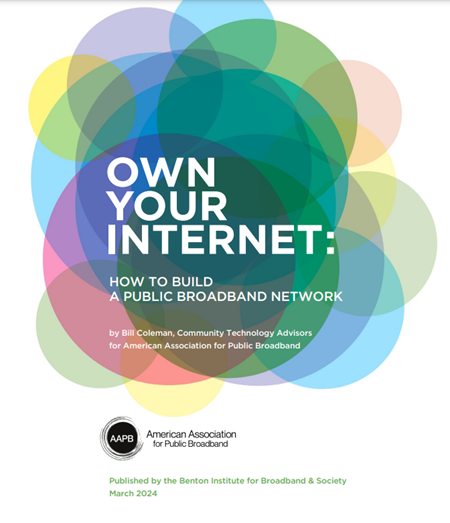
Hot off the presses this week comes “Own Your Internet: How To Build A Public Broadband Network” – a project of the American Association for Public Broadband (AAPB), published in partnership with the Benton Institute for Broadband & Society.

Image
AAPB handbook cover

“This handbook is a key part of AAPB's strategy to double the number of public networks in the next five years, supporting communities in leveraging these networks for economic development, smart city initiatives, and attracting new residents," AAPB Executive Director Gigi Sohn said in announcing the handbook release.

Benton Executive Director Adrianne B. Furniss said the collaboration in publishing the guide made sense because “every community has a stake in this broadband moment—and they must have the tools they need to decide how they will meet their connectivity needs. We trust that this handbook is one of many tools communities will use to assess their situation and plan for a connected future.”

NTIA Letter of Credit Waiver Victory for Community Broadband

The National Telecommunications and Information Administration (NTIA) recently announced it has created a “programmatic waiver” that offers alternatives to the much-criticized letter-of-credit (LOC) requirement buried in the BEAD program.

The announcement comes after hearing from a coalition of public interest groups and a chorus of broadband experts that the LOC requirement would effectively shut out smaller ISPs from participating in the national effort to expand high-speed Internet access.

When the bipartisan infrastructure law was passed in 2021, establishing the $42.5 billion BEAD program, the NTIA issued a Notice of Funding Opportunity (NOFO) that detailed the spending rules for BEAD grants. Designed to ensure Internet service providers (ISPs) did not take federal grant dollars and leave a project incomplete, the LOC requires BEAD grant applicants to provide a letter-of-credit from a bank that verifies the applicant has at least 25% of the grant dollar amount in cash reserves held in a bank account for the entire time it takes to complete a network build.

Expert Coalition Says Existing BEAD Rules Harm Small ISPs, Municipalities

A massive coalition of more than 300 broadband policy experts and organizations have written a letter to the U.S. government, warning that smaller broadband providers, nonprofits, and municipalities will be elbowed out of an historic $42.45 billion broadband grant program without some notable changes to program rules.

At the heart of their concerns sits the Broadband Equity Access and Deployment (BEAD) program, made possible by the recently passed infrastructure bill, and administered by the National Telecommunications and Information Administration (NTIA). The grant program is a once-in-a-lifetime opportunity to put a significant dent in America’s longstanding digital divide.

But BEAD program rules currently require grant recipients to obtain a letter of credit (LOC) from a bank, collateralized by cash or cash-equivalent. They also require grant winners to provide "matching funds of not less than 25 percent of project costs," though the latter restriction can be waived in some high deployment cost areas.

While the restrictions were intended to reduce the risk of project failure (a touchy subject for the government in the wake of problems with the FCC’s RDOF program), they require grant recipients to lock away vast and untouchable sums of capital for the duration of any broadband build, most of which last several years.

The referenced media source is missing and needs to be re-embedded.

According to the coalition’s letter to lawmakers, such requirements present unnecessary obstacles for smaller ISPs and cash-strapped municipalities, undermining the infrastructure bill’s goal of equitable, affordable broadband for all.