
rural

Content tagged with "rural"

Related Topics
Displaying 481 - 490 of 1063

Allband All-in For Rural Michigan Internet Access - Community Broadband Bits Podcast 276

After being told by the large telephone incumbent that he could pay a nominal fee in rural Michigan to get phone service, John Reigle built a home. And when the telephone company changed its mind after quoting an outrageous price, he created a cooperative that is building fiber networks in a very rural region of Michigan. 

General Manager Ron Siegel of Allband Communications Cooperative joins us for episode 276 of the Community Broadband Bits podcast. We talk about the realities of connecting the most rural unconnected, while fighting for what meager support is available from state and federal sources. 

Along the way we talk about how the cooperative grew up and where its future lies in an uncertain time for local networks as the federal government showers money on the biggest incumbents that aren't really investing in rural America.

We previously wrote about Allband here.

This show is 22 minutes long and can be played on this page or via Apple Podcasts or the tool of your choice using this feed

Transcript below. 

We want your feedback and suggestions for the show-please e-mail us or leave a comment below.

Listen to other episodes here or view all episodes in our index. See other podcasts from the Institute for Local Self-Reliance here.

Thanks to Arne Huseby for the music. The song is Warm Duck Shuffle and is licensed under a Creative Commons Attribution (3.0) license.

KentuckyWired: Partners, Poles, Problems Plague Project

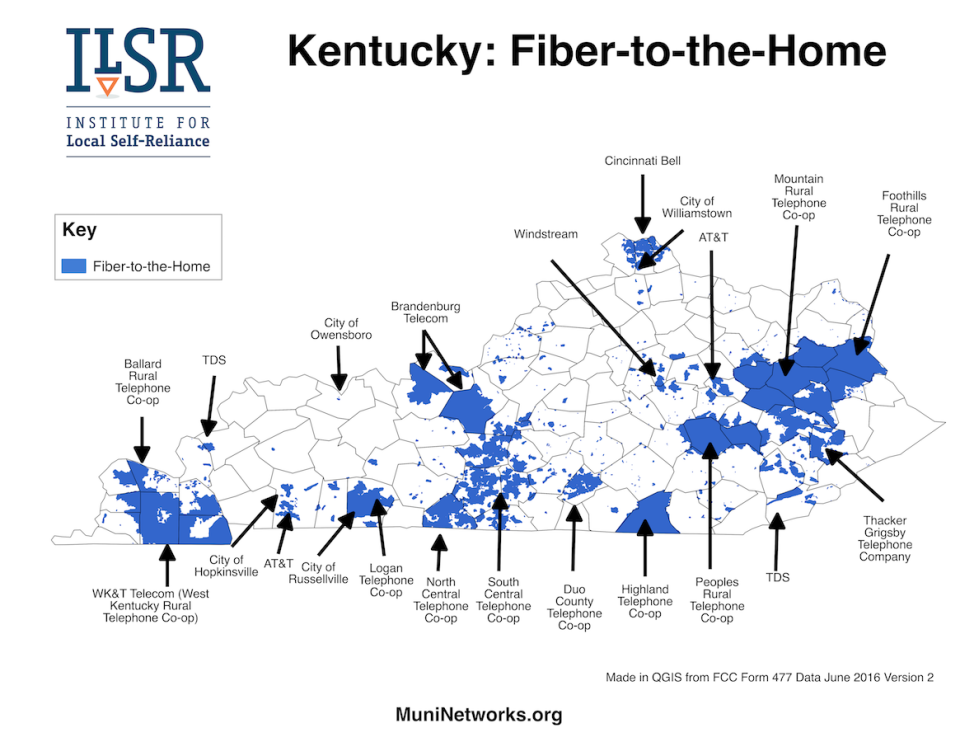
With the best intentions, Kentucky announced in late 2014 that it would build out a statewide open access fiber optic network to at least one location in each county to encourage high-quality connectivity in both urban and rural communities. Hopes were high as rural residents and businesses that depended on DSL and dial-up envisioned connectivity to finally bring them into the 21st century. After almost three years and multiple issues that have negatively impacted the project, legislators and everyday folks are starting to wonder what's in store for the KentuckyWired project. 

Local Communities Are Best Suited To Deploy Community Networks

There is no one-size-fits-all method of deploying across a state filled with communities and landscapes as diverse as Kentucky. From the urban centers like Louisville and Lexington to the rocky, mountainous terrain in the southeastern Appalachian communities, demographics and geography vary widely. But most lack modern Internet access and local ISPs have found it hard to get affordable backhaul to connect to the rest of the Internet.

There are several municipal networks in Kentucky, some of which have operated for decades. In addition to Glasgow, Paducah, Bowling Green, Frankfort, and others, Owensboro is currently expanding a pilot project that proved popular. As our own Christopher Mitchell discussed at the Appalachia Connectivity Summit, several cooperatives have made major fiber-optic investments in the state.

When it comes to connecting residents and local businesses, we strongly believe local entities are the best choice. Local officials have a better sense of rights-of-way, the challenges of pole attachments, and the many other moving pieces that go into network investment. Projects with local support see fewer barriers - people are more willing to grant easements, for instance. 

Up North Blandin Border to Border Conference Reminder!

Next week’s Border to Border Broadband Conference from the Blandin Foundation promises to be a great opportunity to meet like-minded people with an eye on infrastructure. This year, the event is titled “Bridging the Gaps - Expanding the Impact” and will take place at Madden’s on Gull Lake. If you haven’t already made your plans, now is an excellent time to plan on heading up north to enjoy some fall weather, Minnesota style. 

The folks at Blandin shared more information about the event and we want to pass it on to you:

Minnesota is hosting its annual Border to Border Broadband Conference October 25-26 in beautiful Brainerd Minnesota on Gull Lake.  Come learn about Minnesota's broadband innovative broadband infrastructure grant program that has had a significant impact on broadband deployment in some of the most rural places in Minnesota. 

Blandin Foundation will present new research demonstrating the impact of investment in broadband infrastructure and adoption on five rural Minnesota communities where world-class broadband is meeting smart economic development strategies.

Providers and communities will host eight interactive learning stations showcasing successful rural projects funded through Minnesota’s Border-to-Border grant program.

Pre-conference sessions will include a Broadband 101 Workshop and a Digital Inclusion Showcase:

Laura Withers, Director of Communications, NTCA – The Rural Broadband Association; Roberto Gallardo, Assistant Director, Purdue Center for Regional Development; and Aaron Brown, Iron Range storyteller, blogger (http://minnesotabrown.com/)  and broadband advocate; are among the conference’s featured speakers.

Learn more at the conference website.

Garrett County Builds Better Connections By Combining Technologies in Rural Maryland - Community Broadband Bits Podcast 275

Maryland may be home to our nation’s bustling, urban capital, but on the other side of the state are the Appalachians and many rural communities that struggle with poor Internet access. One of those communities is Garrett County. Residents, businesses, and institutions have limped along for years using outdated connections.  Some people don’t have any access to the Internet; all that is changing.

In episode 275 of the Community Broadband Bits podcast, the county’s Natural Resources Business Specialist Cheryl DeBerry and county CIO Nathanial Watkins join Christopher to discuss the initiative that is changing the local connectivity landscape.

Cheryl, Nathaniel, and Christopher discuss the project that combines fiber, fixed wireless, and TV white space technologies in order to reach people and businesses across the county. They also talk about how a significant portion of people in the rural community simple can’t afford the high cost of satellite and how mobile Internet access just doesn’t cut it in a rural area like Garrett County. Cheryl describes how the project is an economic development initiative and Nathaniel shares more details about their need to combine technologies and the results.

This show is 23 minutes long and can be played on this page or via Apple Podcasts or the tool of your choice using this feed

Transcript below. 

We want your feedback and suggestions for the show-please e-mail us or leave a comment below.

Listen to other episodes here or view all episodes in our index. See other podcasts from the Institute for Local Self-Reliance here.

Thanks to Arne Huseby for the music. The song is Warm Duck Shuffle and is licensed under a Creative Commons Attribution (3.0) license.

Eastern Tennessee: Newport Smart Grid, Morristown Incubator

Approximately 30 miles separate Morristown and Newport, but the two are joining forces to better connect local businesses and residents as entrepreneurs take up residence in the region's newest high-tech work space.

An Incubator for Innovation in Morristown

SkyMart Venture Place is a new cooperative workspace stirring innovation in the quaint downtown district of Morristown.

Morristown was on the forefront of implementing city-wide Fiber-to-the-Home (FTTH) back in 2006. Today their gigabit network MUS FiberNET is fostering innovation in this thriving co-working space and helping neighboring communities bridge their connectivity gaps. Lynn Wolfe explains that the new space has helped support her in the early stages of her business. “[SkyMVP] gives me a place—with super-fast internet—to come and do my internet marketing, and it has been very beneficial for that and being able to upload my training videos,” Wolfe said.

SkyMVP’s doors opened in August of last year and it’s become a hub for local entrepreneurs. The space allows members to hold workshops, rent office space, and network with other professionals.

Similar incubator projects are underway in Virginia’s Roanoke Valley and Indianola, Iowa. SkyMVP is yet another example of how gigabit connectivity can spur positive transformations for local communities. Morristown’s decision to invest in FTTH infrastructure is emboldening their local economy and potential for small business growth in the area is promising. Sky MVP has even begun offering a course for budding entrepreneurs and a handful of free workshops.

Expanding the 'Net in Newport

Transcript: Community Broadband Bits Episode 274

This is the transcript for episode 274 of the Community Broadband Bits podcast. Justin Holzgrove and Joel Myer join the show from Mason County, Washington, to discuss how a publicly-owned network delivers high-speed Internet service throughout the county. Listen to this episode here.

Justin Holzgrove: They didn't bring pitchforks, but they brought their pens and they were ready to sign up with their checkbooks. And they said, "Bring it on. We want this now."

Lisa Gonzalez: This is episode 274 of the Community Broadband Bits podcast from the Institute for Local Self-Reliance. I'm Lisa Gonzalez. Public Utility District 3 in Mason County, Washington, delivers symmetrical gigabit connectivity to every customer in its service area. They have no speed, capacity or data thresholds. You have access to a gigabit regardless of whether you are in a rural area or within city limits and whether or not you're a household, business, or one of the ISPs that work with PUD 3. This week Justin Holzgrove and Joel Myer from PUD 3 in Mason County spent some time talking with Christopher about how the Public Utility District is working to bring high quality connectivity to each customer. In addition to describing their plan to build out and manage their network, Justin and Joel share the story of how connectivity has come to be offered from PUDs in Washington. Now here's Christopher with Justin Holzgrove and Joel Myer talking about Public Utility District 3 in Mason County, Washington.

Christopher Mitchell: Welcome to another edition of the Community Broadband Bits podcast. I am Chris Mitchell at the Institute for Local Self-Reliance up in Minneapolis. Today I'm speaking with Justin Holzgrove the Telecommunications and Community Relations Manager up at Mason County's Public Utility District number 3. Welcome to the show.

Justin Holzgrove: Hey how's it going?

Christopher Mitchell: It's going well. I'm excited to learn more about what you're doing. But first I have to introduce our other guest. Joel Myer the Public Information and Government Relations Manager at PUD number 3. Welcome to the show.

Joel Myer: Thank you it's a beautiful day in the Fiberhood.

Mount Washington, Massachusetts, Set To Debut New FTTH Network

Mount Washington, Massachusetts, is set to light up its new Fiber-to-the-Home (FTTH) network this month. By “building our own Fiber-to-the-Home broadband network, we are taking an important step in securing our community’s long-term vitality and sustainability,” says Selectboard Member Gail Garrett

Mount Washington Recap

Mount Washington is nestled within the forested Taconic Mountains area located in the southwest corner of the state. The roughly 150 full-time residents have been frustrated with the lack of connectivity. "Everybody's had it with their current connections” said Garret and believes the town “deserves the same opportunity to connect to the internet as those in larger communities.” 

The final estimates for the network came in at $603,000 but the town planned for any unanticipated make ready or dig costs and prepared for a high estimate of $650,000. To fund construction, Mount Washington authorized the use of $250,000 from their stabilization fund in 2015, received $230,000 in federal and state funds from the Massachussetts Broadband Institute (MBI) earlier this year, and established a plan to borrow the remaining $400,000 through a state loan program. This spring, received an additional $222,000 grant from the Executive Office of Housing and Economic Development, which will allow them to pay down the debt sooner and have the network paid off within five years.

The FTTH network is set to provide residents who opted in, over 60 percent of the town, with up to 1 gigabit of upload and download speeds. To opt in, residents deposited $300 per household and committed themselves to three years of data and telephone service on the FTTH network.

Mason PUD 3 Responds to Muni Fiber Demand with Fiberhoods - Community Broadband Bits Podcast 274

Mason County Public Utility District 3 covers a large area with a lot of people that have poor Internet access. If "PUD" didn't give it away, it is located in Washington State on the Olympic Peninsula and had already been investing in fiber as an electric utility for monitoring its internal systems.

Mason PUD 3 Telecommunications & Community Relations Manager Justin Holzgrove and Public Information & Government Relations Manager Joel Myer join us for episode 274 of the Community Broadband Bits podcast to discuss how they are expanding their open access fiber optic network to the public after seeing tremendous support not just for Internet access but specifically for the PUD to build the infrastructure.

We talk about how they are financing it and picking areas to build in as well as the role of the Northwest Open Access Network, which we have discussed on previous shows and written about as well. We cover a lot of ground in this interview, a good place to start for those interested in open access and user-financed investment.

This show is 38 minutes long and can be played on this page or via Apple Podcasts or the tool of your choice using this feed

Transcript below. 

We want your feedback and suggestions for the show-please e-mail us or leave a comment below.

Listen to other episodes here or view all episodes in our index. See other podcasts from the Institute for Local Self-Reliance here.

Thanks to Arne Huseby for the music. The song is Warm Duck Shuffle and is licensed under a Creative Commons Attribution (3.0) license.

Image of the Mason PUD 3 Fiberhood courtesy of COS Systems.

Fiber For Key Industrial Areas Coming To Somerset County, Pennsylvania

Over the past several decades, the population of Somerset County, Pennsylvania, has incrementally jumped up and down, but today's population is the same as it was in 1960. In order to boost economic development and encourage growth with more jobs, community leaders are deploying fiber for better connectivity in several industrial areas.

Financial Help For Fiber Connectivity

In May, U.S. Department of Commerce’s Economic Development Administration (EDA) announced that they would provide a $569,000 grant to the county to help fund the project. The EDA consider the project worth while because they expect the project to retain 20 existing jobs, generate 42 new jobs, and stimulate $25 million in private investment.

County officials intend to combine the EDA grant with an additional grant they received in January from the Appalachian Regional Commission. The ARC grant of almost $949,000 will allow Somerset County to dedicate approximately $1.5 million to run fiber four industrial parks. The County will match the grant award in order to fully fund the 22-mile network, which will expand existing Somerset County fiber infrastructure. View a map of the proposed expansion here.

Lack Of Meaningful Connectivity In Rural Pennsylvania

Recently, the County Board of Commissioners approved a contract with a firm to oversee the project. Long-term goals are to improve connectivity for approximately 1,100 businesses and 3,900 households along with local community anchor institutions (CAIs) and other entities. Approximately 18 percent of the people in Somerset don’t have broadband as defined by the FCC (25 megabits per second (Mbps) download and 3 Mbps upload) according to Form 477 data. The number is likely much higher, however, because Form 477 data tends to overstate coverage, especially in rural areas. Shortly after the county received the EDA award, two local Internet service providers expressed interest in delivering services via the new infrastructure.

Transcript: Community Broadband Bits Episode 272

This is the transcript for Episode 272 of the Community Broadband Bits Podcast. Christopher Mitchell sits down with three local leaders in Lyndon Township, Michigan, to discuss how the community decided to pursue a Fiber-to-the-Home network. Listen to this episode here.

Gary Munce: We had a voter turnout of 43 percent of the Township residents. That is by far and away the largest turnout for any August election in the history of voting in Lyndon township.

Lisa Gonzalez: This is episode 272 of the Community Broadband Bits podcast from the Institute for Local Self-Reliance. I'm Lisa Gonzalez. In August, the small community of Lyndon Township, Michigan voted to raise property taxes to fund publicly-owned fiber optic infrastructure. Marc Keezer, Gary Munce, and Ben Fineman from Lyndon joined Christopher to talk about the vote, their proposed network, and how they spread the word about improving connectivity in their rural community. Our guests also describe the work of Michigan Broadband Cooperative that's working on the Lyndon project. Now, here's Marc, Gary, Ben, and Christopher.

Chris Mitchell: Welcome to another edition of the Community Broadband Bits podcasts. I'm Chris Mitchell, and today I'm speaking with a cohort of folks from Lyndon Township in Michigan. I'll start with introducing Marc Keezer, Lyndon Township Supervisor. Welcome to the show.

Marc Keezer: Thank you, Chris.

Chris Mitchell: We also have Gary Munce who led the Lyndon Broadband initiative ballot campaign and is also a board member of the Michigan Broadband Cooperative. Welcome to the show.

Gary Munce: Thanks, Chris.

Chris Mitchell: And our third guest is Ben Fineman who volunteers as president of the Michigan Broadband Cooperative and is someone that I know has been working on this for a long time. Welcome to the show.

Ben Fineman: Thank you very much for having us, Chris.