
middle mile

Content tagged with "middle mile"

Displaying 31 - 40 of 146

Realizing Ambitions of Open Access in Marin County, California

Creative efforts are underway in Marin County, California to bring fiber connectivity to underserved pockets of the community and eventually the whole area. Digital Marin, currently housed within the county’s Information Services and Technology Department, is coordinating the project, and is leaning towards a municipally-owned, open-access solution modeled after Ammon’s standout network in Idaho.

Just across the Golden Gate Strait from San Francisco, Marin County is home to about 265,000 residents, as well as the Muir Woods National Monument, a County Civic Center designed by Frank Lloyd Wright, and nearly 73 miles of coastal trail. Despite largely being considered an urban county, Marin also includes suburban and rural areas with 40 percent of the county classified as protected park land.

When it comes to Internet connectivity, the area is peppered with what Marin County resident and Digital Marin Executive Steering Committee member, Bruce Vogen, calls “donut holes of high-quality Internet access.” An unknown provider built a DSL network in the region many years ago and then Comcast later bought and inherited the antiquated infrastructure. Soon after, AT&T entered the market but selected only the most profitable neighborhoods to serve. All 90,000 of the county’s urban households can access the Internet through Comcast, but just 20,000 of these homes have access to the archipelago of AT&T’s fiber network. In any case, Marin’s urban areas are either subject to monopoly or duopoly market control. It has long been apparent there is a digital divide in Marin County, but it wasn’t until the 2022 FCC maps were released that the contours of this divide came into focus.

Summit County, Ohio Building $75 Million, 125-Mile Fiber Ring

Summit County, Ohio says it’s making progress on a $75 million, 125-mile fiber-optic ring made possible courtesy of American Recovery Plan Act (ARPA) funds. The project will start by providing gigabit connectivity to all county first responders, after which county leaders say they’ll focus on shoring up lagging broadband access to long-neglected communities.

A 2017 report by an outside consultant found that Summit County, like so much of America, struggles with a dearth of affordable broadband access thanks to a heavily monopolized U.S. broadband market. The county’s fixed-line broadband market is dominated by two major incumbents, Centurylink and Comcast, and wireless access remains spotty across large swatches of the county’s more rural territories.

Introduced last year, Summit County Executive Ilene Shapiro noted the network will first connect all 31 city, village and township governments to gigabit speed broadband and a data center. The network is expected to cost as much as $75 million. $35 million of that total will be pulled from the $105 million in ARPA funding received by the county.

Image
Summit County Ohio police vehicle

Summit County’s interest in more affordable broadband extends back years. County leaders played a key role in beating back monopoly efforts in the state legislature to effectively ban publicly-owned broadband networks. Once those efforts were defeated, county leaders began formulating their broadband expansion plans in earnest.

Avon, Colorado Will Join ‘Project Thor’ Middle Mile Coalition

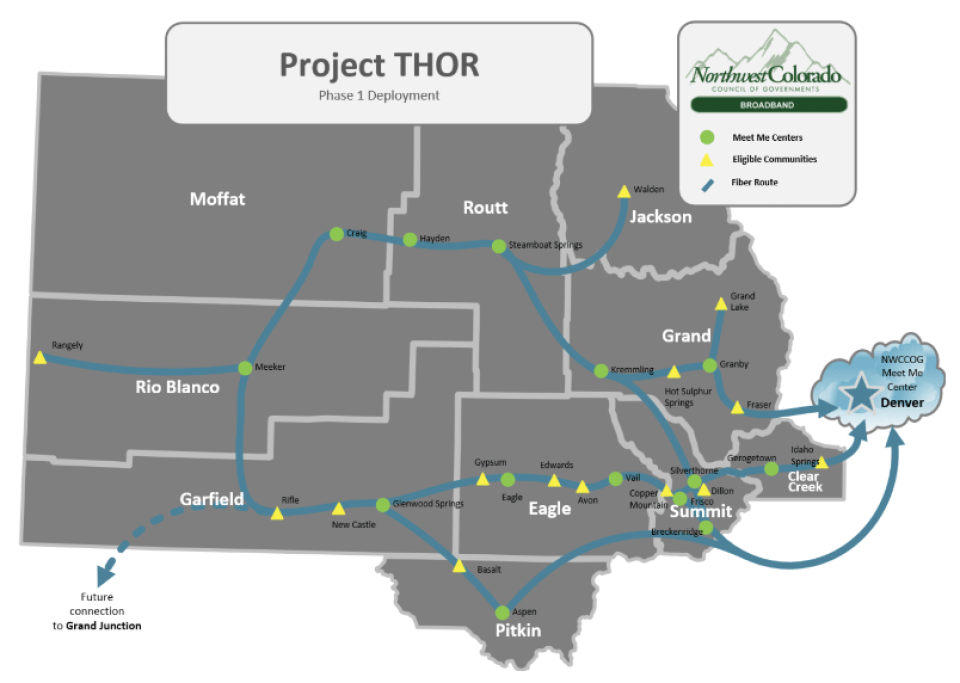
Avon, Colorado will soon be joining Project THOR, an open access middle mile fiber alliance of 14 communities spearheaded by the Northwest Colorado Council of Governments (NWCCOG).

The network, which feeds into NWCCOG’s Point of Presence in Denver, has dramatically benefited state anchor institutions and boosted network reliability across large swaths of Northwest Colorado. 

We detailed Project Thor and talked with NWCCOG Executive Director Jon Stavney in episode 406 of the Community Broadband Bits podcast. “The image of the hammer and breaking down roadblocks and breaking down barriers really worked,” NWCCOG officials told the Colorado Sun when asked about the project being named after the Norse god of thunder.

Image

A recent broadband assessment (page 50) of Avon conducted by an outside consultant found that Avon locals were annoyed by limited broadband competition, high prices, and a lack of reliability from current private sector broadband offerings. The survey also found locals would be supportive of a city-run broadband initiative if it meant lower prices and faster service. 

“We believe the installation of a fiber optic network to enable improved broadband service is appropriate and beneficial in Avon and deployment should commence in the near term so that Avon does not fall too far behind peer communities,” the report found. 

Yavapai County, Arizona Pushes Forward with $20 Million Broadband Expansion

Yavapai County, Arizona is pushing forward with a $20 million plan to shore up broadband access across the region. While dramatically scaled back from a $55 million proposal pushed last year, county leaders are hopeful that the effort still drives significant upgrades across the rugged and predominantly rural desert county.  

Last fall, Yavapai County officials announced they would be committing $20 million of the county’s $45.6 million in American Rescue Plan Act (ARPA) funds toward its Broadband Final Mile Initiative, a project spearheaded by the Yavapai County Education Service Agency (YCESA) and designed to bring affordable broadband to every student in Arizona.

The county issued an RFP last October looking for broadband providers willing to use ARPA funding to push symmetrical 100 Megabit per second (Mbps) connections further into rural regions. The expansion was to lean heavily on a 2018 Yavapai County decision to spend $3.7 million on a fiber-optic middle mile network connecting 74 schools and libraries.

Image

“The proposals have been reviewed and contracts have been awarded,” Yavapai County School Superintendent Tim Carter told ILSR in an update. “Cox Communications has been awarded the contract for Black Canyon City and Congress, and Altice USA has been awarded the contract for Mayer, the Beaver Creek area, Cornville, and Paulden.”

Brownsville, Texas and Lit Communities partner to Build Citywide Fiber Network

Brownsville recently took a Texas-sized step toward the creation of better broadband options for its residents and businesses, as city commissioners voted in late July to enter into a public-private partnership to build a city wide fiber network known as BTX Fiber

As reported by The Brownsville Herald:

At a Wednesday morning ceremony in city commission chambers, Brownsville Mayor Trey Mendez and Brownsville Public Utilities Board CEO and General Manager John Bruciak signed an agreement with Brian Snider, CEO of Lit Communities, that will allow the fiber infrastructure to be completely built out.

The city commission at its July 19 regular meeting approved the public-private partnership between the city, LIT Texas LLC and its subsidiary BTX Fiber, “for the construction, operations and maintenance of city-wide broadband infrastructure, including but not limited to incorporation and approval of a Right of Way and Encroachment Agreement; Engineering, Procurement and Construction Contract; and Middle Mile Connection Agreement and Grant of Indefeasible Rights of Use Agreement.

Wake up call for Brownsville

From the outside it may seem like an overnight success. But, like most stories, the planning started years ago.

NTIA Rejects Grafton County, New Hampshire Bid, Officials Seek Other Funding for Middle Mile Network

One way or another, Grafton County, New Hampshire is lining up funding to build a massive new middle-mile network county officials hope will drive broadband competition—and more affordable fiber—into long underserved New Hampshire communities. 

Grafton was one of 230 U.S. communities that applied for a National Telecommunications and Information Administration (NTIA) Broadband Infrastructure Program grant. Grafton’s specific application asked for $26.2 million to help fund the creation of the 353 mile broadband middle mile network they’re calling Grafton County Broadband Now.

Costly Challenge from National Incumbent Providers

Charter Communications filed costly challenges with the NTIA challenging the application, falsely claiming that the county’s proposal was “duplicative” and Charter already provided broadband to the region. Most of the claims were based on older, unreliable data provided to the FCC by Charter dramatically overstating broadband availability.

Image

Grafton County surveys actually indicate the majority of county residents still can’t get access to the FCC’s base definition for broadband, 25 Megabits (Mbps) per second downstream, 3 Megabits per second upstream. Availability data across the county will likely look even worse should the FCC pass a new proposal to boost the definition of broadband to 100 Mbps.

A Plan for Middle and Last-Mile Comes Together in York County

For the past two years, York County, Pennsylvania (est. pop. 459,000) has been working hard on a multi-part plan to connect both rural and urban areas.  

York began laying out plans for a county-owned middle-mile network in 2020. The idea was to make last-mile hookups viable for private providers in more areas of the county, and to close its major connectivity gaps.

Along with these plans, York launched a middle-mile pilot project along a 16-mile stretch of the York Heritage Rail Trail, which runs from the York metropolitan area in the center of the county down to Pennsylvania’s southern border. The project leveraged $1.5 million in CARES Act funding and a length of conduit that had been lying underneath the rail trail for two decades. The fiber that was deployed currently provides middle-mile capacity throughout the south central part of the county, as well as some wireless coverage from a tower at the stretch’s midpoint in Hanover Junction.

Building Beyond the Pilot

In early 2021, it was left to the YoCo Fiber Broadband Task Force, “led by the York County Economic Alliance and composed of representatives from business, government, health care, education, and other sectors,” to recommend to the county a way to “develop and implement a countywide broadband strategy.”

In July of that year, the Board of Commissioners voted unanimously to spend as much as $25 million of its American Rescue Plan money, under the guidance of the task force. The first $20 million was dedicated to building out the first half of an underground middle-mile network throughout southern York County, which was designed to “connect anchor institutions and build redundancy.”

Santa Clara County Moves Toward Municipal Fiber Network

Driven by Covid frustration and a boom in available grant money, Santa Clara County, California officials say they’re moving forward with their plans to explore a municipal broadband network, with the formal next steps expected to be announced at the tail end of this year. 

Last December, the board of supervisors in Santa Clara unanimously approved the creation of a publicly-owned fiber municipal broadband network. Spearheaded by County Supervisors Cindy Chavez and Susan Ellenberg, the project aims to provide “affordable, reliable high speed broadband service” to communities across Santa Clara County.

Santa Clara county contracted CTC Technology and Energy to examine various construction and funding proposals and develop a project master plan. County officials tell ILSR that the next report on that effort isn’t expected until November or December of this year, but the county is working on building a bridge toward a publicly-owned option in the interim. 

Hidden In Plain Sight

According to the California State Association of Counties (CSAC), 70,000 Santa Clara residents have no access to broadband whatsoever. Another 73,000 currently qualify as underserved, meaning they remain stuck on dial up or antiquated DSL incapable of meeting the FCC’s minimum threshold of 25 Megabit per second (Mbps) downstream/3 Mbps upstream to even be considered “broadband.” 

“The pandemic has exposed the digital inequity that has been hidden in plain sight in the heart of Silicon Valley for two decades now,” Santa Clara County Supervisor Cindy Chavez told ILSR. 

New York’s First Bite of the Municipal Broadband Apple

Breaking new ground in New York, state leaders are launching the first municipal fiber-to-the-home (FTTH) projects in the Empire State with funds from its new ConnectALL Initiative

Four small rural communities in four different counties will be the beneficiaries of New York’s initial foray into municipal broadband, targeting “areas where existing state-owned fiber can create a fiber bridge between large data centers (first mile) and individual homes (last mile), primarily in rural areas that are not serviced by private broadband providers.”

At the end of May, Gov. Kathy Hochul’s office announced the $10 million grant award, which will fund fiber deployments to the Village of Sherburne in Chenango County, the Town of Nichols in Tioga County, the Town of Diana in Lewis County, and the Town of Pitcairn in St. Lawrence County.

A ‘Banner Day’ for Municipal Broadband

A collaborative project that includes the Empire State Development office, the Development Authority of the North Country (DANC) and the Southern Tier Network, the initial deployment will be managed by the New York Power Authority (NYPA) and begin in Sherburne.

In Sherburne (est. pop. 1,300), NYPA will be joining forces with the village’s municipal utility, Sherburne Electric, a NYPA municipal electricity customer, to extend NYPA’s existing middle mile fiber network and bring last-mile FTTH connectivity to the village’s 1,800 homes and businesses. The work is expected to be completed by the end of the year with residential and business service to be offered by yet-to-be-named private Internet Service Providers (ISPs).

When the grant was announced, Sherburne Mayor William Acee lauded the effort as “a banner day for Sherburne Electric customers.”

BEAD, the NYC Master Broadband Plan, and Co-op Consortia | Episode 44 of the Connect This! Show

Join us today, June 2, at 5pm ET in the chat for the latest episode of the Connect This! Show. Co-hosts Christopher Mitchell (ILSR) and Travis Carter (USI Fiber) are joined by regular guests Kim McKinley (UTOPIA Fiber) and Doug Dawson (CCG Consulting). 

The panel will dig into recent news on the BEAD program (including Alan Davidson's remarks at the Mountain Connect conference last week) and what we're likely to see with states that continue to maintain restrictions on municipal solutions. They'll also talk about the New York City Master Broadband Plan, and end with thoughts on Arkansas and Indiana creating middle mile consortia with co-ops.

Subscribe to the show using this feed on YouTube Live or here on Facebook Live, on find it on the Connect This! page.

Email us [email protected] with feedback and ideas for the show.

Watch here on YouTube Live, here on Facebook live, or below.