

LancasterOnline Investigates Cities' Public-Private Partnership, Cites Christopher in Analysis

LancasterOnline - April 2, 2017
LanCity Connect: Lancaster's municipal broadband is the first of its kind in Pennsylvania
Written by Tim Stuhldreher
In mid-January, The Candy Factory in Lancaster joined the early adopter program for LanCity Connect, the fiber-optic broadband network being built for the city by MAW Communications.
Previously, the co-working venue on North Queen Street got its internet service from Comcast, but “we were having nothing but problems,” co-founder Anne Kirby said.
“The minute we switched over to fiber, literally every internet issue we had went away,” Kirby said.
Lancaster officials have worked for more than a decade to bring high-speed municipal broadband to the Red Rose city.
It required creation of a unique public-private partnership with MAW, the first of its kind in Pennsylvania. Starting this spring, LanCity Connect is being made available to the public. ...
With speeds of up to a gigabit per second — that’s 1,000 megabits-per-second, or Mbps — LanCity Connect is a game-changer, local officials say, both for city services and for local residents and businesses.
An advocate for community broadband concurs.
“This is a good deal” for Lancaster, said Christopher Mitchell, the director of the nonprofit Community Broadband Networks Initiative, based in Washington, D.C. “It’s far better than the status quo.”
...
In Pennsylvania, a 2004 law requires cities to give their dominant local telecommunications carrier first dibs on building broadband. Only if it refuses can the city go ahead.
Fortunately for Lancaster, the carrier in question is Verizon. Unlike most of its peers, it’s been honest about its lack of interest in small markets, Mitchell said, and it granted the needed waiver.
The PPP
Not only are fiber-optic networks expensive, they’re technologically challenging and have to comply with complex regulations.
To overcome those obstacles, Lancaster and MAW developed a public-private partnership, or PPP.
Mignon Clyburn To Keynote At Digital Southwest April 17 - 18
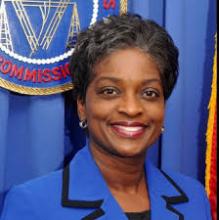
Next Century Cities’ just announced that Federal Communications Commissioner Mignon Clyburn will Keynote at the Digital Southwest event on April 18th. You can register now to attend the conference in Mesa, Arizona, at the Mesa Convention Center.
This full-day event will bring together broadband champions from federal, state, and local government, as well as community leaders and broadband policy experts from the Southwest and across the nation. The event will feature stories of broadband deployment success, digital inclusion initiatives, financing opportunities, and more.
Participants will hear from mayors, other city officials, state and federal policymakers, rural and tribal representatives, as well as national broadband experts. From financing to infrastructure development to smart cities, panelists will share a wealth of practical information.
The full agenda and participant list is available online, but here’s peek at some of the topics:
- Stories of Success
- Small Cells and Poll Attachments
- Rural and Tribal
- Broadband Financing
- Models 101
Christopher, as Policy Director of Next Century Cities, will participate in the Broadband Infrastructure Panel.
There will be a welcome reception from 5:30 - 7 p.m. at the Media Arts Center in Mesa and the conference starts at 8:30 a.m. at the Convention Center. Register now and be sure to book your hotel.
Press Release: U.S. Senator Booker Introduces 2017 Community Broadband Act

Press Release: Legislation Introduced in the U.S. Senate to Promote Local Internet Choice
The "Community Broadband Act" is Boosted by Senators Concerned with Competition
Contact:
Christopher Mitchell
Christopher Discusses the Future of Community Networks on TWiT

On March 24th, Christopher was on episode 232 of the web show "This Week in Enterprise Tech." Christopher discussed the future of community broadband networks in the Trump era as well as shared information about the models of successful networks across the country.
Christopher begins his discussion of these issues at 29:45 with host Friar Robert Ballecer and guest co-hosts Lou Maresca and Brian Chee. Throughout the show, the group covers the beginning of the FCC Chairmanship of Ajit Pai, how the Senate is legislating against Internet privacy regulations, and how community networks are pushing ahead to achieve better connectivity for local businesses and residents.
The folks at TWiT.tv share excerpts from our video on Ammon, Idaho, and the guys get into a deeper discussion about the possibilities of local empowerment from community networks.
You can stream the episode at TWiT.tv, or watch here:
ILSR's Building Local Power Podcast Tackles Hyper-Partisanship

Whether you’re a local elected official, a business owner, or a grassroots advocate, you’ve learned that politics can make or break an initiative to invest in publicly owned Internet infrastructure. Improving local connectivity is only one of many initiatives that are influenced by partisanship. As we’ve seen in Washington, DC, hyper-partisanship leads to ineffective gridlock. Is there a way to move forward despite strong diametric positions?
In the most recent episode of ILSR’s Building Local Power podcast, "Breaking Through Partisanship: Left-Right-Local," our own Christopher Mitchell leads a conversation with John Farrell, Stacy Mitchell, and David Morris, directors of the ILSR Energy Democracy, Community-Scaled Economies, and Public Good initiatives, respectively.
The group discusses both broad and focused solutions. They get into the effect of corporate concentration of power and how it undermines our democracy. The group ponders monopoly power and lobbying forces, and how they influence decisions that impact the ability for local communities to make decisions. The conversation touches on media and perception, economic analysis and language, and other factors that influence how people who may have opposing political beliefs may still be able to organize for a common local policy.
“Talking about economics is one way to get there, but also, there are these shared values that we have around democracy, local control, liberty,” says Stacy Mitchell of organizing for better local solutions to national problems. “Those are things that are widely all American. I think, also, going back to those basic values and motivations are really helpful in getting past being trapped in an unhealthy partisan conversation.”
The conversation is free flowing and last about 34 minutes. You can also read the transcript of the show.
Christopher Talks North Carolina, Local Solutions

How do we connect rural America? Unreliable, slow Internet service with data caps is the norm for much of the country. Even though the federal government gives billions of dollars to large telecom companies, North Carolina is one of the many states that still has an urban and rural digital divide.
Western North Carolina Public Radio (WCQS) recently spoke with our Christopher Mitchell about local ways to improve rural Internet access. While Christopher spoke of electric cooperatives, two other initiatives are also seeking creative solutions in the western half of the state.
Potential Service from Electric Cooperatives
Communities across the U.S. are already bringing better connectivity to their homes and businesses. Specifically, Christopher pointed to the growing number of electric cooperatives providing Internet service:
“When you look at the threat communities face from not having broadband Internet—the way people are moving away, and fewer people are willing to move in—these electric membership corporations really have to think about what they can do to make sure there’s a high quality of life.”
In our 2016 North Carolina Connectivity report, we explored the work of two local electric cooperatives, Lumbee River and Blue Ridge Mountain. They collaborated with telephone cooperatives to provide high-speed Internet service in the several rural counties near Georgia.
Spotlight on Local Solutions
The WCQS article reported on two more local initiatives: the community network in Highlands, North Carolina, and the nonprofit Land of Sky Regional Council.
Back in 2015, the people of Highlands saw that poor Internet access was hurting their community. They quickly built the Altitude Community Broadband network. Highlands Internet Technology Director Matt Shuler told WCQS:
Christopher Speaks to Politico Live on "The Future of the Wireless World"

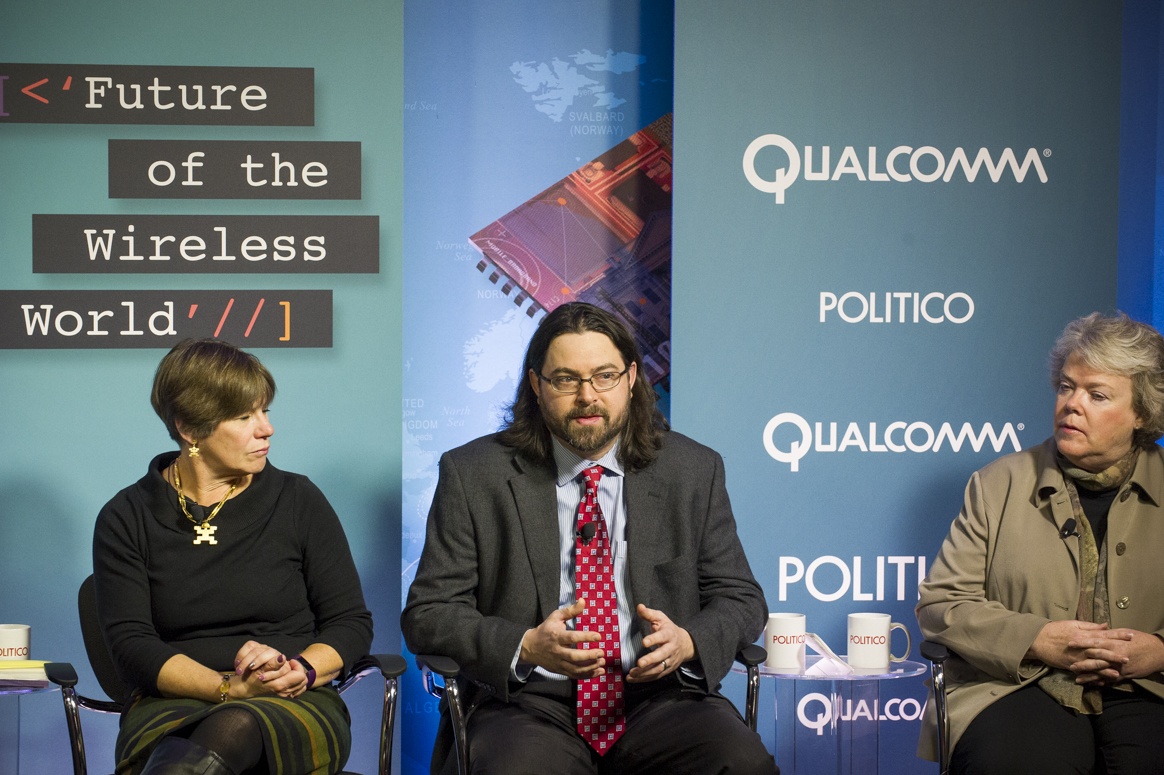
On March 7th, Christopher participated in a panel discussion sponsored by Politico and Qualcomm as part of an event called "The Future of the Wireless World." The panel was moderated by Politico Technology Reporter Alex Byers and included the following participants:
- Steven Crowley, P.E., Consulting Wireless Engineer
- Mindel De la Torre, former Chief of the International Bureau, Federal Communications Commission
- Christopher Mitchell, Director of Community Broadband Networks Initiative, Institute for Local Self-Reliance
- Joan Marsh, Senior Vice President of Federal Regulatory, AT&T
Watch the video at Politico's website.
Highlights from this conversation include Christopher's interaction with the AT&T representative about their claim that a "one touch make ready" policy was specific to Google Fiber. This interaction is at 36:20 in the conversation.
Broadband Communities 2017 Summit, May 1- 4 In Dallas
The 2017 Broadband Communities Summit, Fiber: Get In The Game Of Gigs, is approaching fast. From May 1 - 4, the Downtown Sheraton in Dallas, Texas, will be packed with policy wonks, advocates, experts, and vendors all mulling over the importance of high-quality connectivity. You can still register online.
Once again, the Coalition for Local Internet Choice (CLIC) will hold a special preconference session on Monday afternoon. Christopher will participate in the CLIC session as a panelist on the section titled, “The 2017 State Legislative Session: Challenges and Opportunities for Local Internet Choice.” It’s scheduled to start at 2 p.m. and the panel will discuss various state legislative measures this session and state barriers in general.
Christopher will also be on Tuesday’s Blue Ribbon panel as part of the Economic Development Program at 3 p.m. Lev Gonick, CEO from OneCommunity will moderate the discussion and the other speakers will be Nicol Turner-Lee, a Fellow in Governance Studies at the Center for Technology Innovation from the Brookings Institutions and Hilda Legg, Vice Chairman of Broadband Communities. Here’s a description of the topic from the agenda:
We now have a new administration, a new congress, and a new FCC. They are all focusing on new investment strategies, accelerating high-capacity wireless deployment, and addressing the digital divide. What does all this mean for local communities? Can public-private partnerships provide fertile common ground?
Check out the full agenda for the main event and for the CLIC preconference session.
Earlybird full pass registration expires on April 19, so register now for the best price.
Christopher On "The Takeaway": Monopolies, Munis, And Making A Difference

Christopher recently took some time to visit with John Hockenberry on The Takeaway from PRI and WNYC. The conversation covered municipal networks, big cable and telephone monopolies, and how local community initiatives for better connectivity are raising the bar in rural areas.
WNYC wrote about the show:
Net neutrality advocates got some bad news when Ajit Pai was tapped by President Donald Trump to be chairman of the Federal Communications Commission — it appears that Pai wants to largely reverse the Obama administration's approach to the Internet.
Large telecommunications monopolies have been digging their heels in, but some citizens are fighting back. The Takeaway considers the broadband debates that currently are taking place with Christopher Mitchell, the director of Community Broadband Networks at the Institute for Local Self Reliance.
Listen to the interview; it’s about 4 minutes.
Subsidies For Big Boys? Knoxville News Sentinel Op-Ed

In January, Governor Bill Haslam announced that he and Senator Mark Norris would introduce legislation to provide grant funding and tax credits to private companies in order to expand rural connectivity in Tennessee. In a recent Knoxville News Sentinel, Christopher took another look at more subsidies to large private providers and how that strategy has worked out so far.
We've reprinted the op-ed here:
Christopher Mitchell: State needs better broadband, not subsidies
If you were tasked with improving the internet access across Tennessee, a good first start would be to examine what is working and what’s not. But when the General Assembly debates broadband, it frequently focuses on what AT&T and Comcast want rather than what is working.
Broadband expansion has turned into a perennial fight between Tennessee’s municipal broadband networks and advocates of better connectivity on one side and AT&T and Comcast on the other. On one side is a taxpayer-subsidized model, while the other depends solely on the revenues of those who choose to subscribe. But which is which?
AT&T has received billions of taxpayer dollars to build its networks, whereas Chattanooga, Tullahoma and Morristown, for example, financed their fiber-optic networks by selling revenue bonds to private investors and repaying them with revenues from their services. The big telephone companies are massively subsidized, whereas municipal networks have generally not used taxpayer dollars.
It is true that after it began building, Chattanooga received a Department of Energy one-time stimulus grant for $111 million, but that was actually less than AT&T is getting from just one federal program in Tennessee alone – over $125 million from the Connect America Fund. And most of the money to Chattanooga went into devices for its smart grid that have since led to massive job gains.
These community networks offer modern connectivity. Chattanooga offers 10,000 Mbps to anyone in its territory. AT&T is getting enormous checks from Uncle Sam to deliver 10 Mbps. Comcast will soon offer 1,000 Mbps, but only for downloads. If you are a small business trying to upload lots of data, Comcast won’t get you there.