
Georgia CPF Funds Go Mostly to Big Incumbents; Cooperatives Share Leftovers

Kicking off the new year, Georgia Gov.

Fast, affordable Internet access for all.
Kicking off the new year, Georgia Gov.

While many of us were in the midst of celebrating the holiday season, a number of significant broadband developments were being unwrapped in the nation’s capital.

As the bipartisan Infrastructure Investment and Jobs Act (IIJA) is set to unleash an unprecedented amount of federal funds to expand high-speed Internet access as part of the Biden-Harris administration’s “Internet for All” initiative, all 50 states and U.S.

As we head into the holiday break, we present you with a bit of commentary made possible by a practical gift created by our GIS and Data Visualization Specialist Christine Parker.

When it comes to affordable broadband, Vermont has always been a trailblazer.

Whether it is UTOPIA Fiber or the growing number of cities establishing open access fiber network agreements with Strata Networks, Utah continues to be on the cutting edge of developing creative, highly-localized alternatives to entrenched regional monopolies, the first step in genuinely bridging the n

A bipartisan coalition of Pennsylvania lawmakers have introduced legislation that attempts to reverse some of the state’s most-stringent provisions hamstringing municipal broadband builds.
But experts suggest that while the bill may be well-intentioned, a cleaner approach would be to eliminate the state’s harmful and dated restrictions on municipal broadband entirely.

North East Mississippi Electric Power Association (NEMEPA) cooperatives celebrate another year of funding and progress toward building better broadband across nine service areas.
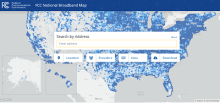
In November, the Federal Communication Commission (FCC) unveiled its new Broadband Availability Map.

Legislative changes and funding in Maine in the last year have made it easier for local communities to consider municipal broadband options. While incumbent providers have been pushing back, local communities are pulling themselves forward.
Setting the Stage

After years of efforts, the telecom industry and a range of independent broadband experts are making progress in a quest to make broadband grants tax exempt, a move industry players large and small say is necessary if the federal government wants the historic round of new federal broadband funding to benefit as m

The U.S. Treasury Department announced another six states have been approved to receive nearly $1 billion in Capital Projects Funds from the American Rescue Plan to bring new broadband infrastructure to more than 180,000 homes and businesses.

The Tribal Broadband Bootcamps, which have worked with 20 Tribes and more than 100 participants over the past 2 years, offering hands-on training in wireless and fiber-optic networks, will continue in 2023 with an expanded schedule and expanded curriculum.

Allegan County, Michigan is moving forward with an ambitious new plan to bring affordable fiber broadband to 12,000 unserved addresses across the county. The project will be in partnership with Southfield, Michigan based 123NET, made possible in large part due to more than $17.7 million in county American Rescue Plan Act funds.

Nevada is looking at an historic influx of broadband funding thanks to the Broadband, Equity, Access and Deployment (BEAD) program and the Infrastructure Investment and Jobs Act (IIJA). But state laws designed to shield monopolies from competition have added unnecessary complications to the state’s quest to maximize an historic round of public broadband funding.

The Washington Island Electric Cooperative is preparing to deliver affordable fiber broadband access to long-neglected communities across Washington Island, Wisconsin. The first subscribers are expected to receive service sometime later this month, and the entire island is slated to be upgraded sometime around 2027.

Historically, Enfield was known for its tobacco and peanuts. Today, there’s a new wave cresting in this small rural community in eastern North Carolina.

Nichols, New York (pop. 2,300) is the latest U.S. community to embrace open access, community-run fiber as an alternative to monopoly power. The upstate New York town, saddled among rolling green hills close to the Pennsylvania border, hopes the new initiative will boost broadband availability and lower costs.

In 2020, New York City officials unveiled a massive new broadband proposal they promised would dramatically reshape affordable broadband access in the city.
Instead, the program has been steadily and quietly dismantled, replaced by a variety of costly half-measures that critics say don’t solve the actual, underlying cause of expensive, substandard broadband.