


A recent study suggesting New York State officials are trying to hide that the state’s ambitious grant programs are facing significantly higher costs and lower reach doesn’t appear to be based in reality, and originates from a group that fails to disclose its funding.
A recent analysis of New York State’s broadband grant programs by the Advanced Communications Law and Policy Institute (ACLP) at New York Law School claims that New York State’s ConnectALL Municipal Infrastructure Program (MIP) is facing $38 million in higher costs, resulting in 34,000 fewer connections than originally promised.
“10 projects have had their grant revised up by at least 5 percent since first announced, against 7 revised down,” the analysis claims. “The upward revisions add about $38M to the programs’ combined cost. To cover these increased costs, the state moved unspent funds from the AHCP program to cover the MIP shortfall.”
The study also claims, incorrectly, that New York State is attempting to hide this data from the public.

“This fact was buried in a footnote in the state’s latest CPF Performance Report submitted to the U.S. Treasury in July,” the authors wrote, at other times insisting that “none of these changes were announced by the state broadband office,” and that “New York does not report these grants consistently.”
But there’s a problem: despite the study making the rounds at various media outlets, there’s little evidence that the analysis is accurate.
Not only is all of New York’s municipal broadband progress data transparently accessible to the public in granular detail, it doesn’t support the claim that the program is facing $38 million in increased costs resulting in 34,000 fewer last-mile connections.
The analysis conflates New York’s MIP program with its Affordable Housing Connectivity Program (AHCP), mashing together rural municipal fiber passing utility poles (MIP) with low-income apartment building retrofit wirings (AHCP). ACLP then averages wildly divergent cost structures (trenching rural fiber vs. retrofitting multi-dwelling units) to produce an artificial aggregate "cost per connection" figure.
The total pot of federal CPF money did not magically balloon by $38 million; in reality, New York state reallocated unspent AHCP funds into the MIP program to ensure the state didn't forfeit expiring federal funds back to the U.S. Treasury.
The study’s claim that New York State policy is somehow responsible for 34,000 fewer connections also appears to be misleading. Many of the reductions in total served customers appear to be the result of straightforward CPF and NTIA rule challenge process corrections, affordable housing unit total recalculations, or project cancellations the state had no control over.
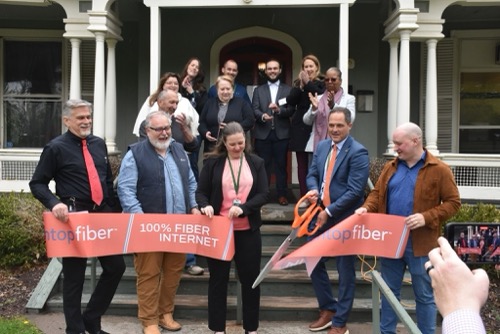
“As projects advance, we will continue adapting to changing construction conditions while maintaining our focus on delivering these investments efficiently and building the durable, scalable infrastructure New York communities need for the future,” the New York State Empire State Development office said in a statement to ILSR.
What is known: the ACLP has historically opposed municipal broadband, often makes misleading claims about municipal broadband projects being "risky," "wasteful," and engaging in "unnecessary overbuilding," and fails to disclose its funding sources, raising red flags.
New York’s Massive Investment In Better, More Affordable Broadband
New York state has invested $300 million in federal Capital Projects Fund (CPF) and state funds to underwrite broadband deployment via MIP and AHCP.
New York State officials say the $268 million in MIP grant funding has funded active projects across 24 New York counties, resulting in more than 2,300 miles of new fiber optic infrastructure and 68 new wireless hubs serving more than 96,000 homes and businesses. Most of this funding was made possible by the 2021 federal American Rescue Plan Act (ARPA).
The MIP program is part of New York state’s billion-dollar ConnectALL Initiative, and was specifically designed to support municipal broadband projects proven to be a viable, and increasingly popular, way to bring affordable, high-quality Internet service to long-neglected U.S. communities left unserved or underserved by America’s telecom monopolies.
“Governor Hochul has made closing New York’s digital divide a priority, and the ConnectALL Municipal Infrastructure Program is turning that commitment into lasting broadband infrastructure in communities across the state,” the New York State Empire State Development office told ILSR. “These investments are bringing new providers into underserved markets, expanding competition and creating more affordable, reliable options for New Yorkers.”
Unlike many states, New York’s MIP program has heavily funded many promising municipal broadband deployments in regions long neglected by the private sector, resulting in significantly faster speeds, lower prices, and better overall coverage and customer service.
The program has been transformative for communities like Dryden, New York, which has constructed an open-access municipal fiber network that delivers affordable next-gen fiber to the long-underserved rural communities of Dryden and nearby Caroline (population 3,321).

Murky Funding, Grains Of Salt
Sascha Meinrath, the Palmer Chair in Telecommunications at Penn State University, tells ILSR that ACLP doesn’t transparently disclose who funds their research.
“There is no clear delineation of where ACLP's funding comes from — which is a huge red flag for astroturf,” (fake grass roots policy activism). “A quick search does show that major donors to New York Law School include Comcast, NCTA, and Charter — which, of course, may or may not include funding for ACLP.”
“ACLP claims that they disclose funders in their disclosure statement,” Meinrath added. “However, they do not.”
He also noted that several of the ACLP study’s authors previously worked at the FCC’s "Removing State & Local Regulatory Barriers to Broadband Deployment Working Group" under Trump first-term FCC boss Ajit Pai. That group often overstated government bureaucracy as the cause of inadequate broadband, and downplayed private industry market failure.
ACLP members have also testified in NY state hearings in opposition to municipal broadband, and have repeatedly falsely claimed that municipal broadband expansion is a waste of money because it at times targets areas that already have broadband access. Even in instances when said “access” often involves slow and expensive service dominated by a regional monopoly.
Regional telecom monopolies leverage no limit of third party proxy groups and various think tanks to seed false claims about municipal broadband in the press, public, and state and federal policy statements in a bid to erode public and policymaker support. These efforts generally involve falsely claiming that municipal broadband is an inherent taxpayer boondoggle.
“They may be less blatant in their slant — but I expect there's a reason ISPs and telcos have previously funded the endeavor — and why they no longer disclose their current funding sources,” Meinrath said.
Header image courtesy of Kevin Ku, CC0 1.0 Universal Public Domain Dedication
Inline image of ribbon cutting ceremony in Sullivan County courtesy of Empire State Development Facebook page
Inline image of father and son on laptop in front yard courtesy of Empire State Development Facebook page