
maple broadband

Content tagged with "maple broadband"

Related Topics
Displaying 1 - 5 of 5

Vermont Closes In on Universal Broadband Access as Federal Dollars, Local Innovation, and Workforce Training Converge

In the marathon to bring universal high-speed Internet service to the most rural state in the nation, Vermont is heading into the last-mile stretch of the race with the finish line in sight.

In February, the Vermont Community Broadband Board (VCBB) announced that the National Telecommunications and Information Administration (NTIA) overseeing the federal Broadband Equity, Access, and Deployment (BEAD) program, had approved Vermont’s Final Proposal, unlocking $93 million of the state's nearly $229 million federal allocation.

After years of painstaking planning, public input, and navigating bureaucratic hurdles, it marked a pivotal moment – with the state's selected grant recipients cleared to begin deploying mostly fiber to the communities that have long been waiting for high-speed connectivity after decades of neglect from the Big Cable and Telecom providers.

“This is a major milestone for many of our rural towns and a once-in-a-generation opportunity to strengthen and revitalize communities,” Gov. Phil Scott said in a statement, crediting NTIA, Vermont's congressional delegation, and the VCBB for shepherding the state's plan.

Image
Vermont State House building on a sunny day after snowfall

U.S. Sen. Bernie Sanders, never one to mince words, spoke to both the significance and the frustration of the moment. “Affordable, high-speed [I]nternet is a vitally important resource in every corner of the country. It is foundational to modern life,” he said. 
Vermont CUD Maple Broadband Moving Quickly To Expand Access

Vermont’s Communications Union Districts (CUDs), which were the subject of a recently released ILSR report, continue to make steady inroads in delivering high-quality broadband access to long-neglected rural Vermont residents.

That includes locally owned not-for-profit municipal operation Maple Broadband, which has completed the first phase of its broadband network and is busy on an expansion.

Maple Broadband is technically an extension of the Addison County Communications Union District (ACCUD), a coalition of 20 different member towns working collaboratively to bring gigabit-capable fiber to residents long left unserved or underserved by regional telecom giants.

In September of 2021 Maple Broadband announced a public private partnership with Vermont-based Waitsfield and Champlain Valley Telecom (WCVT), to build and operate a district-wide fiber network. The $30 million network is, in part, propped up by ARPA funds and a $9.1 million grant from the Vermont Community Broadband Board (VCBB).

Image
Maple Broadband logo

Three years later and the CUD says it has completed the first phase of its network; laying 143.5 miles of fiber and passing 1,647 homes and businesses in portions of the Vermont towns of Cornwall, Orwell, Shoreham, Whiting, Salisbury, and Middlebury.

Neighborly Networks: Vermont's Approach to Community Broadband

Image
Neighborly Networks report

In partnership with the Benton Institute for Broadband and Society, today ILSR releases a new report examining how the state of Vermont is supercharging its telecommunications infrastructure efforts to reach the unconnected by puttings its weight behind community broadband-driven efforts.

The report - Neighborly Networks: Vermont's Approach to Community Broadband [pdf] - traces the emergence of a unique public-public partnership arrangement that first appeared in the Green Mountain State in 2008. The Communications Union Districts (CUD) model first emerged more than a decade and a half ago among a coalition of towns in the eastern part of the state long-ignored by for-profit Internet Service Providers. There, a collection of community broadband champions came together to prove that the solution to the broken marketplace lay internal to east-central Vermont. ECFiber, a publicly owned, nonprofit ISP was borne of that effort, and began bringing affordable, fast, reliable service to households in the region.

Image
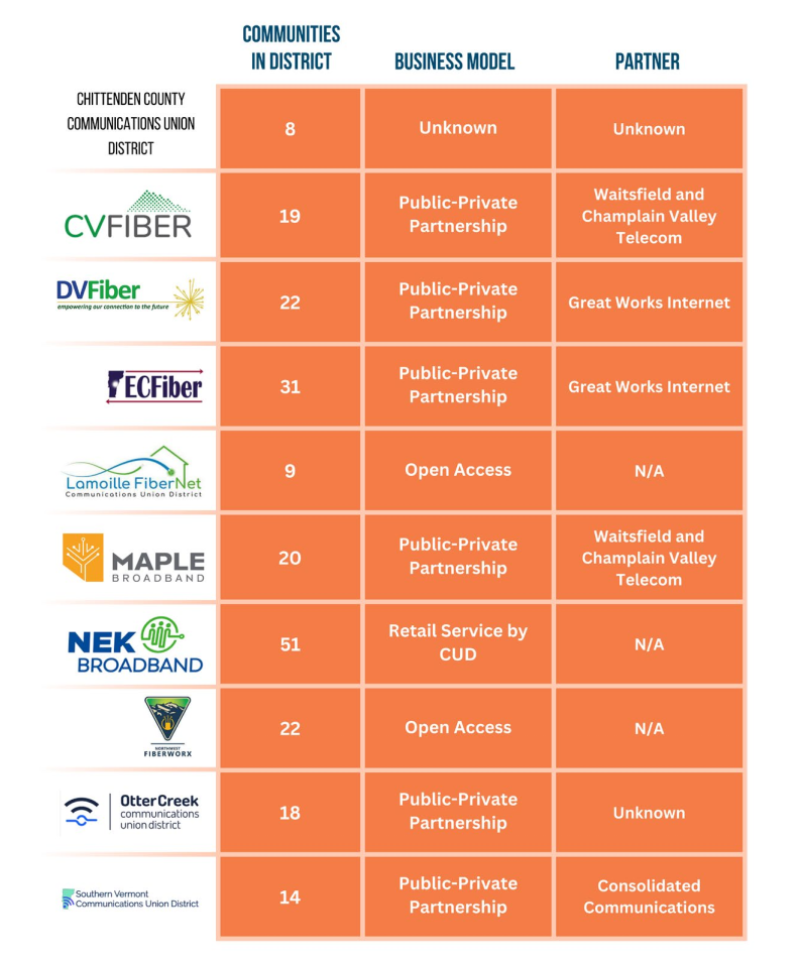
CUD models

Ten years later, when the state began formulating a plan for the future of Internet access, the progress made by and lessons learned from ECFiber drove a landmark shift in public policy in the state. Volunteers emerged, towns voted, and CUDs were placed at the center of Vermont’s effort to bridge the infrastructure gap in the state. Today, there are ten CUDs covering 216 towns across the state, and Vermont’s leaders have put the lion’s share of public funds behind the communications union district model.

New Report: Neighborly Networks - Vermont's Approach to Community Broadband

In partnership with the Benton Institute for Broadband and Society, today ILSR releases a new report examining how the state of Vermont is supercharging its telecommunications infrastructure efforts to reach the unconnected by puttings its weight behind community broadband-driven efforts.

The report - Neighborly Networks: Vermont's Approach to Community Broadband [pdf] - traces the emergence of a unique public-public partnership arrangement that first appeared in the Green Mountain State in 2008. The Communications Union Districts (CUD) model first emerged more than a decade and a half ago among a coalition of towns in the eastern part of the state long-ignored by for-profit Internet Service Providers. There, a collection of community broadband champions came together to prove that the solution to the broken marketplace lay internal to east-central Vermont. ECFiber, a publicly owned, nonprofit ISP was borne of that effort, and began bringing affordable, fast, reliable service to households in the region.

Image
CUD models

Ten years later, when the state began formulating a plan for the future of Internet access, the progress made by and lessons learned from ECFiber drove a landmark shift in public policy in the state. Volunteers emerged, towns voted, and CUDs were placed at the center of Vermont’s effort to bridge the infrastructure gap in the state. Today, there are ten CUDs covering 216 towns across the state, and Vermont’s leaders have put the lion’s share of public funds behind the communications union district model.

Tracing the history of this effort from 2008 to today, this report breaks down the conditions that led to this sea change, where the CUDs are at today, and how we might learn from the Vermont case to improve Internet access elsewhere across the country.

Maple Broadband Sets the Table for FTTH Network

Vermont’s nine Communication Union Districts (CUDs) were formed to build communication infrastructure to deliver reliable and affordable high-speed Internet access across one of the most rural states in the nation.

The East Central CUD, which owns and operates EC Fiber, has led the charge since its founding in 2011. But over the last few years other CUDs have launched their own plans to build fiber-to-the-home (FTTH) networks in their respective districts with each at various stages of planning or building.

Addison County is situated on the western border of the state about 35 miles west of the state capital (Montpelier), tucked between Lake Champlain and the Green Mountains. The region has long been served, or rather underserved, by Comcast, as the area’s primary Internet Service Provider does not cover the most rural parts of the county, leaving many of the county’s approximately 36,200 residents with outdated DSL service.