funding

Content tagged with "funding"

Related Topics
Displaying 1 - 10 of 19

Next B4DE: Digital Equity After the Election and What Communities Can Do Now

With the midterm elections behind us and long-stalled federal digital equity funds waiting on the horizon, it would be easy to assume the funding problem is solved. It isn’t. 

The spending rules and the timeline for those dollars are still unsettled for a program that’s already been cancelled once.

The next — and last — Building for Digital Equity (B4DE) livestream of 2026 will take on the question digital inclusion practitioners are still wrestling with: who pays for digital inclusion now?

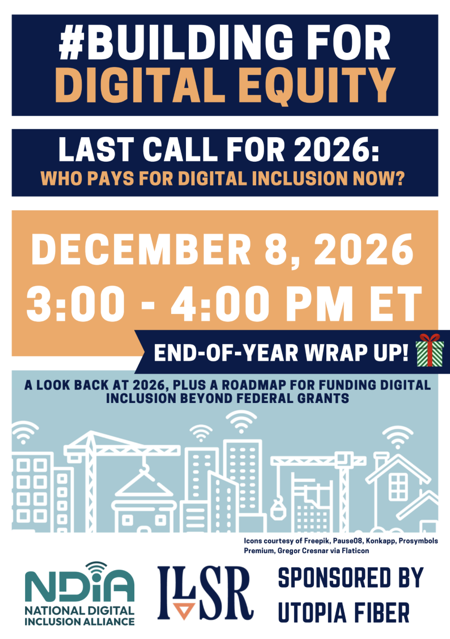
Join us Tuesday, December 8, at 3 pm ET as the Institute for Local Self-Reliance’s Community Broadband Networks initiative and the National Digital Inclusion Alliance (NDIA) co-host: “Last Call for 2026: Who Pays for Digital Inclusion Now?”

Registration for the free webinar is now open here.

Image
B4DE Flyer

The hour will begin with a fast look back at the year, with NDIA’s Angela Siefer helping us take stock. That segment will cover the Digital Equity Act’s cancellation, NDIA’s lawsuit, and the revived grant program now headed toward a December opening.

Off the Funding Cliff: Building Sustainable Support for Digital Adoption – Episode 31 of Unbuffered

Unbuffered Logo - Two text bubbles

In this episode of Unbuffered, Chris is joined by Samantha Schartman, Director of Philanthropic Programs at Connect Humanity, to discuss the Alt Funding Field Guide: Building Sustainable Funding for Digital Adoption. 

The guide is a new resource that maps how digital skills and connectivity programs create value across six sectors: education, healthcare, telecom, workforce development, housing, and local government.

Samantha shares the personal history behind the guide. She helped lead the BTOP-funded Connect Your Community program, which trained 33,000 first-time computer users across five states, only to see its staff laid off when federal funding ended. 

She describes watching the field rebuild during the pandemic with ARPA and Capital Projects Fund dollars, then shrink again after the Digital Equity Act was canceled. That experience led her to form the Alt Funding Working Group, which has grown from six people to more than 150 leaders nationwide.

Together, they dig into the core idea of co-investment. Rather than relying on the next grant, programs can show local stakeholders the value they receive and ask them to invest in proportion to it. 

That could be a hospital system cutting emergency costs, an ISP gaining subscribers, or a housing provider seeing more regular rent payments. Samantha explains why this requires programs to move from testimonials to measurable outcomes, and to redesign their work around community goals.

Concluding with a case for government efficiency, Samantha shares findings from her Connecting Cuyahoga report. It found that serving social service clients offline costs roughly four times as much as serving them online, meaning digital inclusion programs can pay for themselves. 

Chris and Samantha also take aim at wasteful policies, like Medicaid-funded tablets locked to a single use, and preview future episodes that will dive deeper into each sector.

For more information about Connect Humanity's Alt Funding Field Guide, click here!

This show is 48 minutes long and can be played on this page or via Apple Podcasts or the tool of your choice using this feed. 

You can also check out the video version via YouTube.

Transcript below.

We want your feedback and suggestions for the show-please e-mail us or leave a comment below.

Listen to other episodes in our index. See other podcasts from the Institute for Local Self-Reliance.

Thanks to Whitedrift for the song Operator, licensed Creative Commons Attribution (3.0).
ILSR Launches Latest Tribal Internet Networks Census Update

The Institute for Local Self-Reliance today released its comprehensive 2026 census of Tribal Internet networks, finding that the number of active Tribal-owned and operated broadband networks has doubled since ILSR first conducted this research in 2020 while offering a new way to interact with these networks’ stories.

Across the country, nearly 90 Tribal nations are actively providing Internet access to their communities. These Tribes own the wires or the wireless equipment that guarantee community members can stay connected to loved ones, continue their education remotely, check in with their doctors without driving an hour each way, and stay engaged in the social civic life of their communities.

This number underscores a period of massive growth in the last ten years among Tribal broadband owners. 

Image
Tribal Network Growth

Nor is that growth over. Our research also located about 50 Tribal nations that are building or have received funding to build networks, and another few dozen that have expressed interest in bringing Internet access to their communities. Over the next decade, the ranks of Tribal broadband owners may well double again.
 

Charter and Cox Merge, Hotspots Under Threat, and the End of the Digital Equity Act | Episode 114 of the Connect This! Show

Connect This! Show

Catch the latest episode of the Connect This! Show, with co-hosts Christopher Mitchell (ILSR) and Travis Carter (USI Fiber) joined by regular guests Kim McKinley (TAK Broadband) and Doug Dawson (CCG Consulting) and special guest Angela Siefer (National Digital Inclusion Alliance) to talk about all the recent broadband news that's fit to print. Topics include:

Join us live on May 16th at 2pm ET, or listen afterwards wherever you get your podcasts.

Email us at [email protected] with feedback and ideas for the show.

Subscribe to the show using this feed or find it on the Connect This! page, and watch on LinkedIn, on YouTube Live, on Facebook live, or below.

Native Nations and Federal Telecom Policy Failures: Lessons from the Rural Digital Opportunity Fund

Image
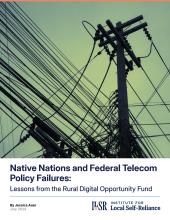
Native Nations report

A new report published today by the Institute for Local Self-Reliance (ILSR) reveals how the sovereignty of Tribal Nations and their own efforts to solve connectivity challenges on Tribal lands can be undermined by the poor design and maze of bureaucracy associated with some federal broadband programs. 

The report – Native Nations and Federal Telecom Policy Failures: Lessons from the Rural Digital Opportunity Fund [pdf] –shows how even as the National Telecommunications and Information Administration (NTIA) takes over administration of the largest federal funding programs and re-situates Tribal closer to where they belong, the Federal Communications Commission (FCC) continues its long-standing practice of scant engagement and infrequent consultation, complicating the terrain and stymieing Tribal efforts to close the digital divide in Indian Country.

Completed in December 2020, the Rural Digital Opportunity Fund auction underscores the pernicious consequences of federal policy. While the report begins with a real-life example of how Tribal nations now working to build their own broadband networks can be blindsided by bureaucratic neglect and non-Tribal ISPs, it goes on to detail why the FCC’s approach to broadband funding has fostered tension between providers and Tribal ISPs, and why RDOF has earned a particularly bad reputation among many Tribes.

The report also examines how RDOF impacts the roll-out of the federal government’s major broadband infrastructure funding program known as BEAD (Broadband Equity, Access, and Deployment), which is being administered by the National Telecommunications and Information Administration (NTIA).

Read Native Nations and Federal Telecom Policy Failures: Lessons from the Rural Digital Opportunity Fund [pdf].

New Report: Native Nations and Federal Telecom Policy Failures: Lessons from the Rural Digital Opportunity Fund

A new report published today by the Institute for Local Self-Reliance (ILSR) reveals how the sovereignty of Tribal Nations and their own efforts to solve connectivity challenges on Tribal lands can be undermined by the poor design and maze of bureaucracy associated with some federal broadband programs.

The report – Native Nations and Federal Telecom Policy Failures: Lessons from the Rural Digital Opportunity Fund [pdf] – begins with a startling example of how one Tribe learned about the plans of a major fiber Internet provider to serve “a handful of locations in the heart of the Tribal Reservation.”

Authored by Dr. Jessica Auer, Tribal Broadband Policy Analyst with ILSR’s Community Broadband Networks initiative, the report captures the pernicious consequences of a program that was supposed to help bring high-speed Internet service to rural communities who lacked access:

A non-Tribal telecommunications company had received federal funding to build broadband infrastructure on Tribal lands without consent, had appeared to shirk required federal Tribal engagement requirements, had ignored the Tribe’s attempt to raise concerns about it, and now seemed to be expecting to dictate what would happen next.

While the report begins with a real-life example of how Tribal nations now working to build their own broadband networks can be blindsided by bureaucratic neglect and non-Tribal ISPs, it goes on to detail why the FCC’s approach to broadband funding has fostered tension between providers and Tribal ISPs, and why RDOF has earned a particularly bad reputation among many Tribes.

“Some recent federal broadband programs do actually require ISPs to secure Tribal consent prior to receiving funds,” Auer says. “But, the FCC still has not adopted this approach. The problems outlined in this report reinforce the need for such a requirement.”

Industry Insights on Connecting Underserved Communities - Episode 604 of the Community Broadband Bits Podcast

In this special episode of the podcast, Chris shares a segment from our Connect This! show, featuring insights from industry leaders Robert Boyle, Travis Carter, Kim McKinley, and Blair Levin.

The discussion delves into the impacts of the Affordable Connectivity Program (ACP) and the Emergency Broadband Benefit (EBB). These programs have been instrumental in providing internet access to millions of low-income families, and our guests share their experiences and perspectives on their successes and challenges.

The episode explores the complexities of funding and future efforts to connect underserved areas, with a particular emphasis on rural communities. The conversation highlights the financial strategies and incremental approaches needed to efficiently expand broadband infrastructure. Travis discusses USI Fiber's decision to self-fund the ACP to ensure continued service for their customers, emphasizing the importance of sustainability and low churn rates.

Blair provides a detailed account of his testimony before Congress, addressing questions from policymakers like Ted Cruz. This segment offers a critical look at the political and legislative aspects of broadband funding and the potential for future investments to bridge connectivity gaps.

For more information on Connect This! and to find previous episodes, please visit our website at connectthisshow.org

This show is 54 minutes long and can be played on this page or via Apple Podcasts or the tool of your choice using this feed.

Transcript below.

We want your feedback and suggestions for the show-please e-mail us or leave a comment below.

Listen to other episodes or view all episodes in our index. See other podcasts from the Institute for Local Self-Reliance.

Thanks to Arne Huseby for the music. The song is Warm Duck Shuffle and is licensed under a Creative Commons Attribution (3.0) license

Mapping, BEAD, and the Future of Broadband - Episode 516 of the Community Broadband Bits Podcast

This week on the podcast, Christopher is joined by Jon Chambers, industry veteran and partner at Conexon. The two begin by talking about the work electric cooperatives are doing in rural areas to convert subscribers from DSL connections reluctantly maintained by monopoly providers to member-owned fiber connections.

Then, they address what Jon calls the next frontier in broadband policy and funding with BEAD, initiated by the inherent shortcomings of the new Broadband Data Collection Fabric and which underscore the FCC's continued inability to act decisively to figure out where and which types of connections are available at the address level. This includes the fraught and complicated consequences when the federal government sets too low a definition of broadband, the challenge process, the delay in funding until a complete list of Broadband Serviceable Locations is complete, the lack of transparency in the new data sets, and more.

This show is 47 minutes long and can be played on this page or via Apple Podcasts or the tool of your choice using this feed. 

Transcript below. 

We want your feedback and suggestions for the show-please e-mail us or leave a comment below.

Listen to other episodes here or view all episodes in our index. See other podcasts from the Institute for Local Self-Reliance here.

Thanks to Arne Huseby for the music. The song is Warm Duck Shuffle and is licensed under a Creative Commons Attribution (3.0) license.

The Wireless Show, Part 2 | Episode 46 of the Connect This! Show

Join us live on Thursday, June 23rd, at 4pm ET in the chat for the latest episode of the Connect This! Show. Co-hosts Christopher Mitchell (ILSR) and Travis Carter (USI Fiber) will be joined by regular guests Kim McKinley (UTOPIA Fiber) and Doug Dawson (CCG Consulting).

The panel will discuss Verizon and T-Mobile Fixed Wireless Access (FWA) adds, LTE versus Starlink, and Dish and the future and impact of the 12GHz spectrum bands. They'll also touch on a few other topics, including the headaches and heartaches of the Affordable Connectivity Program (ACP), rhetoric versus reality when it comes to municipal broadband, and the real cost in transitioning from DSL to fiber.

Subscribe to the show using this feed on YouTube Live or here on Facebook Live, on find it on the Connect This! page.

Email us [email protected] with feedback and ideas for the show.

Watch here on YouTube Live, here on Facebook live, or below.

Event: Building for Digital Equity, Chapter 2: Claiming Broadband For Your Community

In March, the Institute for Local Self-Reliance and the National Digital Inclusion Alliance held a livestream event on the range of challenges and tools available to communities to accomplish infrastructure, equity, and inclusion goals. We called it Building for Digital Equity: Demystifying Broadband Policy and Funding. There, we discussed the new policies and funding options available that can be applied at the state and local levels to help communities improve their Internet services.

This time we will be focusing on organizing around broadband, community impact of the federal funding, and new initiatives in progress thanks to the grants communities are taking advantage of. 

Join us on Wednesday June 29th from 1:00pm-2:15pm ET as we discuss what's happening on the ground in these communities and what some of them are planning to do with the new federal broadband dollars. We are calling it Building for Digital Equity, Chapter 2: Claiming Broadband For Your Community. Register here.

This event will feature:

  • Your favorite co-host:  Christopher Mitchell of ILSR and Pamela Rosales of NDIA
  • Videos from communities discussing what they are planning and doing with the funding
  • Discussing the “how” in organizing communities
  • Guest speakers discussing organizing strategies, and success stories.
  • The return of the crowd favorite Broadband Trivia!

Looking forward to seeing you all there!

Event Links

Register for Building for Digital Equity, Chapter 2 here to get the livestream links; on the day of the event, it will also be available on Twitter, via @netinlusion, @communitynets and @muninetworks. 

During the livestream, you can also join the trivia game (link to follow).