
digital equity

Content tagged with "digital equity"

Related Topics
Displaying 1 - 10 of 124

A Cap, Gown, and Connection

The first time Belinda Parker-Mendoza set foot on the campus of San Antonio College was to get her cap and gown for graduation, having earned her Associate’s Degree in Business Administration.

It was not only a first for her. She was the first person in her entire family to earn a diploma of any kind.

The gateway to that moment, the 45-year-old mother says, came in 2022, when she signed up for a digital skills training course offered through AmeriCorps VISTA at one of the city’s Opportunity Home apartment complexes where she lives on San Antonio’s cultural and historic East Side.

“If I didn’t have a laptop and the Internet, none of that would’ve happened,” she explains, sitting in her fourth-floor apartment before diving into a writing assignment for one of her classes as she works towards her bachelor’s degree.

She does her school work on a laptop – a refurbished Dell computer she earned through the digital skills training program. Before that, she didn’t have a computer or Internet access at home. The class provided her a laptop and through the Americorps program, she was able to enroll in the now-expired Affordable Connectivity Program (ACP), which allowed her to get home Internet service for the first time.

Image
Belinda Parker-Mendoza at digital skills event holding two signs. One says: "Americorps VISTA," the other reads: "Make Poverty History"

“Thank God,” she says. “Because when the ACP ended, I was working in the (Americorps) program – and getting paid – so it worked out.”

For millions of others, it did not.

Court Asked to Pause Digital Equity Act-Related Lawsuit, Pending Key Court Decision

*The following story by Broadband Breakfast Reporter Kelcie Lee was originally published here.

The lawsuit over the Trump administration’s suspension of grants from the $2.75 billion program to close the digital divide may come to a pause. 

The National Digital Inclusion Alliance (NDIA) filed a motion Wednesday to put its lawsuit suing President Donald Trump on hold, because there is a similar case further along that would control the outcome. 

NDIA was a key player in the Digital Equity Act (DEA), having been one of 65 recommended awardees that were blindsided after having spent two years building plans approved by the federal government. 

The DEA was a Biden-era program from the bipartisan Infrastructure Investment and Jobs Act of 2021 (IIJA) that worked to ensure Americans could access, afford and fully participate in the increasingly digital society. 

In May 2025, Trump halted $1.25 billion in DEA competitive grants, explaining that the act was unconstitutional, racist and illegal.

A Constitutional Crisis in Broadband and The Fight to Restore Digital Equity Funding

The Trump administration's illegal “termination” of the 2021 Digital Equity Act continues to have devastating real world impacts on everything from affordable broadband access to protecting Americans from skyrocketing online scams.

The $2.75 billion Digital Equity Act was passed by Congress as part of the 2021 infrastructure law. It mandated the creation of three different major grant programs intended to shore up equitable, widespread access to affordable Internet, while providing the tools and digital literacy education needed to help neglected U.S. communities get online.

But last May the Trump administration unceremoniously demolished the Act, froze all program funding, and left countless states, programs and organizations – many on the cusp of major new efforts – high and dry.

At the time, President Trump and GOP leaders like Sen. Ted Cruz disingenuously attacked the Act’s programs as “racist” and "unconstitutional,” – part of a broader effort to dismantle programs deemed as “DEI,” even in instances where the programs had little to nothing to do with race or gender. Many of the “covered populations” covered by the bill included rural residents, veterans, and elderly Americans from all walks of life.

Funding Freeze Puts Most Vulnerable Americans at Risk

The sudden "termination" of the popular law resulted in dozens of states having to abruptly cancel major broadband expansion plans. But the freeze has also been a massive problem for state programs that were taking aim at a U.S. online fraud epidemic proving particularly harmful to the U.S. elderly and marginalized communities.

B4DE: Moving At The Speed of Trust Reprise

Yesterday, the third Building for Digital Equity livestream of the year brought together policy experts and frontline workers to explore how community-driven connectivity solutions are inextricably tied to building local trust.

If you missed it, the entirety of the hour and 15 minute event can be viewed here.

Hosted by ILSR’s Community Broadband Networks initiative and the National Digital Inclusion Alliance (NDIA), this week’s B4DE served as an unofficial kick-off to Digital Inclusion Week and the variety of events that will mark the occasion in communities across the country.

With each B4DE guest focused on various aspects of the theme, “Moving At The Speed Of Trust,” the event provided attendees a jolt of hope and optimism, even as the world of digital equity has been upended by the demise of the federal Affordable Connectivity Program, the sudden termination of the Digital Equity Act, and numerous other Trump administration policy shifts that will make it harder to bridge the digital divide.

Abundance for Whom? - Episode 656 of the Community Broadband Bits Podcast

In this episode of the podcast, Chris is joined again by Sascha Meinrath, Palmer Chair of Telecommunications at Penn State, for a wide-ranging, discussion about the book Abundance by Derek Thompson and Ezra Klein—and what it gets wrong about broadband and public policy. 

They dive into the historical failures of corporatist infrastructure models, the rise of regulatory complexity that benefits incumbents, and the dangers of framing government as the problem instead of part of the solution. 

From the Kingsbury Commitment to BEAD to trickle-down tech policy, Chris and Sascha explore why bold, community-centered visions of abundance are necessary to deliver real digital equity and structural change.

This show is 39 minutes long and can be played on this page or via Apple Podcasts or the tool of your choice using this feed.

Transcript below.

We want your feedback and suggestions for the show-please e-mail us or leave a comment below.

Listen to other episodes or view all episodes in our index. See other podcasts from the Institute for Local Self-Reliance.

Thanks to Arne Huseby for the music. The song is Warm Duck Shuffle and is licensed under a Creative Commons Attribution (3.0) license

“Wired for Freedom” Livestream Replay

If you missed our Building for Digital Equity “Wired for Freedom” Livestream, you can watch it in its entirety on YouTube.

Earlier this week, the second UTOPIA Fiber-sponsored event of the year, hosted in partnership with the National Digital Inclusion Alliance (NDIA), brought together community-based digital inclusion practitioners and policy experts to talk about the road ahead for expanding broadband access amid a rapidly shifting political landscape.

After a blues-infused beginning with Sky Downing of digitalLIFT, NDIA’s policy director Amy Huffman provided attendees with an update on the long court battle over the constitutionality of the FCC’s Universal Services Fund.

The recent Supreme Court ruling, Huffman explained, ruled that the program – which supports connectivity for rural communities, schools, and libraries – was indeed constitutional. In what Huffman described as “good news,” she also said it would give Congress a chance to reform USF without having to do so as “a ticking time,” giving lawmakers and advocates a chance to “put together a thoughtful framework and path forward to ensure that the fund not only continues but is modernized.”

In the lightning round presentations, Sara Nichols from the Land of Sky Regional Council in western North Carolina spoke of the work her planning agency has been involved with working toward building resilient connectivity in the wake of Hurricane Helene followed by Kaala Souza, executive director of Digital Ready Hawaii, who discussed how digital literacy was rooted in the local culture’s emphasis on literacy dating that dates back before the dawn of the computer age.

California’s Affordable Broadband Bill At Risk Of Being Destroyed By Lobbying

California lawmakers’ efforts to pass a new law mandating affordable broadband access is at risk of being destroyed by industry lobbying. California insiders say the changes are so dramatic they may wind up making broadband affordability in the state worse – undermining years of digital equity activism and discarding a rare opportunity to bridge the digital divide.

The California Affordable Home Internet Act (AB 353), introduced by Assemblymember Tasha Boerner last January, would require that broadband providers in the state provide broadband at no more than $15 per month for low-income households participating in a qualified public assistance program.

The original legislation mandated that state residents should be able to receive $15 for all ISPs for broadband at speeds of 100 megabit per second (Mbps) downstream, 20 Mbps upstream. The proposal mirrored similar efforts by New York State which opened the door to other state efforts after the Supreme Court recently refused to hear a telecom industry challenge.

Image
Several dozen digital equity advocates hold a rally on the lawn of the California statehouse

“I want to get something fair and reasonable that helps those who need it most,” Boerner said in a press release. “AB 353 will fill the gap and ensure our children can turn in their homework, families can get access to telehealth, and apply for jobs online.”

On June 4 a vote moved the legislation through the state Assembly and on to the state senate by a 52-17 margin.

Event: Building For Digital Equity - Wired for Freedom

On Tuesday, July 1, the Institute for Local Self-Reliance and National Digital Inclusion Alliance will present the next Building For Digital Equity event - Wired For Freedom: Digital Access and the American Dream. It will run from 3:00 - 4:15 ET.

Register for the free event here.

Once again, we thank UTOPIA Fiber for their sponsorship in making these events happen.

We will kick off the event with co-hosts Christopher Mitchell from ILSR and NDIA's Gina Cooper. Skye Downing will set our tone with a song, to be followed by Amy Huffman updating everyone on the latest news relating to the Trump Administration's efforts to cancel the Digital Equity Act.

This B4DE will again feature the Lightning Round speakers that will offer short presentations - Ka'ala Souza from Digital Ready Hawaii and Sarah Nichols from Land of Sky.

Monica Gonzalez from Methodist Healthcare Ministries will be sharing information about their work in South Texas.

The big finish will be moderated by ILSR's Sean Gonsalves - featuring Tony Batalla, CIO for the city of Oakland; Alisa Valentin from Public Knowledge; Autumn Evans of the Rocket Community Fund; and Patrick Messac from Oakland Undivided.

As always, we would love to see you commenting and asking questions in the chat to help us keep it real!  

The livestream will be available (and later archived) on Facebook, YouTube, and LinkedIn with live viewer questions answered by the invited speakers and presenters, which is still being finalized.

We will also be live posting from the Community Broadband Networks Bluesky page.

Never seen a Building for Digital Equity event before? Check out our last one below, where we were joined by Revati Prasad (Benton Institute for Broadband and Society), Virginia Benzan (Massachusetts Law Reform Institute), and Alisa Valentin (Public Knowledge) and talked about adapting to a shifting policy landscape in the midst of much confusion and change.

Baltimore Issues RFP For Plan To Expand Affordable Broadband

Baltimore city leaders have issued a request for proposals (RFP) for a partner willing to help the city’s ongoing efforts to expand affordable broadband access to marginalized city residents.

According to the RFP, the city’s latest efforts would help bring affordable, high-speed Internet to over 4,100 new housing units spread across eight different public housing communities.

“The RFP is part of Baltimore's Broadband Access Initiative, a citywide effort aligned with our broader Digital Inclusion Strategy to close the digital divide – starting with communities that have been historically underserved,” Baltimore Communications Manager Rafael McFadden says of the effort.

Data indicates that Baltimore, population 565,000, sees some of the highest rates of digital disconnectivity in the nation. Over 96,000 Baltimore households lack wireline Internet service, and 75,000 city residents lack access to a desktop or laptop computer.

Image
Coversheet of Baltimore Digital Equity plan cover sheet.png

Baltimore has used American Rescue Plan Act (ARPA) funds to create a $5 million Digital Equity Fund grant program, which is driving partnerships with local nonprofits to expand access and improve local digital literacy. The city’s digital equity report, released last March, details the progress the city has made in bridging the digital divide over the last two years.

In addition to numerous other initiatives, the city says it continues to expand its public Wi-Fi network, FreeBmoreWiFi.

SAVE THE DATE: Next #B4DE Celebrates Digital Opportunity In The Face of Challenges

Manacled by the Trump administration “termination” of the Digital Equity Act (DEA), Internet access advocates still in the fight are invited to save the date for the next Building For Digital Equity (#B4DE) livestream.

Days before Independence Day, the virtual gathering – slated for July 1 from 3 to 4:15 pm ET – will be centered around the theme: “Wired for Freedom: Digital Access and the American Dream.”

The agenda is shaping up to offer attendees new battlefield intelligence and how community-centered organizations and coalitions are carrying on in the face of vital funding and programming cuts.

Image
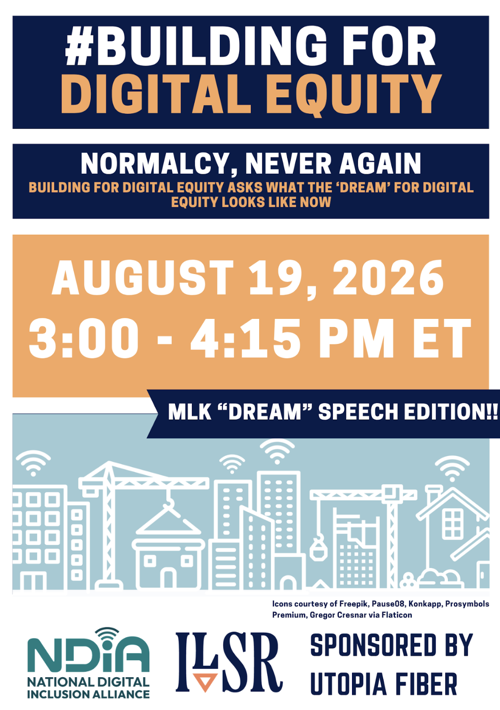
B4DE July 2025 Flyer

A line up of digital inclusion advocates working to expand broadband access will share practical insights and inspiration for digital navigators and other frontline workers looking to navigate the shifting landscape.

Register for the free event here.

As with the previous #B4DE events, the live stream will once again be sponsored by UTOPIA Fiber and co-hosted by the Institute for Local Self Reliance (ILSR) Community Broadband Networks Initiative and the National Digital Inclusion Alliance (NDIA).

Don't miss out on this exciting opportunity to learn, connect, and make a difference as digital equity advocates across the nation chart a new course forward.