
Digital C

Content tagged with "Digital C"

Related Topics
Displaying 1 - 10 of 19

DigitalC Beats 2025 Targets, Now Tests If ‘Cleveland Model’ Can Be Replicated
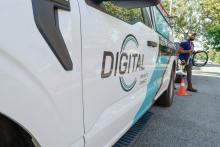
For years, Cleveland was labeled as one of the worst-connected cities in the nation despite the presence of AT&T and Charter Spectrum. But all of that is changing, thanks to an innovative nonprofit community network provider.

Even without getting a cent from the federal government’s flagship $42.5 billion dollar BEAD program, Cleveland is no longer just home to the Rock & Roll Hall of Fame. It’s now also the home of skyrocketing connectivity rates as DigitalC transforms the city’s digital landscape.

The data-backed progress was enough to convince the Cleveland City Council to recently sign off on a $4.35 million “performance payment” — part of an overall $20 million earmark from the city's coffers — to DigitalC after the nonprofit Internet provider blew past its 2025 goals for getting residents online and teaching them digital skills, a milestone city leaders are pointing to as proof that “The Cleveland Model” for closing the digital divide actually works.

Under its performance-based contract with the city, DigitalC was on the hook to add 4,700 new household Internet subscriptions and deliver digital skills training to 10,000 residents in 2025 or miss out on the multi-million dollar infusion of city cash.
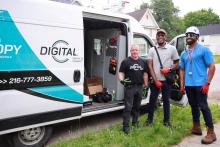
Broadband Communities Names Its 2026 Provider of the Year Shortlist — and It's Not the Usual Suspects

As states across the nation are poised to begin awarding BEAD grants as part of the single-largest federal investment in U.S. history to build new high-speed Internet networks, a sizable share of the funding is going to the big cable and telecom giants, with hundreds of millions in subsidies slated for Starlink and Amazon Leo.

Yet, eight community and independently-owned networks are in the running for this year’s Broadband Provider of the Year Award – a reminder that bigger does not always mean better and BEAD isn’t the only way to solve the digital divide in local communities.

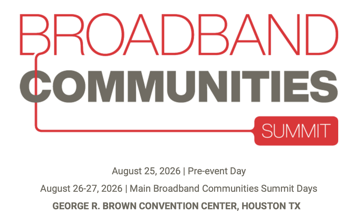
“From municipal pioneers to digital equity champions and rapidly scaling fiber builders, the 2026 shortlist for the Broadband Communities Broadband Provider of the Year represents the best in high-speed connectivity, customer-first service, and network innovation,” Broadband Communities, one of the nation’s leading digital and broadband technology publications, announced in the run-up to its Broadband Communities Summit 2026.

Image
Broadband Communities Summit 2026 logo

The winners will be revealed live during a special awards ceremony at the end of Day 1 at this year’s summit, which will be held on August 26 at the George R. Brown Convention Center in Houston, Texas.

And Nominees Are…

The shortlist of standouts competing for top honors this year are the following:

DigitalC at 10,000 Subscribers - Episode 11 of Unbuffered

Unbuffered Logo - Two text bubbles

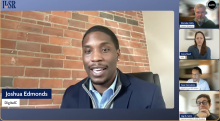
In this episode of Unbuffered, Chris is joined again by Joshua Edmonds, CEO of DigitalC, for an ongoing conversation about one of the most ambitious efforts in the country to address the digital divide.

Josh explains how DigitalC evolved into a nonprofit Internet service provider serving Cleveland with next-generation fixed wireless technology. He shares how the organization built a citywide network, why it offers service starting at $18 per month, and what it means to be approaching 10,000 subscriber households serving more than 23,000 people.

Chris and Josh discuss the relationship between digital equity and everyday economics, including affordability, rising household costs, and why low-cost Internet service continues to resonate with residents. They also explore how DigitalC’s approach could influence the broader telecommunications industry, from pricing strategies to customer contracts.

The conversation also looks at the realities of operating a nonprofit ISP, including customer payments, subscriber growth, apartment building deployments, and the challenge of finding the right technology for different situations. Josh explains how DigitalC uses a mix of fixed wireless, existing infrastructure, and other solutions to reach both single-family homes and multi-dwelling units across the city.

Throughout the episode, Chris and Josh reflect on what it takes to build a sustainable model for connecting residents, why local solutions matter, and how communities can move beyond talking about the digital divide to actually closing it.

This show is 53 minutes long and can be played on this page or via Apple Podcasts or the tool of your choice using this feed

You can also check out the video version via YouTube.

Transcript below.

We want your feedback and suggestions for the show-please e-mail us or leave a comment below.

Listen to other episodes (formerly Community Broadband Bits) or view all episodes in our index. See other podcasts from the Institute for Local Self-Reliance.

Thanks to Whitedrift for the song Operator, licensed Creative Commons Attribution (3.0).

The Digital Divide Is a Civil Rights Issue: The Fight for Digital Equity and the Battle Against Dark Money- Episode 9 of Unbuffered

Unbuffered Logo - Two text bubbles

In this episode of Unbuffered, Chris is joined by Sean Gonsalves, Doug Dawson, and Bill Callahan for a conversation about digital discrimination, digital equity, and the growing challenges around Internet access in the United States.

They begin by discussing the “regressive moment” surrounding digital equity, including the cancellation of the Digital Equity Act, the Eighth Circuit ruling, and broader questions about what digital discrimination actually means in practice. The group reflects on how many people still do not have access to “a normal Internet connection,” as well as the barriers created by affordability, devices, skills, and reliability.

Chris, Sean, Doug, and Bill then discuss monopoly power, local organizing, municipal networks, and the role of money in politics. They reflect on local fights over broadband projects, efforts to undermine public options, and why communities often face organized opposition when trying to build their own infrastructure.

The episode also explores BEAD, NTIA guidance, low-income broadband requirements, and the tension between federal policy and state decision making. Along the way, the group discusses New York, Pennsylvania, co-ops, affordability programs, and the limits of relying on large monopoly providers to solve access problems.

This show is 53 minutes long and can be played on this page or via Apple Podcasts or the tool of your choice using this feed

You can also check out the video version via YouTube.

Transcript below.

We want your feedback and suggestions for the show-please e-mail us or leave a comment below.

Listen to other episodes (formerly Community Broadband Bits) or view all episodes in our index. See other podcasts from the Institute for Local Self-Reliance.

Thanks to Whitedrift for the song Operator, licensed Creative Commons Attribution (3.0).

ILSR and AAPB Webinar Shines Light on Connecting Multi-Family Housing

Closing the digital divide where it's most dense – inside multi-family housing – took center screen during yesterday's webinar hosted by the Institute for Local Self-Reliance Community Broadband Networks Initiative and the American Association for Public Broadband (AAPB).

Co-host and AAPB Executive Director Gigi Sohn framed the discussion as a new way of thinking about universal broadband access. 

"If you want to connect a community, we can’t just think street by street. We have to also think floor by floor, building by building," Sohn said. 

"Apartment complexes, public housing, condos, and mobile home parks contain some of the largest concentrations of unserved and underserved households in the country. These buildings should be cost-efficient to serve, but in reality they often present some of the toughest barriers – from wiring challenges and access restrictions to exclusive provider agreements and outdated policies."

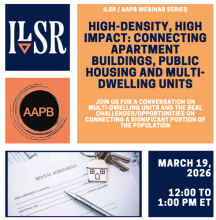
The webinar, "High-Density, High Impact: Connecting Apartment Buildings, Public Housing and Multi-Dwelling Units," featured Cleveland-based DigitalC CEO Joshua Edmonds; REVinternet founder and CEO Brendan Kelly; and Anna Read, a Principal with the national consulting firm HR&A.

The conversation ranged from why MDU's matter to the business and technical realities of providing Internet access to those who live in them; as well how federal and state policies have helped or hindered the push to ensure everyone has the ability to meaningfully participate in a digital world.

Watch the webinar in its entirety below:

Event: High Density, High Impact - Connecting Apartment Buildings and Public Housing

Today at 12pm ET/11am CT, ILSR and the American Association of Public Broadband co-host an event aimed at tackling the digital divide in a realm rife with both challenges and opportunities: apartments, public housing, and multi-dwelling units. 

Co-hosted by AAPB’s Gigi Sohn and ILSR’s Community Broadband Networks’ Associate Director for Communications Sean Gonsalves, they will be joined by Cleveland-based DigitalC CEO Joshua Edmonds; REVinternet founder and CEO Brendan Kelly; and Anna Read, a Principal with the national consulting firm HR&A who previously worked on broadband funding at the U.S. Treasury Department and also with several states in establishing programs to help connect public housing residents.

This event is free to register.

Where the Digital Divide Is Densest: Why Universal Internet Access Runs Through Apartment Buildings

On paper, it’s cheaper to connect densely-clustered residences. But, as many as 4.3 million households inside apartment, condo, and mobile-home complexes do not have Internet access – either because the service is unaffordable or because the building has antiquated wiring.

Given the importance of Internet access for meaningful participation in a digital economy – and because universal access to high-speed Internet has cascading community benefits that not only save subscribers and municipalities money, but also improve health outcomes – more cities and towns are looking to ensure high-performance Internet access is available in what industry insiders call “multi-dwelling units” (MDUs).

Next week, the increasingly popular webinar series hosted by the Institute for Local Self-Reliance (ILSR) Community Broadband Networks initiative and the American Association of Public Broadband (AAPB) will dive into the challenge head-on with a focus on how local communities can better serve the places where the largest numbers of disconnected Americans are clustered.

The free webinar – “High-Density, High Impact: Connecting Apartment Buildings, Public Housing and Multi-Dwelling Units” – is slated for March 19 from noon to 1 pm ET.

Registration is now open here.

“Most of the federal government’s funding focus for building new networks is targeted at sparsely populated rural areas. But the fact is: apartment buildings – especially those living in public housing in urban and suburban settings – represent large concentrations of unconnected or underconnected households,” AAPB Executive Director Gigi Sohn said. 

Cleveland’s DigitalC Gets $500K Google Infusion For Affordable Fixed Wireless

Innovative digital equity nonprofit DigitalC has been working for years to shore up affordable broadband access in underserved cities like Cleveland, Ohio. 

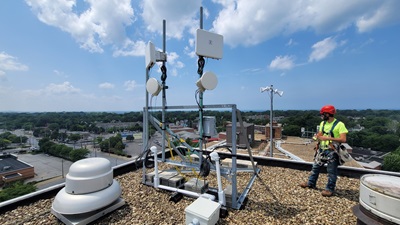
Now the organization is enjoying new momentum for its plans to expand fixed wireless broadband access in the city thanks to a $500,000 cash infusion from tech giant Google. According to a recent announcement, the donation includes next-generation Fixed Wireless Access (ngFWA) equipment from Tarana, which will allow DigitalC to expand its Canopy home broadband service – which provides symmetrical 100 megabit per second (Mbps) at $18 a month – to even more neighborhoods in Ohio.

The nonprofit just celebrated the connection of its 6,000th household in Cleveland, a city once ranked the worst-connected large city in the U.S. by the National Digital Inclusion Alliance (NDIA).

Image
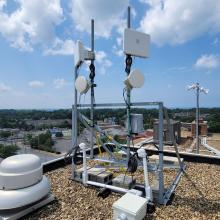
Digital C worker on rooftop

“This meaningful investment from GFiber adds bandwidth to our capacity to scale the Cleveland Model,” DigitalC CEO Joshua Edmonds said of the cash infusion. “This community-based blueprint proves that next-generation technology can be deployed quickly, trusted deeply, and scaled effectively to deliver the superior internet experience more communities deserve.”

IN OUR VIEW: ‘Without Political Power, There is No Path to Digital Equity’

For decades, ILSR has recognized that communities need to be engaged on Internet access issues to make sure that everyone – from low-income, historically marginalized residents to small businesses and even municipal departments – have the Internet access they need to thrive in the digital age.

Digital equity is essential to help resolve other challenges and the current chasm between the haves and have-nots makes solving many other challenges – like education – more difficult.

To further the quest for greater digital inclusivity, recently ILSR’s Community Broadband Networks Initiative Director Christopher Mitchell put together a panel for Net Inclusion 2024, a conference convened by the National Digital Inclusion Alliance (NDIA) that drew 1300 attendees and was by far the largest digital inclusion conference held in many years of doing this work.

Entitled “Without Political Power, There is No Path to Digital Equity,” the panel was originally going to focus on the importance of structural change – and how we cannot ensure everyone is connected by relying solely on the networks already present in neighborhoods that see quite low broadband penetration. Instead, the panel discussion went a bit deeper than that and landed on an observation often made by Joshua Edmonds from Digital C in Cleveland. To paraphrase Joshua, we cannot coupon our way to digital equity.

People Over Profit: DigitalC's Mission to Connect Communities in Cleveland- Episode 589 of the Community Broadband Bits Podcast

This week on the podcast, Christopher is joined again by Joshua Edmonds, the Chief Executive Officer of DigitalC, a community-based nonprofit dedicated to bridging the digital divide in Cleveland, Ohio. DigitalC achieves this by offering fast and affordable internet access through a fixed wireless network, priced at $18 per month, to underserved neighborhoods. Additionally, they provide digital equity programs such as digital literacy training and device deployment.

Christopher and Joshua discuss recent updates, including DigitalC's successful bid for a $20 million contract from the city of Cleveland to establish a citywide infrastructure. Joshua details the plan to connect over 23,000 households within 18 months, expanding their network with commercial fiber infrastructure to link homes and businesses.

While DigitalC continues generating revenue to support digital equity programs, the conversation concludes with Chris and Joshua emphasizing the importance of prioritizing people over profit. They emphasize the need to serve the unserved and underserved populations and comprehensively address the digital divide.

This show is 38 minutes long and can be played on this page or using the podcast app of your choice with this feed.

Transcript below.

We want your feedback and suggestions for the show: please e-mail us or leave a comment below.

Listen to other episodes here or see other podcasts from the Institute for Local Self-Reliance here.

Thanks to Arne Huseby for the music. The song is Warm Duck Shuffle and is licensed under a Creative Commons Attribution (3.0) license.