
Christopher Mitchell

Content tagged with "Christopher Mitchell"

Related Topics
Displaying 1 - 10 of 353

Join Us Today for "Sustain, Empower, Evolve: Planting Local Seeds for Digital Equity"
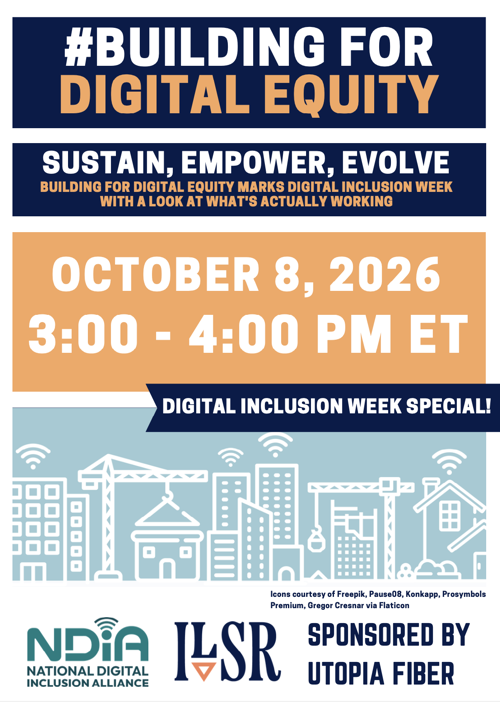
Join us today, Thursday, October 8, from 3:00 to 4:00 PM ET, for this latest installment of the Building for Digital Equity webinar series — a Digital Inclusion Week 2026 special edition built around a question every practitioner in this field is living right now: with federal support growing less certain, what does it actually take to sustain this work, empower the people building it from the ground up, and evolve to keep reaching the communities who need it most?

Registration is still open here.

It can be viewed on YouTube here.
Image
B4DE DIW Oct 8 flyer

The hour opens with Sustain, a grounded look at where Digital Equity Act funding actually stands. NDIA Policy Director Amy Huffman will walk through what's landed in states and what's stalled, while NDIA Director of Research & Programs Aaron Schill introduces a new evaluation and data-collection tool — "the aggregator" — built to help coalitions and funders track what's actually working and make the case for continued investment.

From there, the show turns to Empower, a spotlight on Esther Jang and the Seattle Community Network.

Esther will take us back to the earliest days of the pandemic, when Seattle's Tiny House Villages often weren't even recognized as valid addresses by internet providers, let alone served by them. She'll share the story of the November 2020 open call that asked Seattle's tech workers to help "barnraise" a community wireless network fast, and what she learned once an army of eager volunteers actually showed up.
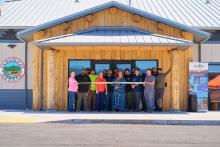

Tribal Broadband Is About Sovereignty, Not Just Speed

*The following story was originally published here by Broadband Breakfast.

Tribal broadband is not simply a faster connection. For tribal nations, panelists said Wednesday, durable infrastructure can preserve language, extend health care and education, support economic development and strengthen sovereignty, but only when tribes control the choices shaping their networks.

That connection between culture and infrastructure emerged during a Broadband Breakfast Live Online discussion on tribal broadband and adoption. 

The conversation ranged from fiber and satellites to open-access networks, spectrum rights, data sovereignty and the cost of helping residents get online.

“We want our members to learn the language. We want other people to learn the language,” said Rob Griffin, tribal broadband director for the Choctaw Nation of Oklahoma. “But to do so, we have to have good infrastructure.”

The Choctaw Nation began pursuing fiber after encountering a school limited to satellite internet, Griffin said. It has since received $110 million in grants and is building 1,000 miles of fiber alongside fixed wireless connections. Such networks can support language programs, remote work, testing and telehealth for decades.

Infrastructure and sovereignty

Federal investment has helped accelerate tribal deployments. Christopher Mitchell, director of the Community Broadband Networks initiative at the Institute for Local Self-Reliance (and co-founder of the Tribal Broadband Bootcamp), said his organization is tracking about 190 tribal networks, including roughly 100 already operating. (Check out ILSR's in-depth Tribal networks tracker and interactive map here).

Five Years of Tribal Broadband Bootcamps - Episode 14 of Unbuffered

Unbuffered Logo - Two text bubbles

In this special episode of Unbuffered, Sean Gonsalves takes over hosting duties and sits down with Matthew Rantanen and Christopher Mitchell for a conversation about the origins, growth, and impact of the Tribal Broadband Bootcamps.

The discussion begins with the story behind the first bootcamp, tracing its roots to the Indigenous Connectivity Summit in Hawaiʻi and a hands-on effort to help a community deploy Internet connectivity for the first time. Matt and Chris reflect on the lessons learned from those early experiences and how they shaped a model focused on learning by doing, peer-to-peer problem solving, and building confidence alongside technical skills.

Sean, Matt, and Chris also discuss a new census of tribal networks, which shows that the number of active tribal broadband networks has more than doubled since 2020. They explore what is driving that growth, including direct federal investments, local leadership, and a growing belief that tribes do not need to wait for outside providers to solve connectivity challenges.

Throughout the conversation, they return to the idea of digital sovereignty and network sovereignty, discussing why tribes are increasingly choosing to build, own, and operate their own infrastructure. Along the way, they share examples from across Indian Country, including efforts to build middle-mile infrastructure, expand local expertise, and create networks rooted in the needs and priorities of tribal communities.

The episode also examines current policy and funding challenges, including the future of tribal broadband funding programs and concerns about how federal decisions could affect connectivity efforts moving forward.

Finally, Matt and Chris look ahead to the next Tribal Broadband Bootcamp, reflecting on how the program has evolved over five years while remaining focused on hands-on learning, collaboration, and helping tribes build the knowledge and confidence needed to shape their own digital futures.

This show is 53 minutes long and can be played on this page or via Apple Podcasts or the tool of your choice using this feed. 

You can also check out the video version via YouTube.

Transcript below.

We want your feedback and suggestions for the show-please e-mail us or leave a comment below.

Listen to other episodes (formerly Community Broadband Bits) or view all episodes in our index. See other podcasts from the Institute for Local Self-Reliance.

Thanks to Whitedrift for the song Operator, licensed Creative Commons Attribution (3.0).

On State Scoop podcast: New Mexico's Timely Broadband Subsidy Program

New Mexico Gov. Michelle Lujan Grisham signed into law new legislation that aims to provide tens of thousands of low-income households in “The Land of Enchantment” an Internet lifeline similar to the now-expired federal Affordable Connectivity Program (ACP).

It makes the state the first to step up in the absence of federal action to support households that just can’t afford to pay for monthly service. Senate Bill 152 will update the state’s Rural Telecommunications Act and empower the New Mexico Public Regulation Commission (PRC) to offer up to $30/month for qualified households to pay for Internet service.

ILSR's Community Broadband Networks program director Christopher Mitchell talks to State Scoop’s Priorities podcast about the significance of the New Mexico law and how can states can take a leadership role in the absence of federal action.

Watch and listen to the podcast below. And you can read our story about the New Mexico law here.

Remote video URL

Digital Equity Unwrapped: A Look Back at a Challenging Year – and the Hope That Remains

The end of the year may be winding down, but the digital equity community is gearing up for one last big Building for Digital Equity (#B4DE) gathering.

“Digital Equity Unwrapped” – a special livestream bringing together advocates and broadband-for-all leaders who spent 2025 pushing for a more connected and inclusive nation – is slated for Wednesday, December 17, beginning at 3 pm ET.

Registration is available here.

Co-hosted by the Institute for Local Self Reliance (ILSR) Community Broadband Networks Initiative and the National Digital Inclusion Alliance (NDIA), the final #B4DE of the year will open with a look ahead at Net Inclusion 2026, coming to Chicago this February.

Image
B4DE End of Year 2025

A special gift-wrapped part of the #B4DE line-up will feature Kyla Williams Tate, who will share original poetry grounded in digital equity, reminding us that connectivity isn’t just about infrastructure – but about the human networks that do the work.

Then, attention will turn to a major focus of 2025 for digital equity proponents: fighting for affordability. For that, Lindsey Skolnik of the California Alliance for Digital Equity (CADE) will take center screen to discuss California’s push for statewide affordable broadband legislation.

B4DE: Moving At The Speed of Trust Reprise

Yesterday, the third Building for Digital Equity livestream of the year brought together policy experts and frontline workers to explore how community-driven connectivity solutions are inextricably tied to building local trust.

If you missed it, the entirety of the hour and 15 minute event can be viewed here.

Hosted by ILSR’s Community Broadband Networks initiative and the National Digital Inclusion Alliance (NDIA), this week’s B4DE served as an unofficial kick-off to Digital Inclusion Week and the variety of events that will mark the occasion in communities across the country.

With each B4DE guest focused on various aspects of the theme, “Moving At The Speed Of Trust,” the event provided attendees a jolt of hope and optimism, even as the world of digital equity has been upended by the demise of the federal Affordable Connectivity Program, the sudden termination of the Digital Equity Act, and numerous other Trump administration policy shifts that will make it harder to bridge the digital divide.

Wisconsin Public Radio Covers New City-Owned Broadband Network in Superior with Assist from ILSR

This week Wisconsin Public Radio aired a story that looked at the city of Superior, Wisconsin and its city-owned open access fiber network, known as ConnectSuperior.

Wisconsin Public Radio reporter Richelle Wilson not only spoke with city officials about how "the new network has been a game-changer for Superior," Wisconsin Public Radio also reached out to our Christopher Mitchell, Director of ILSR's Community Broadband Networks initiative.

Chris provided context and insight on how the rapidly changing federal policy landscape may or may not affect ConnectSuperior, how state preemption laws hinder communities in Wisconsin and some other states from duplicating Superior's success, and how tribes in Wisconsin have participated and benefited from a recent Tribal Broadband Bootcamp in the Upper Peninsula.

Listen to the Wisconsin Public Radio story here.

In addition to Wisconsin Public Radio's story on ConnectSuperior, you can check out our extensive coverage of ConnectSuperior here. 

Or, you can listen to ConnectSuperior Broadband Manager Stephanie Becken on our Community Broadband Bits podcast go more in-depth into the city’s quest to deliver affordable access to city residents below:


Broadband Bootcamp for Great Lakes Tribes to Take Place in August

*The following story by Broadband Breakfast Reporter Jennifer Michel was originally published here.

From August 18-21, the Sault Ste. Marie Tribe of Chippewa Indians will host a four-day Tribal Broadband Bootcamp on the Tribe's Marquette campus in Michigan’s Upper Peninsula.

The Bootcamp aims to equip Tribal Nations with the skills to build, manage, and expand their own broadband networks. It will be the second held in the Great Lakes region, designed primarily for members of 36 federally recognized Tribes across Michigan, Wisconsin and Minnesota.

The first Tribal Broadband Bootcamp took place in California in 2021, organized by Matthew Rantanen and Christopher Mitchell, co-founders of the broadband advocacy group Waskawiwin, who hoped to build and encourage nontraditional broadband networks.

Image
Tribal Networks Map

Seventeen bootcamps have occurred since 2021, each with an agenda adjusted to the experiences and interests of hosting Tribes. Overall, the training program has hosted more than 400 participants from more than 70 Tribal Nations across the United States and Canada.

The training program, led by Rantanen and Mitchell, will unite tribal technology staff, community leaders, and broadband advocates for hands-on instruction in network design, deployment and management.

According to Mitchell, the goal of the Bootcamp “is to connect people working in Indian Country on Internet access to build skills and share knowledge on how to make sure everyone is well connected.”

The USF Survives Supreme Court, But Massive Challenges Remain

The FCC’s Universal Service Fund (USF) has survived a Supreme Court challenge by a right wing activist nonprofit, but the program – which for decades has helped extend broadband to underserved rural homes and schools – still faces a precarious immediate future.

It is a peculiar political story, given that the rural regions that overwhelmingly vote for Republicans are now seeing Republicans try to dismantle a program that has been crucial for rural investment and development.

The FCC established the fund in 1997 in compliance with the Telecommunications Act of 1996. Historically a program with broad, bipartisan support, the USF leverages around $8 billion annually to expand broadband access to rural communities, libraries, and schools. The program is primarily paid for by consumers via a small levy on traditional phone lines.

In 2023, a right wing activist nonprofit named “Consumer’s Research” sued the government over the USF, claiming that the FCC lacked the constitutional authority to levy a fee on consumers’ bills. The lawsuit claimed that the USF depended on what amounted to an “unconstitutional tax” on consumers to fund operations.

AAPB and ILSR Prepare For Inaugural ‘Future of Public Broadband’ Conference

Some of the nation’s leading thinkers and doers in the community broadband sector will connect and collaborate in the nation’s capital for the inaugural Community First: The Future of Public Broadband Conference and Hill Day next week.

Slated for May 14 and 15, the two-day conference is being hosted by the American Association for Public Broadband (AAPB) and New America Open Technology Institute (OTI), in partnership with ILSR's Community Broadband Networks Initiative, the Benton Institute for Broadband & Society, and the Community Broadband Action Network.

The in-person gathering will bring together public broadband champions, community leaders, policymakers, and industry experts to focus on strategy and advocacy in the face of potentially dramatic changes to the $42.5 billion BEAD program – the single-largest federal investment to ensure every household in the nation has access to high speed Internet connectivity.

Registration and tickets are still available here.

Image
Gigi Sohn AAPB

With the rise of community-owned broadband networks and cooperatives now flourishing across the nation, organizers are hoping to create “an essential space to share best practices, discuss financing, shape public policy, and support the development and expansion of public broadband networks.”